
The global transition toward sustainable transportation has catalyzed an unprecedented surge in electric vehicle (EV) adoption. As EV fleets expand across residential, commercial, and public infrastructure, the demand for intelligent, cost-effective charging solutions has never been more urgent. Central to this challenge is the concept of dynamic load balancing (DLB) — a smart energy management technology that distributes available electrical capacity across multiple chargers in real time, preventing circuit overloads while optimizing charging throughput.
Simultaneously, solar photovoltaic (PV) systems have matured into a cost-competitive renewable energy source capable of meaningfully reducing commercial electricity expenditures. The integration of solar energy with EV charging infrastructure offers a compelling pathway to decarbonize transportation while managing operational costs. However, not all solar configurations are equal in their ability to interact with DLB systems. The two dominant paradigms — grid-tied and off-grid solar installations — exhibit fundamentally different electrical characteristics that have significant implications for their compatibility with dynamic load balancing.
This article examines both solar system types in depth, explores their respective integration pathways with DLB technology, and evaluates which approach — or combination thereof — best serves the goal of cost-effective, high-performance EV charging.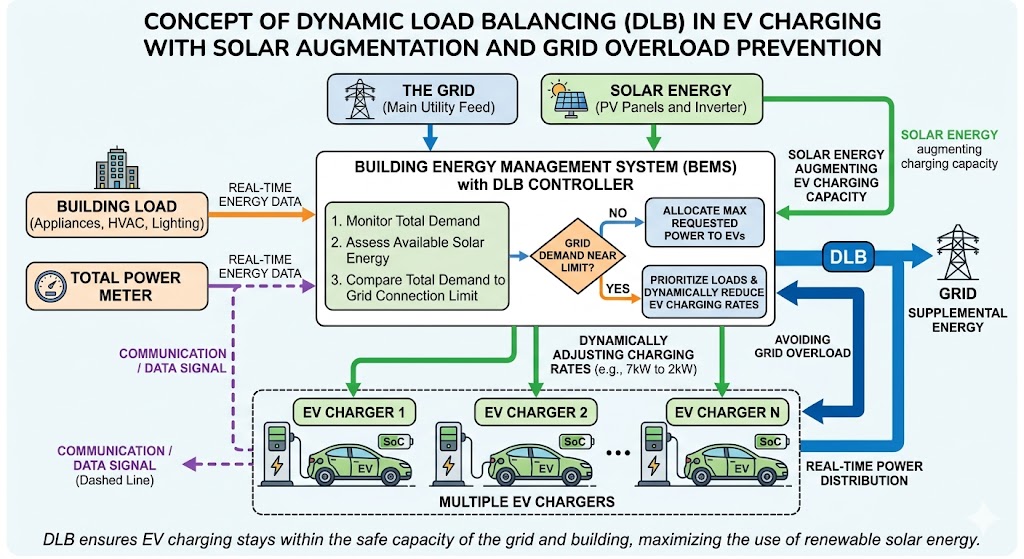
2. Understanding Dynamic Load Balancing in EV Charging
Dynamic load balancing is an intelligent power management strategy employed by EV charging management systems (EVMS) to allocate electrical capacity dynamically among connected chargers. Rather than assigning fixed power limits to each charging point — a static approach that results in either unused capacity or repeated tripping of circuit breakers — DLB continuously monitors real-time energy consumption across the entire installation and redistributes available current based on actual demand.
Modern DLB systems typically rely on three core capabilities: real-time power metering at the building or site level, communication protocols (such as OCPP 1.6/2.0 or proprietary APIs) between the charger and the energy management controller, and the ability to modulate charging current in sub-minute intervals. The financial rationale is clear — by preventing demand peaks, operators avoid costly demand charges that can constitute 30–70% of commercial electricity bills in many utility rate structures.
When a solar generation source is introduced into this equation, the DLB controller can be further enhanced to factor in real-time PV output, effectively treating solar generation as a virtual capacity expansion. This solar-augmented DLB enables what is sometimes called "solar surplus charging" — automatically increasing charging speed when solar generation exceeds base building loads, and throttling chargers when generation drops or demand spikes.
3. Grid-Tied Solar Systems: Native Compatibility with DLB
3.1 Architecture and Operation
A grid-tied solar system connects PV panels directly to the utility grid through a grid-tie inverter, with no local battery storage in its basic form. Electricity generated by the panels is consumed on-site first, and any surplus is exported to the grid — with the homeowner or operator typically receiving a credit through net metering. When solar output is insufficient, power flows seamlessly from the grid to supplement on-site needs.
3.2 Integration with DLB: High Compatibility
Grid-tied systems are architecturally well-suited to DLB integration for several reasons. First, because the grid acts as an infinite buffer, voltage and frequency remain stable regardless of solar variability. The DLB controller can rely on steady AC power quality, which is a prerequisite for precise current modulation in EV chargers. Second, modern grid-tie inverters typically offer data outputs — via Modbus, SunSpec, or REST APIs — that provide the DLB system with real-time generation figures, enabling the controller to precisely calculate available surplus capacity.
For example, if a commercial site has a 100A service panel, a 30kW PV system generating the equivalent of 50A at peak output, and baseline building loads consuming 20A, the DLB controller can allocate up to 130A across all connected EV chargers — 100A from the grid plus 30A of solar surplus — without triggering the main breaker. As clouds reduce PV output, the system automatically scales back charging current within seconds. This fluid integration with grid power makes the grid-tied model the gold standard for solar-DLB compatibility.
3.3 Cost Savings Potential
The cost benefits of grid-tied solar with DLB are multi-layered. Solar self-consumption directly offsets retail electricity purchases, which is particularly valuable for daytime EV charging. Time-of-use (TOU) rate optimization allows the DLB system to schedule charging during solar peak hours, avoiding premium peak-period tariffs. Demand charge reduction — arguably the largest single savings opportunity for commercial operators — is achieved by using solar output to "fill in" high-demand windows, keeping the metered peak below rate-tier thresholds.
Industry case studies indicate that well-designed grid-tied solar DLB installations at commercial fleet depots or multi-unit residential buildings can reduce EV charging energy costs by 25–45% compared to grid-only charging operations, with payback periods of 4–7 years depending on local solar resources and utility rate structures.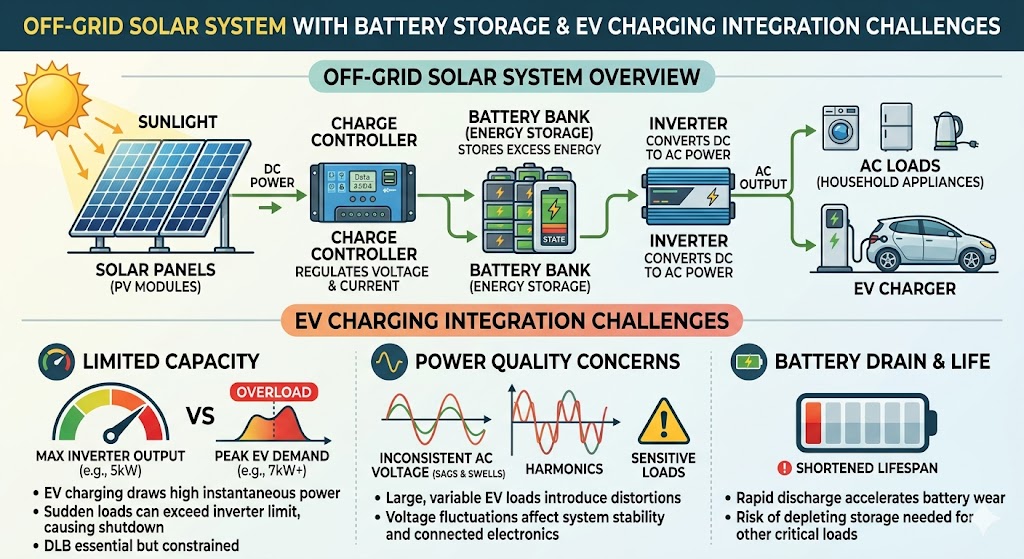
4. Off-Grid Solar Systems: Challenges and Niche Opportunities
4.1 Architecture and Operation
Off-grid solar systems operate in complete electrical isolation from the utility grid. They comprise PV panels, a charge controller, a battery bank, and an off-grid inverter that synthesizes AC power from stored DC energy. Because there is no grid connection, the battery bank and inverter must collectively meet 100% of the site's power needs at all times, including during periods of low solar generation or high demand. System sizing must account for worst-case scenarios — overcast periods, seasonal variation, and peak concurrent loads.
4.2 Integration with DLB: Significant Technical Barriers
Off-grid systems present substantially greater challenges for DLB integration. The central issue is capacity constraint — a battery-inverter combination has a finite continuous power rating, and EV charging is one of the most power-intensive residential and light-commercial loads. A single Level 2 EV charger may draw 7.2–19.2 kW, while a typical off-grid inverter for a home system may be rated at 5–10 kW continuous. This creates a fundamental sizing problem: adequately powering EV charging from an off-grid system requires very large battery banks and high-capacity inverters, dramatically increasing capital cost.
Power quality is another concern. While premium off-grid inverters produce pure sine wave output suitable for sensitive electronics, voltage and frequency regulation under rapidly changing EV charging loads can be less precise than grid power. Some DLB systems require stable power quality to make accurate current calculations, and voltage sags during charging events can trigger protective shutdowns. Additionally, most off-grid inverters lack the standardized data interfaces that grid-tie inverters use, making it harder for DLB software to retrieve real-time generation and battery state-of-charge information.
That said, modern battery energy storage systems (BESS) paired with sophisticated energy management software are beginning to close this gap. Advanced off-grid controllers from manufacturers such as Victron Energy and Schneider Electric offer comprehensive monitoring APIs and programmable load-shedding routines that can be configured to interface with EVMS platforms. In these implementations, the EV charger effectively becomes a controllable flexible load that the off-grid controller can shed or throttle to protect battery state-of-charge — a form of demand-side management analogous to DLB.
4.3 Appropriate Use Cases
Off-grid solar EV charging is most economically and technically viable in specific scenarios: remote locations where grid connection costs are prohibitive (rural properties, mining sites, agricultural operations), small-scale installations serving a single EV with a modest daily charging requirement, and emergency resilience applications where charging capability must be maintained during extended grid outages. In these contexts, a well-designed off-grid system with DLB-style load management can provide reliable service, though usually at a higher levelized cost than a comparable grid-tied installation.
5. Hybrid Solar Systems: Bridging the Gap
Hybrid solar systems — grid-tied installations augmented with battery storage — represent an increasingly popular third pathway that combines the strengths of both paradigms. A hybrid system maintains the stable grid connection that enables seamless DLB operation while also providing battery backup for resilience and additional optimization opportunities. The battery can absorb solar surplus during midday for discharge during evening peak-rate periods, or serve as a buffer that smooths DLB calculations by providing dispatchable capacity on demand.
From a DLB perspective, hybrid systems offer the greatest operational flexibility. The energy management system can optimize across three simultaneous inputs — solar generation, battery storage, and grid supply — dynamically prioritizing charging from the lowest-cost source at any moment. During a typical day, EVs might charge on solar surplus during peak generation hours, switch to battery discharge at dusk to avoid TOU peak rates, and draw from the grid only during overnight low-tariff periods.
The trade-off is upfront cost. Battery storage adds $400–$1,000 per kWh of usable capacity, and appropriate sizing for commercial EV charging applications typically requires 50–200 kWh of storage — representing a substantial capital investment. However, declining battery costs and increasingly favorable utility incentives are improving the economic case for hybrid installations at fleet charging hubs and large commercial properties.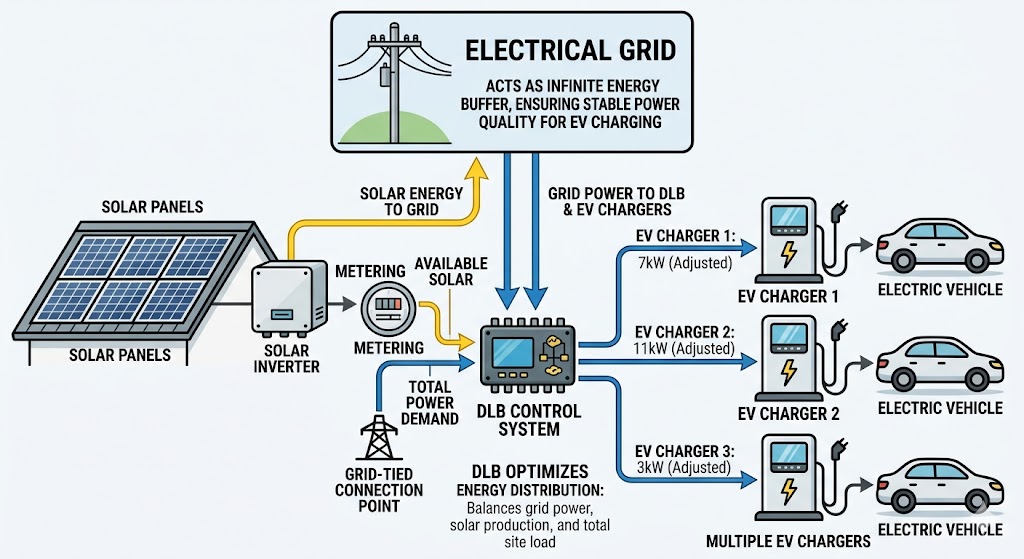
6. Comparative Analysis: Key Decision Factors
When evaluating which solar system type is most compatible with DLB for EV charging, operators should weigh the following factors:
- Grid Availability: Grid-tied and hybrid systems require utility connection. Off-grid is appropriate only when grid access is economically or physically impractical.
-
Charging Scale: High-volume installations (10+ chargers, fleet depots) almost universally favor grid-tied or hybrid approaches. Single-vehicle off-grid charging can be viable with careful system design.
-
Utility Rate Structure: Sites subject to high demand charges benefit most from DLB — and solar amplifies those savings most effectively in grid-tied configurations. Flat-rate tariff environments may see reduced financial advantage.
-
Resilience Requirements: Hybrid systems offer the best combination of DLB compatibility and backup capability. For sites where charging must continue through power outages (emergency services, healthcare), hybrid is the optimal architecture.
-
Capital Budget: Grid-tied solar + DLB offers the lowest total capital cost per optimized charging kilowatt. Hybrid systems cost more upfront but deliver greater long-term savings in suitable rate environments. Off-grid systems carry the highest per-kWh cost for EV charging applications.
7. Future Trends and Emerging Integration Technologies
The convergence of solar energy, battery storage, and EV charging is driving rapid innovation in integrated energy management platforms. Vehicle-to-grid (V2G) and vehicle-to-home (V2H) technologies are beginning to blur the boundary between EVs and stationary energy storage, creating a new dimension of flexibility for DLB systems — one where the vehicle battery itself can be recruited to buffer solar variability or shave demand peaks. Bidirectional chargers capable of V2G operation are now available from multiple manufacturers, and their integration with solar DLB systems represents the next frontier of cost optimization.
Artificial intelligence and machine learning are also entering the solar-DLB integration space. Predictive algorithms that combine weather forecast data, historical load profiles, and EV arrival patterns can pre-position battery state-of-charge and pre-condition charging schedules hours in advance — moving beyond reactive current modulation toward truly proactive energy optimization. Early adopters of AI-enhanced solar DLB systems have reported incremental cost savings of 10–20% over conventional rule-based DLB implementations.
Standardization efforts, particularly the OpenADR and IEEE 2030.5 protocols for demand response, are also enabling tighter integration between utility grid signals, solar systems, and EV charging management platforms — paving the way for solar-DLB systems that can participate in utility demand response programs, earning additional revenue streams while further reducing net charging costs.
8. Conclusion
The analysis presented in this article demonstrates that grid-tied solar systems are substantially more compatible with dynamic load balancing for EV charging than off-grid alternatives. The stable power quality, seamless capacity augmentation through grid backup, standardized data interfaces, and favorable economics of grid-tied installations collectively make them the preferred foundation for solar-DLB integration in the vast majority of EV charging scenarios.
Off-grid solar, while technically capable of supporting limited EV charging with appropriate system design and load management, faces fundamental constraints in power capacity, power quality consistency, and DLB interface standardization that make it suitable only for specific niche applications. Operators considering off-grid solar for EV charging should conduct thorough energy audits and select inverter/controller platforms with robust energy management APIs to minimize compatibility challenges.
Hybrid solar systems with battery storage represent the highest-performance architecture for solar-DLB integration, offering unmatched operational flexibility and cost optimization potential. As battery costs continue to fall and AI-driven energy management becomes more accessible, hybrid systems are likely to become the dominant configuration for new commercial EV charging installations seeking to maximize the synergy between solar generation and intelligent load management.
Ultimately, the optimal solar-DLB strategy is site-specific, shaped by grid access, charging scale, local utility rates, and capital constraints. What is universally clear, however, is that the integration of solar energy with dynamic load balancing is not merely a technical option — it is an increasingly compelling economic imperative for operators seeking to deliver affordable, sustainable electric vehicle charging in an era of rising energy costs and accelerating EV adoption.