
What is Dynamic Load Balancing? Understanding It Through Everyday Examples
Picture this: you and your friends are hanging out at your place, and everyone wants to cook at the same time—someone needs the microwave, another person wants to use the oven, and a third is eyeing the induction cooktop. If everyone goes full power simultaneously, your circuit breaker is definitely getting tripped. What's the smart solution? Let one person use the microwave for 15 minutes, then while they're finishing up, someone else can start the oven, and when the first person wraps up, the next person gets their turn. That way, everyone gets to cook, and you don't blow out your home's electrical system—and that's exactly what dynamic load balancing is all about.
Dynamic load balancing is like having a smart electrical butler constantly monitoring how much power is available and then flexibly distributing it to different devices based on actual needs. It doesn't rigidly say "you take half, you take half." Instead, like a truly intelligent manager, it looks at who needs power urgently and who can wait, then allocates electricity to wherever it's needed most.(1).jpg?w=1024&h=940)
How It Works: What Happens in One Second?
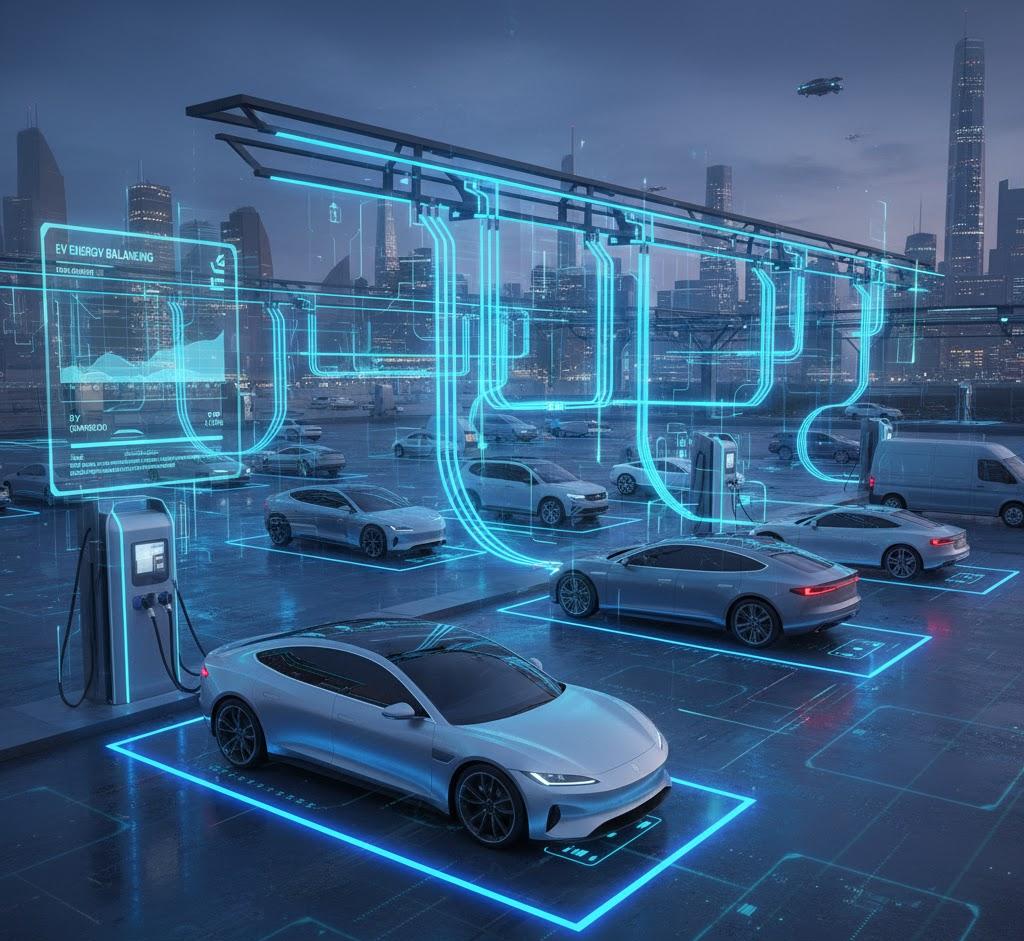
Let's start with a real-world scenario. It's Friday evening, and 15 electric vehicles are simultaneously plugged into charging stations in your office building's parking lot. Without any management system, all 15 cars charging at full capacity could suddenly draw over 1,000 kilowatts of power—enough to destabilize the entire neighborhood's electricity supply. But with a dynamic load balancing system in place, everything changes completely.
Step One: Opening Your Eyes—Real-Time Monitoring
The entire system works like it has eyes watching constantly. Every charging station has sensors continuously measuring: How many vehicles are currently charging? How much power is each one consuming? What other devices in the office building are using electricity right now (AC units, lighting, etc.)? All this data gets collected every single second and sent to the "brain"—the central management system.
Step Two: The Brain Thinking—Algorithm Decision-Making
Once the system receives this real-time data, its algorithms kick into gear. It asks itself several critical questions:
- What's the current battery percentage on each of these 15 vehicles? (Maybe some are at 20% and others already at 60%)
-
Which vehicles are in a hurry and which ones have more flexible charging schedules?
-
How much total power is coming from the grid? After subtracting necessary equipment like AC and lighting, how much power is left available for charging?
-
If I distribute power this way, will all vehicles finish charging as quickly as possible?
The algorithm prioritizes vehicles with lower battery levels and tight charging windows for faster charging, while slightly reducing power to vehicles that already have significant charge.
Step Three: Moving Fast—Real-Time Adjustments
Once the algorithm makes its decision, the system immediately sends new power allocation commands to every charger. This doesn't happen once an hour—it happens many times every second. While you're reading this sentence, the system might have already made 100 adjustment decisions!
If one vehicle's battery reaches full charge and automatically disconnects, the system instantly detects this change and reallocates that vehicle's power to the remaining 14 cars. Now those remaining vehicles charge noticeably faster.
Why Is This So Important for the Electrical Grid?
You might be surprised to learn that EV charging poses a genuine challenge to power systems. The power demand from a single charging electric vehicle can be many times larger than an entire household's daily electricity consumption. If 100 electric vehicles suddenly start charging simultaneously in a neighborhood, the impact on the local grid is enormous.
Without proper management, serious consequences could unfold: voltage fluctuations, frequency instability, and in worst-case scenarios, blackouts affecting the entire community or region. To protect against these risks, utility companies must constantly maintain extra generating capacity on standby—an enormous waste of both money and energy efficiency.
Dynamic load balancing functions like an intelligent traffic controller. Instead of letting all vehicles race down the same road at once, it guides them to spread out across different time periods. This smoothly distributes charging demand, preventing sudden grid stress while maximizing the use of existing electrical infrastructure.
Practical Applications: How Charging Stations Get Smarter
When these principles translate into actual charging systems, what kind of technology is required?
Smart Meters and Sensor Systems
Modern charging systems are packed with intelligent hardware. Each charging station has metering equipment that precisely measures power consumption every single second. The system also knows how much charge each vehicle currently has and how quickly it's charging.
Central Control Systems
All this data flows to the "brain"—the energy management system. Think of it as a tireless 24/7 dispatcher watching all charging demands, calculating optimal distribution plans, and sending commands to each charging station.
Smart Communication Networks
These systems need to communicate quickly and reliably with each other. Standards like IEEE 2030.5 exist specifically so that charging equipment from different manufacturers can understand each other.
A Real-World Example: Seeing It In Action
Let me give you a more concrete scenario. Say you're managing a small company office with a 100-amp electrical service, and you want to install 3 EV charging stations.
Without load balancing, each charging station would try to draw 40-50 amps simultaneously (their normal operating current). What happens? Your circuit breaker trips immediately, charging stops, and everyone gets frustrated.
But install a dynamic load balancing controller, and everything changes:
- The system detects that your office's normal operations (lighting, AC, computers) need 40 amps
-
That leaves 60 amps available for charging
-
The system distributes these 60 amps equally among the 3 vehicles: 20 amps each, running smoothly
Then 2 PM rolls around. The sun is blazing, your AC uses less power, and the office now only needs 30 amps. The system immediately spots this opportunity and allocates the remaining 70 amps to charging—now your 3 vehicles can each receive about 23 amps, speeding up their charging!
By 4 PM, the first vehicle reaches full charge and automatically disconnects. The system quickly recalculates and redistributes its original power allocation to the remaining two vehicles, which now charge even faster. The entire process runs completely automatically—you don't need to manually adjust anything.
What Benefits Does This System Bring?
From a practical user perspective, the benefits are obvious:
Faster charging. Because the system continuously maximizes available power instead of conservatively limiting it like older systems did.
Less infrastructure investment required. You don't need to spend massive amounts upgrading your electrical system. A small company might have previously needed to spend $50,000-$100,000 to upgrade their circuit to 200 amps just to install 3 charging stations. Now they might only need to spend $10,000-$20,000 on a smart load balancing system instead.
Smarter energy usage. The system learns when electricity is cheapest to charge (like late-night off-peak rates) and automatically speeds up charging when renewable energy is abundant (like sunny midday hours). This saves money on electricity bills while being friendlier to the environment.
More stable electrical grid. From the utility company's perspective, they can more easily predict and manage demand without constantly preparing "emergency power reserves." This benefits society's overall energy costs.
The Bigger Picture: The Grid and Renewable Energy
Now imagine if millions of electric vehicles across an entire country all had this kind of smart system installed.
Here's the current problem: wind and solar generation fluctuate—sometimes there's lots, sometimes there's little. At noon, the sun shines brightly while wind power might be weak. At night, the sun disappears but wind picks up. Traditional grids handle this unpredictability by keeping fossil fuel power plants on standby—expensive and environmentally damaging.
But if every EV had dynamic load balancing, utilities could do something revolutionary:
- When wind is strong, automatically increase charging commands so more EVs charge and "store" that excess power in their batteries
-
When wind drops, automatically reduce charging demand, or even let large-battery vehicles send power back to the grid (called Vehicle-to-Grid, or V2G)
Suddenly, renewable energy gets used to its maximum potential and the grid stays stable. It's like having a giant virtual battery scattered across millions of electric vehicles, constantly ready to absorb or release energy to maintain grid balance.
Challenges Still to Overcome
Of course, this technology isn't perfect yet. The biggest current problems include:
Different brands don't talk to each other. Sometimes a charging station from Brand A and a control system from Brand B simply can't communicate—like people from different countries speaking different languages. The industry is working on universal standards, but progress is slow.
Cybersecurity concerns. As charging systems become increasingly connected, they become targets for hackers. If a system gets attacked, the consequences could be serious. So robust security protection is absolutely essential.
Algorithms can get smarter. Today's systems are mainly reactive—they look at current conditions and respond accordingly. Future systems will likely use artificial intelligence, learning from historical data, checking weather forecasts, predicting user behavior, and making optimal decisions proactively. That means much higher efficiency.
Looking Ahead: What's Next?
What will future dynamic load balancing systems look like?
Smarter predictions. Systems will learn to anticipate demand instead of just reacting to it.
True bidirectional power flow. Vehicles won't just draw power from the grid—they'll also supply power back to it, making EVs into mobile energy storage.
Complete automation and optimization. Systems will automatically choose the cheapest charging times and the cleanest energy sources for charging.
Better safety mechanisms. Even if something fails, charging remains safe and reliable.
The Bottom Line: Why This Matters So Much
You might be thinking, "It's just a charging system—what's the big deal?"
But actually, this represents something much deeper: a fundamental shift. For decades, our electrical system barely changed—it worked one way: power generated at plants, flowing through substations, arriving at your home. Demand was relatively fixed and predictable.
Everything just changed. Electric vehicles arrived, and suddenly electricity demand could spike several times over within an hour, unpredictably and hard to forecast. Using the old approach would require building massive numbers of new power plants and transmission lines—astronomical costs.
Dynamic load balancing technology lets us handle this challenge with relatively modest investment. By intelligently distributing and scheduling demand, we can accommodate far more electric vehicles while better utilizing renewable energy and building a greener, more efficient energy system.
So while it sounds like complicated technology, fundamentally it's helping all of us move toward a more sustainable future. The next time you charge your electric vehicle and everything works perfectly, know that a smart system is quietly working behind the scenes to optimize everything—that's dynamic load balancing doing its job for you.