
Electric vehicles (EVs) have evolved far beyond simple transportation tools. Today, modern EVs are increasingly capable of acting as massive mobile batteries — able not only to draw power from the grid, but to push electricity back out to your home, your appliances, or even the broader power grid. This capability, broadly called bidirectional charging, is reshaping how homeowners think about energy resilience, especially during power outages.
This guide explains the underlying principles of V2L (Vehicle-to-Load), V2H (Vehicle-to-Home), and V2G (Vehicle-to-Grid) technologies, walks through the practical steps of setting up and operating the relevant equipment, and explores the many ways these systems can improve everyday life — from camping and emergency backup power to reducing electricity bills.
1. What Is Bidirectional Charging?
Bidirectional charging refers to the ability of an EV's battery system to send electricity in two directions: inward (charging the battery from an external source) and outward (discharging stored electricity back to an external device or grid). This is in contrast to traditional EVs, which can only receive power.
There are three main categories of bidirectional EV technology:
| Technology | Direction | Power Output | Key Requirement |
|---|---|---|---|
|
V2L (Vehicle-to-Load) |
EV → Appliances/Devices |
1.8 – 3.6 kW typical |
Onboard V2L outlet or adapter |
|
V2H (Vehicle-to-Home) |
EV → Home electrical panel |
6 – 10 kW typical |
External charger + gateway unit |
|
V2G (Vehicle-to-Grid) |
EV ↔ Utility grid |
Up to 10+ kW |
Smart charger + utility agreement |
Each technology requires different hardware, software integration, and sometimes utility agreements. V2L is by far the simplest and most widely available today — it requires no installation and can be used immediately by compatible EV owners.
2. The Science Behind V2L: How It Works
2.1 DC to AC Inversion
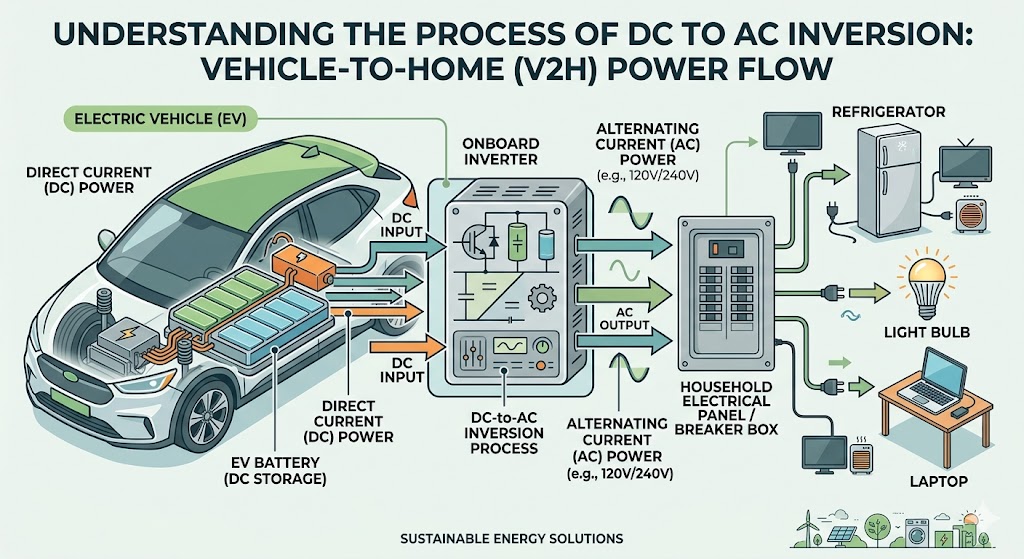
EV batteries store energy as direct current (DC). Household appliances, however, run on alternating current (AC) — 120V or 240V depending on the device and region. For an EV to power external loads, it must convert its stored DC energy into usable AC power. This is done by an onboard inverter.
The inverter is a critical component: it takes the high-voltage DC from the battery pack (typically 400V or 800V in modern EVs) and converts it to standard household AC. The quality and capacity of this inverter determines how much power the vehicle can output and how stable that power is — crucial for sensitive electronics.
2.2 The Role of the Onboard Charger (OBC)
In most traditional EVs, the onboard charger (OBC) is a one-way component: it takes AC from a wall outlet or Level 2 charger and converts it to DC to charge the battery. In bidirectional vehicles, the OBC is replaced or supplemented with a bidirectional power electronics module that can both rectify AC to DC (for charging) and invert DC to AC (for discharging).
This bidirectional OBC is more complex and expensive than a one-way unit, which is one reason bidirectional capability is still not universal across all EV models.
2.3 Power Output and Limits
V2L outputs are typically rated between 1.8 kW and 3.6 kW, which translates to 15–30 amps at 120V. This is sufficient to power many common household appliances but is not enough to run an entire home simultaneously. Understanding these limits helps users prioritize which loads to power during an outage.
| Appliance | Typical Wattage | Can V2L Power It? |
|---|---|---|
|
LED Lighting (10 bulbs) |
~100W |
Yes, easily |
|
Refrigerator |
~150W (running) |
Yes |
|
Phone / Laptop Charging |
20 – 100W |
Yes |
|
CPAP Machine |
~30W |
Yes |
|
Window Air Conditioner |
~1,000W |
Yes (check capacity) |
|
Electric Kettle / Coffee Maker |
~1,200W |
Yes (one at a time) |
|
Microwave Oven |
~1,000 – 1,500W |
Yes (limit other loads) |
|
Electric Clothes Dryer |
~5,000W |
No — too high |
|
Central HVAC |
~3,500 – 5,000W |
No — too high |
|
Electric Water Heater |
~4,500W |
No — too high |
3. V2H and V2G: Advanced Bidirectional Systems
3.1 Vehicle-to-Home (V2H)
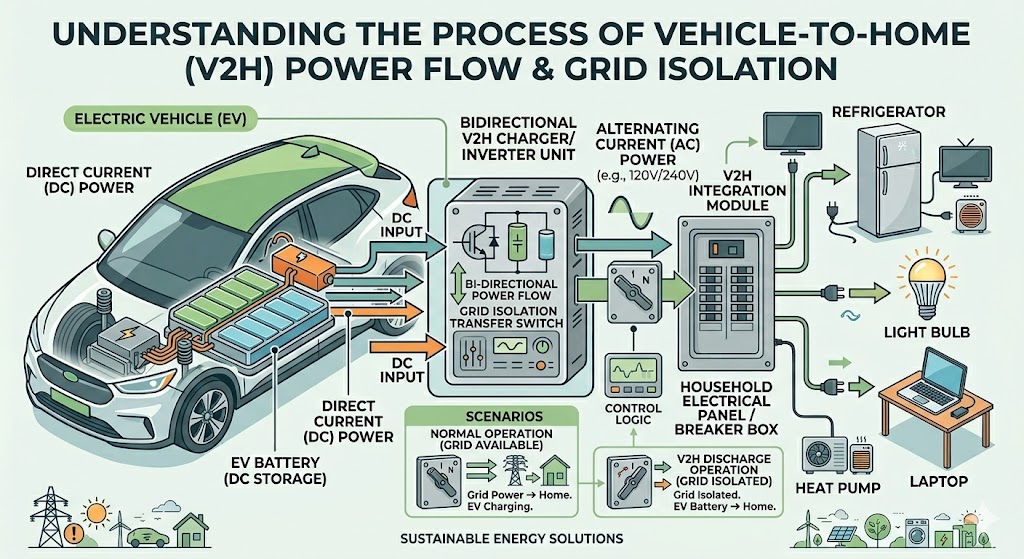
V2H takes bidirectional charging further by integrating the EV's battery into a home's electrical panel. This allows the vehicle to seamlessly supply power to selected circuits — or even the whole home — during an outage, without the need for extension cords or manual switching.
A V2H setup typically requires:
- A bidirectional EV charger (sometimes called a gateway or power control unit) installed at the home
- A transfer switch to safely isolate the home from the grid during discharge
- A compatible EV with V2H capability (e.g., Nissan LEAF with CHAdeMO, Hyundai IONIQ 5/6, Kia EV6, Ford F-150 Lightning)
- Professional installation by a licensed electrician
With V2H, output power is significantly higher — typically 6 to 10 kW — allowing the EV to power most essential home circuits for many hours or even days, depending on battery capacity and load.
3.2 Vehicle-to-Grid (V2G)
V2G is the most sophisticated form of bidirectional charging. It allows the EV to not only power a home but to export electricity back to the utility grid. In a V2G arrangement, the utility can draw from — and pay for — the energy stored in your EV's battery during peak demand periods.
This creates a mutually beneficial relationship: grid operators get flexible distributed storage, and EV owners can earn revenue or credits on their electricity bills. However, V2G requires a smart, bidirectional EVSE (Electric Vehicle Supply Equipment), a utility program or agreement, and regulatory approval that varies by region.
4. Compatible EVs and Equipment
4.1 V2L-Compatible Vehicles (Selected Models)
The following vehicles are among those with built-in V2L or bidirectional charging capability. Always verify with the manufacturer for the latest specifications:
| Vehicle | V2L Output | Battery Capacity | Notes |
|---|---|---|---|
|
Hyundai IONIQ 5 |
3.6 kW |
72.6 kWh |
Built-in V2L outlet + adapter |
|
Hyundai IONIQ 6 |
3.6 kW |
77.4 kWh |
V2L via adapter |
|
Kia EV6 |
3.6 kW |
77.4 kWh |
V2L via adapter or outlet |
|
Genesis GV60 |
3.6 kW |
77.4 kWh |
V2L via adapter |
|
Ford F-150 Lightning |
9.6 kW (240V) |
98 / 131 kWh |
Ford Intelligent Backup Power |
|
Nissan LEAF (CHAdeMO) |
6 kW (V2H) |
40 / 62 kWh |
Requires CHAdeMO V2H charger |
|
Rivian R1T / R1S |
Up to 11.5 kW |
135+ kWh |
Camp & Home power features |
|
Toyota bZ4X |
1.5 kW |
71.4 kWh |
V2L via onboard outlet (lower power) |
4.2 V2L Adapters and Cables
Most V2L-capable EVs require a specific adapter to convert the vehicle's charge port (typically CCS or CHAdeMO) into a standard AC outlet. These adapters are often sold by the automaker or third-party accessory companies. Key points:
- Hyundai/Kia/Genesis vehicles use a proprietary V2L adapter that plugs into the CCS charging port
- Some vehicles have a built-in 120V or 240V outlet in the trunk, frunk, or cargo area
- Ford F-150 Lightning includes integrated 240V outlets in the bed and frunk
- Always use the manufacturer-approved adapter to avoid safety hazards
5. Step-by-Step: How to Use V2L During a Power Outage
Step 1: Confirm Your Vehicle's V2L Capability
Before anything else, confirm your EV supports V2L. Check the owner's manual or the manufacturer's website. Note the maximum output wattage, the type of outlet or adapter needed, and any limitations (e.g., the vehicle must be in Park, climate control may need to be set manually).
Step 2: Obtain the Correct Adapter or Cable
Purchase the official V2L adapter for your vehicle. For vehicles with a built-in outlet (e.g., Ford F-150 Lightning), no adapter is needed. For Hyundai IONIQ 5/6 and Kia EV6, obtain the V2L adapter from a dealer or authorized retailer.
Step 3: Assess Your Power Needs
Before plugging in appliances, calculate your total load. Add up the wattage of all devices you plan to run simultaneously. Keep the total well below the vehicle's maximum V2L output to avoid tripping the circuit. A safe margin is 80% of rated capacity (e.g., for a 3.6 kW V2L, stay under ~2,900W combined).
Step 4: Position the Vehicle Safely
Park the vehicle outside or in a well-ventilated area, especially if running climate control. Ensure the vehicle is on a flat, stable surface. Keep the area around the charge port clear. If using the vehicle in rain, protect connections with appropriate weatherproof covers.
Step 5: Activate V2L Mode
The process varies by vehicle:
• Hyundai IONIQ 5/6 and Kia EV6: Plug the V2L adapter into the charge port. Use the infotainment system or physical button to activate V2L mode. The adapter's outlet becomes live.
• Ford F-150 Lightning: Turn on Pro Power Onboard via the infotainment screen. The bed and frunk outlets activate immediately.
• Rivian R1T/R1S: Enable Camp Mode or Home Power via the Rivian app or center console.
Step 6: Connect Your Appliances
Use heavy-duty extension cords rated for the load you are running. Plug in appliances one at a time, monitoring the vehicle's power output display if available. Prioritize essential items first: refrigerator, medical devices, lighting, communications.
Step 7: Monitor Battery Level
Keep a close eye on the vehicle's state of charge (SoC). Most manufacturers recommend not depleting the battery below 20% to preserve battery health and maintain a reserve for driving. A 77 kWh battery at 80% available capacity gives you roughly 61 kWh of usable energy — enough to run essential loads for 24–48 hours in many scenarios.
Step 8: Deactivate V2L and Recharge
When power is restored or when the battery reaches your minimum threshold, turn off V2L mode through the vehicle's interface, unplug all devices, then safely remove the adapter. Recharge the vehicle at the earliest opportunity.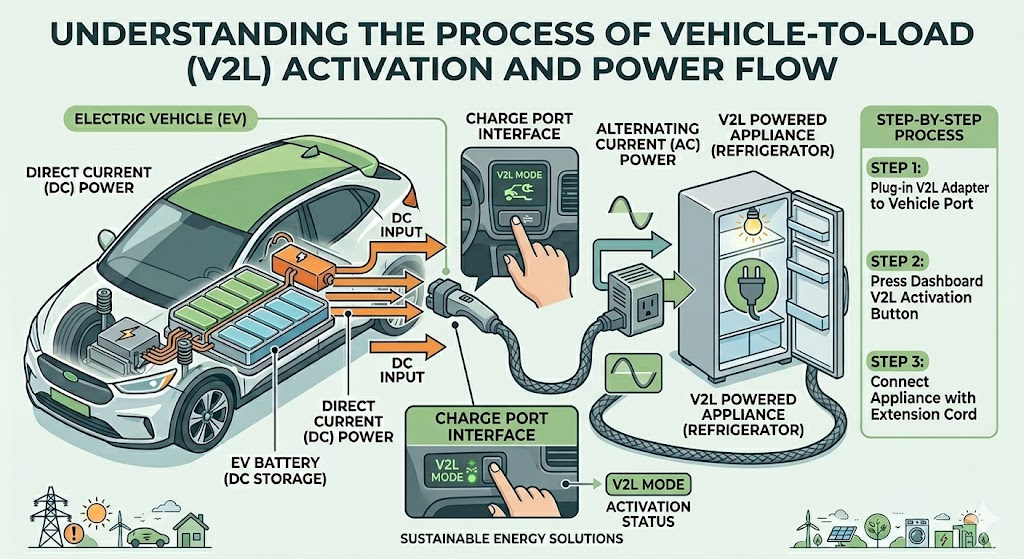
6. Real-World Applications of V2L Technology
6.1 Emergency Home Backup
This is the most compelling use case for most homeowners. During grid outages caused by storms, wildfires, or infrastructure failures, V2L can keep essential appliances running for extended periods without a separate generator. Unlike a gasoline generator, an EV produces no exhaust fumes, operates quietly, and can be recharged from solar panels once power returns.
6.2 Outdoor and Camping Power
V2L is transformative for outdoor enthusiasts. At a campsite without electrical hookups, an EV with V2L can power:
- Portable refrigerators and coolers
- Electric grills and cooking appliances
- LED lighting strings and lanterns
- Power tools for trail maintenance or emergency repairs
- Entertainment systems (projectors, speakers, game consoles)
- Drone charging stations
6.3 Tailgating and Events
Sports fans and event-goers are discovering that V2L-capable trucks and SUVs make for superb mobile power stations. The Ford F-150 Lightning's 9.6 kW output, for example, can simultaneously run a flat-screen TV, a sound system, electric griddles, and phone charging stations at a tailgate party.
6.4 Job Sites and Remote Work
Contractors and tradespeople can use V2L-capable trucks to power tools at job sites without access to shore power. This eliminates the need for a separate generator on smaller jobs, reducing both cost and noise. The Ford F-150 Lightning and Rivian R1T have been particularly popular in this segment.
6.5 Disaster Relief and Emergency Response
In the aftermath of natural disasters, V2L-capable vehicles can serve as mobile command centers, powering communications equipment, medical devices, lighting, and water purifiers. Organizations like FEMA and the Red Cross have begun exploring EV fleets with bidirectional capability for exactly this purpose.
6.6 Solar Integration and Energy Arbitrage
Homeowners with rooftop solar can combine V2H-capable EVs with their solar system. During the day, excess solar generation charges the EV. In the evening, the EV can discharge back to the home, reducing reliance on grid electricity. In regions with time-of-use pricing, this arbitrage can meaningfully reduce electricity bills by storing cheap off-peak power and using it during expensive peak hours.
6.7 Community Power Sharing
In neighborhoods where some residents have EVs and others do not, V2H and V2G systems can enable informal community energy sharing during outages — a concept being piloted in Japan under the name 'energy sharing EVs.' This social dimension of bidirectional charging points toward a future of more distributed, resilient community energy systems.
7. Safety Considerations
Using your EV as a power source is generally safe when done correctly, but there are important precautions to follow:
- Never backfeed power into a home's grid-tied wiring without a proper transfer switch — this can endanger utility workers
- Use only manufacturer-approved adapters and cables
- Keep connections dry and protected from moisture
- Do not exceed the vehicle's rated V2L output
- Monitor the vehicle's battery temperature, especially in extreme weather
- For V2H installations, always use a licensed electrician
- Ensure the vehicle is in Park before activating V2L
8. The Future of Bidirectional Charging
The landscape is evolving rapidly. As of 2024, CCS Combo (the dominant charging standard in North America and Europe) has published the ISO 15118-20 standard that formally supports bidirectional power flow. Major automakers including GM, BMW, and Volkswagen have announced future models with V2H and V2G capability built in.
Tesla, whose proprietary charging standard was widely adopted as NACS in North America in 2023–2024, has filed patents related to bidirectional charging and is expected to introduce V2H capability in future products. The widespread adoption of V2G is expected to transform how electricity grids manage peak demand — turning millions of parked EVs into a vast, distributed storage network.
For consumers, the trajectory is clear: bidirectional charging will become a standard feature, not a premium one. Investing in a V2L-capable EV today is not just about transportation — it is a long-term investment in home energy resilience.
Conclusion
Vehicle-to-Load and bidirectional charging technology represent one of the most practical and powerful advantages of owning a modern electric vehicle. By understanding the principles at work — DC-to-AC inversion, bidirectional power electronics, and load management — and by following the step-by-step guidance for safe operation, EV owners can transform their vehicles into versatile emergency power stations, outdoor power supplies, and smart energy assets.
Whether you are facing a multi-day outage after a hurricane, charging tools at a remote job site, or working toward a more energy-independent home, V2L technology puts the power — quite literally — in your hands.