
So, you've decided to go electric — congratulations! Whether you've already driven your new EV off the lot or you're still deep in the research phase, you've probably started wondering about home charging. And with that wondering comes a flood of information, some helpful, some outdated, and some just plain wrong.
Buying an EV charger (technically called Electric Vehicle Supply Equipment, or EVSE) doesn't have to be complicated, but the myths surrounding it can make the process feel overwhelming. Let's cut through the noise and debunk the most common misconceptions — because the truth is, setting up home charging is much simpler, more affordable, and more flexible than most people think.
Misconception #1: "I Can Just Use a Regular Wall Outlet"
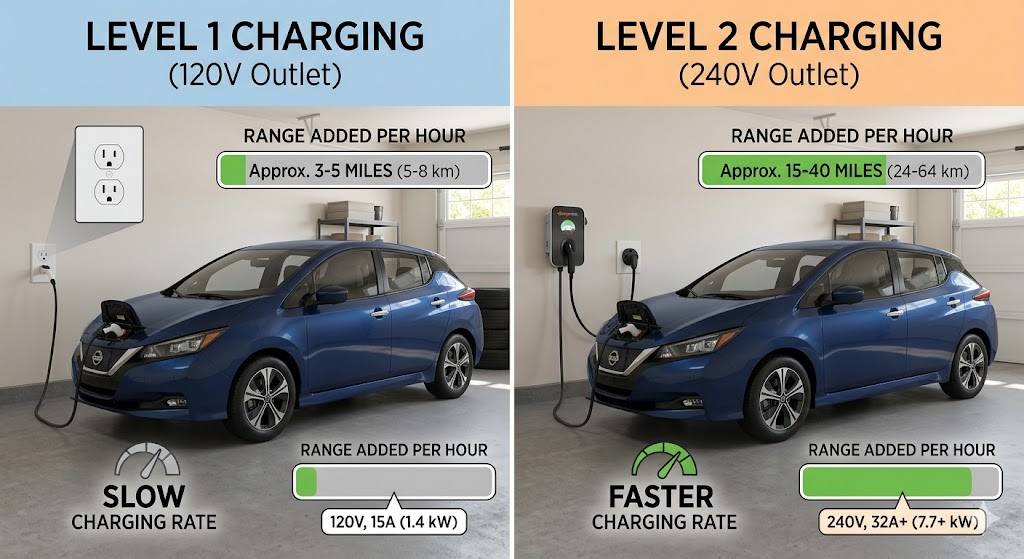
This is probably the most widespread misconception, and it's understandable — after all, your EV does come with a cable that plugs into a standard 120V outlet. This is called Level 1 charging, and while it technically works, it's the equivalent of filling up your car with a garden hose.
Level 1 charging adds roughly 3 to 5 miles of range per hour. If you drive 40 miles a day, you're looking at 8 to 12 hours of charging every night just to break even. Miss a night, and you're in trouble. For most people, this isn't a sustainable long-term solution.
A Level 2 charger, which runs on 240V (the same voltage as your dryer or oven), adds 20 to 30 miles of range per hour — a massive difference. Most EV owners recoup a full charge overnight with ease. So yes, you can use a regular outlet, but you probably shouldn't rely on it as your primary charging method.
Misconception #2: "All EV Chargers Are Basically the Same"
Walk into a home improvement store and you'll find chargers ranging from $150 to over $800. Surely they all do the same thing, right? Not quite.
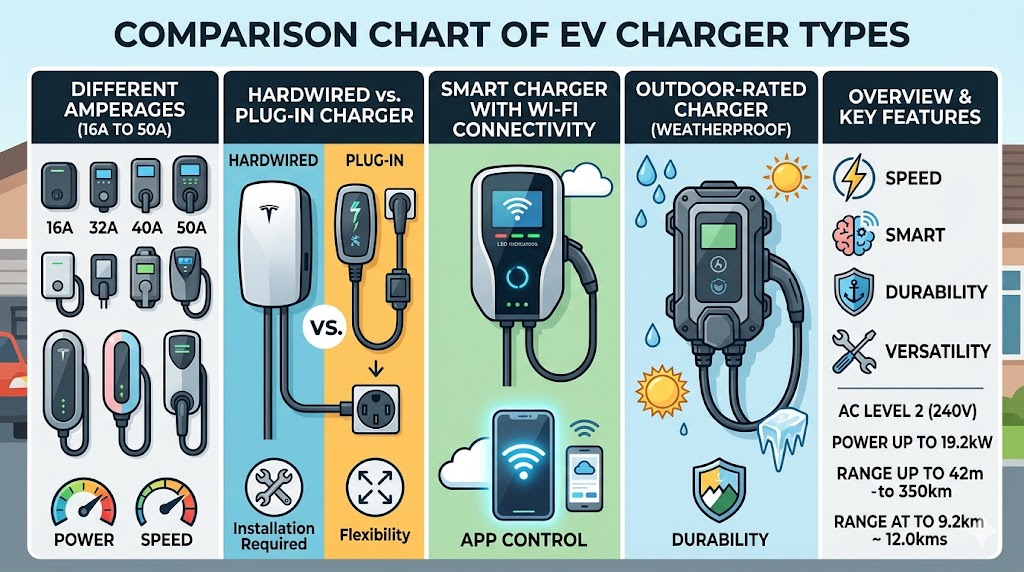
The main variables to consider are:
Amperage (speed): Chargers typically range from 16A to 50A. Higher amperage means faster charging, but your car's onboard charger has a maximum it can accept — there's no benefit going beyond your vehicle's limit.
- Hardwired vs. plug-in: Some chargers are permanently wired into your electrical panel; others use a NEMA 14-50 outlet. Plug-in models are easier to take with you if you move.
- Smart features: Wi-Fi connectivity, scheduling, energy monitoring, and app integration vary widely between models.
- Outdoor rating: If your garage is open or you plan to charge outdoors, you'll need a unit rated for outdoor use (look for NEMA 4X enclosures).
Misconception #3: "Installation Is Expensive and Complicated"
This one causes a lot of people to hesitate, and while it's true that installation isn't always free, it's rarely as costly or complex as people fear. The average cost of installing a Level 2 home charger runs between $200 and $600 for labor, depending on your location and how close your electrical panel is to your garage.
The key factor is whether your home's electrical panel has enough capacity. Many modern homes do; older homes might require a panel upgrade, which does add cost. However, there are workarounds — load management chargers, for example, can intelligently share power with other appliances to avoid overloading your system without requiring panel upgrades.
Additionally, federal tax credits (like the Alternative Fuel Vehicle Refueling Property Credit in the U.S.) and various state and utility rebates can offset installation costs significantly. It's worth checking what's available in your area before assuming you'll be paying full price.
Misconception #4: "You Need the Fastest Charger Available"
Faster sounds better, right? Not necessarily. Many people overbuy when it comes to charger amperage. Here's the reality: if your car's onboard charger maxes out at 11.5 kW (common in many mid-range EVs), buying a 19.2 kW charger won't make your car charge faster — it'll just charge at your car's maximum speed, not the charger's.
Before purchasing, check your vehicle's onboard charging capacity in the owner's manual or on the manufacturer's website. A 32A (7.7 kW) charger is perfectly adequate for the vast majority of EV drivers. The only reason to go higher is if you have a vehicle with higher charging acceptance, plan to upgrade vehicles in the future, or share one charger between two cars.
Buying a charger with some headroom is sensible future-proofing. Buying the most powerful model "just in case" when your car can't use it is just spending money unnecessarily.
Misconception #5: "Brand-Name Chargers from Car Manufacturers Are Always Best"
When you buy a new EV, the dealership often pushes the manufacturer's own charger — and it's tempting to stick with the brand you trust. But here's the thing: Level 2 chargers use the same connector standard (J1772 in North America), which means any certified Level 2 charger will work with any EV that uses that standard. It's not like proprietary cables where you're locked in.
Third-party brands like ChargePoint, Emporia, Grizzl-E, and Enel X Way often offer excellent build quality, better smart features, and lower prices than OEM options. Do your research, read reviews, look for UL certification, and don't assume the manufacturer's charger is automatically the best choice for your specific needs.
Misconception #6: "Renters Can't Set Up Home Charging"
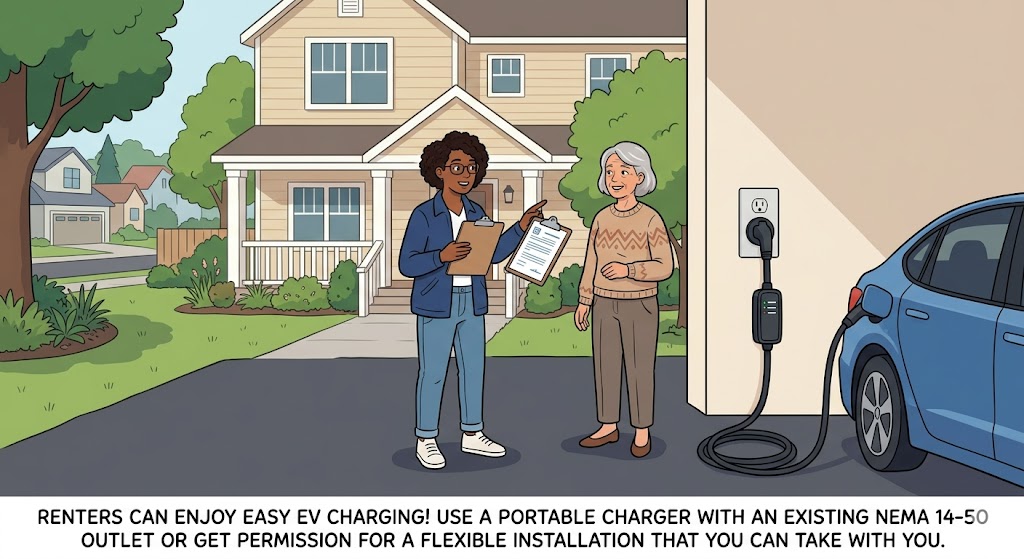
If you're renting, you might feel like home charging is out of reach — but the situation is improving. Many states now have "right to charge" laws that require landlords to permit EV charging installations (sometimes with conditions). California, Florida, and Colorado are among the states with such legislation.
Even without legal protections, many landlords are open to allowing a Level 2 charger installation if the tenant covers the cost and agrees to restore the property upon moving out. A portable plug-in charger that uses a NEMA 14-50 outlet is another option that requires minimal permanent modification.
And if home charging truly isn't an option, workplace charging, public Level 2 stations, and DC fast chargers have become far more widely available in recent years. Many EV owners without home charging manage just fine.
Misconception #7: "Smart Chargers Are Just a Gimmick"
If you're not a tech enthusiast, the Wi-Fi connectivity and app features of smart chargers might seem unnecessary. But these features can actually save you real money. Many utility companies offer time-of-use (TOU) pricing, where electricity is cheaper during off-peak hours (typically late at night). A smart charger lets you schedule charging automatically to take advantage of these rates.
Some smart chargers also integrate with home energy management systems and solar panels, optimizing when you charge based on your home's overall energy consumption or solar production. For some households, this can meaningfully reduce electricity bills. Whether the extra cost of a smart charger pays off depends on your local utility rates and habits — but it's worth considering rather than dismissing outright.
The Bottom Line
Buying an EV charger for your home is, at its core, a pretty straightforward decision once you separate the facts from the fiction. You don't need the fastest, most expensive unit on the market. You don't need to be a homeowner. You don't need to be intimidated by installation. And you definitely don't need to stick with your car manufacturer's branded charger.
What you do need is a clear understanding of your vehicle's charging capacity, your daily driving habits, your home's electrical setup, and your budget. With those four things in hand, choosing the right charger becomes a practical exercise rather than a stressful one.
The EV charging landscape is evolving rapidly, and it's only getting better — more choices, lower prices, smarter technology, and wider public infrastructure. The best time to make the switch to electric was yesterday; the second-best time is today. And now that you know what's actually true, you're ready to make a confident, informed decision.