
As electricity costs continue rising—increasing by 6.1% between August 2024 and August 2025—more utilities across North America are shifting toward Time-of-Use (TOU) pricing structures. For electric vehicle owners in particular, understanding TOU plans can translate into substantial savings on charging costs. Unlike traditional flat-rate electricity pricing, TOU plans charge different rates depending on when you use electricity, creating opportunities for those who can shift their consumption to cheaper hours. This guide explains how TOU works, compares regional pricing differences, and provides practical calculations showing how much you can save.
How Time-of-Use Plans Work
Time-of-Use pricing is fundamentally different from the flat-rate structure most consumers grew up with. Rather than paying a single rate regardless of when electricity is consumed, TOU plans divide the day into distinct periods—typically on-peak and off-peak hours—with different prices for each.
The economic logic behind TOU is straightforward: electricity generation and transmission costs vary dramatically throughout the day. During late afternoon and early evening (typically 4-9 PM), when people return home, run air conditioning, cook dinner, and perform other energy-intensive activities, demand for electricity peaks. To meet this demand, utilities must activate expensive power plants. Conversely, at night and early morning hours, demand plummets, and utilities can rely on cheaper, often renewable sources like wind and hydroelectric power.
By charging customers more during peak hours and less during off-peak hours, utilities incentivize consumers to shift consumption to cheaper times. When aggregate consumer behavior changes, the entire electrical grid becomes more efficient—utilities avoid building additional expensive infrastructure, and grid stability improves.
Typical TOU Rate Structure:
- Off-peak hours: Evening through early morning (typically 9 PM–7 AM) and all day weekends. These hours offer the lowest rates.
-
On-peak hours: Late afternoon through early evening (typically 4 PM–9 PM) on weekdays. These hours carry the highest rates.
-
Mid-peak hours: Some utilities include a mid-tier "mid-peak" period during business hours, though newer plans are simplifying to just two tiers.
For EV owners, this structure presents a significant advantage: most people charge their vehicles overnight or during off-peak windows, aligning perfectly with when rates are lowest.
Regional Rate Comparisons
TOU pricing varies considerably across the United States, reflecting local fuel mixes, infrastructure costs, and regulatory decisions. Here's a detailed comparison of four key regions:
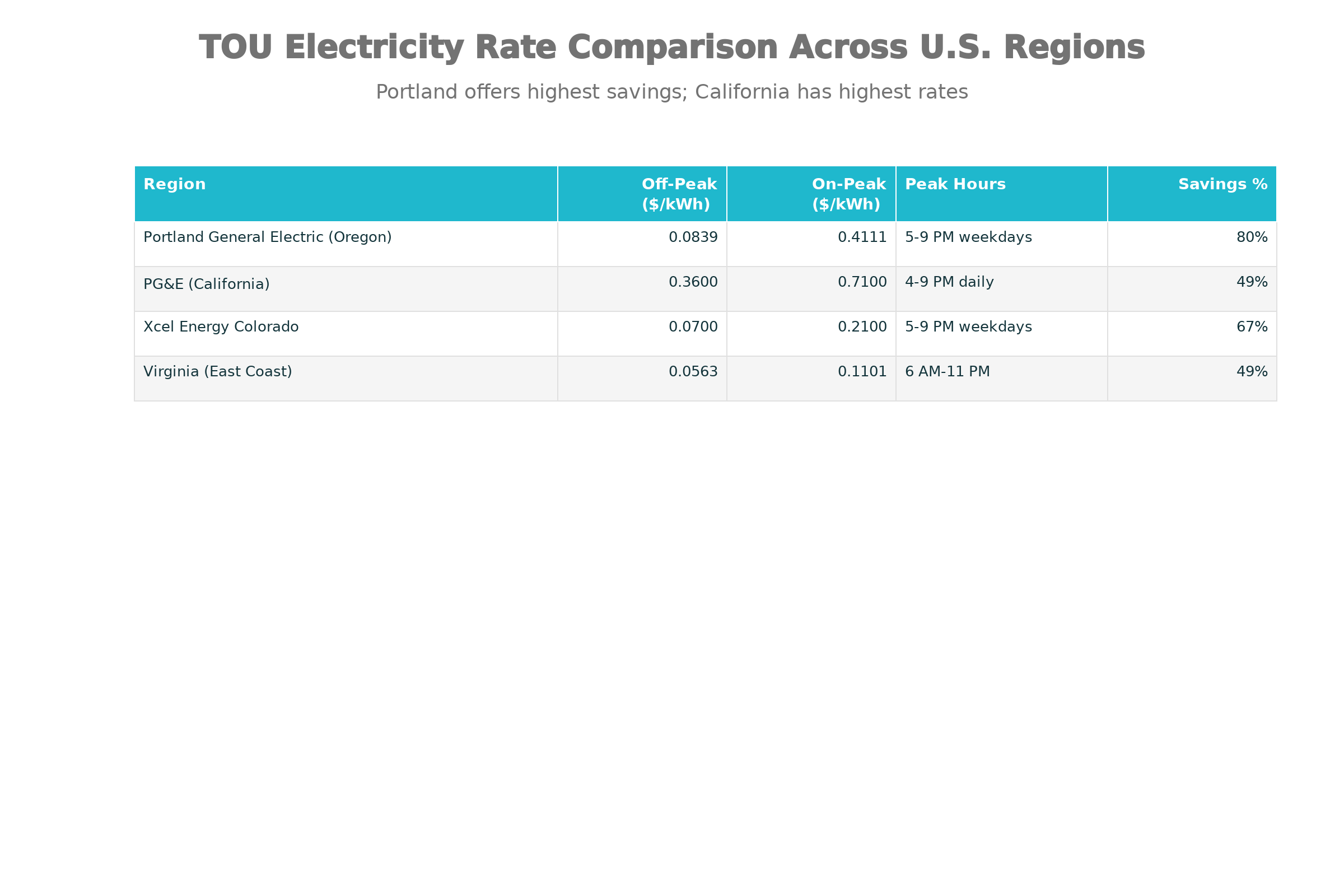
Regional Time-of-Use Electricity Rates Comparison
Portland, Oregon (Portland General Electric)
Portland benefits from the Pacific Northwest's abundant hydroelectric power, which enables some of the most aggressive TOU pricing in the nation. PGE offers rates of just 8.39¢/kWh during off-peak hours compared to 41.11¢/kWh during on-peak periods (5-9 PM weekdays).
This represents an 80% savings potential for EV owners who charge primarily during off-peak windows—the highest difference among major U.S. utilities. Portland General Electric also offers an additional $25 credit for customers who participate in programs that automatically pause EV charging during peak periods, adding another layer of savings.
California (Pacific Gas & Electric)
California's TOU rates reflect the state's elevated electricity prices and the challenge of meeting peak summer demand. PG&E's EV rates show an on-peak rate of approximately 71¢/kWh versus 36¢/kWh during off-peak hours, representing roughly a 49% difference.
PG&E's EV2-A rate plan designates 12 AM–3 PM as the lowest-cost period each day, including weekends and holidays. This extended midday window helps solar-generating customers maximize self-generation benefits. At PG&E's off-peak rate, EV charging costs the equivalent of just $1.90 per gallon of gasoline—a compelling comparison for cost-conscious drivers.
Colorado (Xcel Energy)
Colorado implemented significant TOU rate simplifications effective October 2025. The new structure eliminates the previous "mid-peak" tier, creating just two periods: On-peak (5-9 PM weekdays) at $0.21/kWh during summer and off-peak at $0.07/kWh.
This represents a 67% savings opportunity for off-peak charging. Notably, Xcel made TOU rates the default plan for residential customers, requiring customers to actively opt out if they prefer flat-rate pricing. Analysis by Colorado regulators showed that most customers achieved bill savings or neutral outcomes under the new TOU structure, even without actively shifting consumption.
East Coast (Virginia Example)
Virginia utilities demonstrate moderate TOU savings opportunities. In many Virginia regions, customers can achieve nearly 50% savings by charging during off-peak hours (11 PM–6 AM), paying just 5.63¢/kWh versus 11¢/kWh during peak hours.
Regional Time-of-Use Electricity Rates Comparison
Calculating Your EV Charging Savings
Understanding how much you can save requires a simple calculation. The formula is: Battery Capacity (kWh) × Electricity Rate ($/kWh) = Charging Cost.
Most modern EVs have battery capacities between 60-80 kWh. A Tesla Model Y Standard Range, for example, has a 60 kWh usable battery.
Practical Example: Portland EV Owner
Assume a Portland resident with a 60 kWh battery:
- Off-peak charging cost: 60 kWh × $0.0839/kWh = $5.03 per charge
-
On-peak charging cost: 60 kWh × $0.4111/kWh = $24.67 per charge
-
Savings per charge: $24.67 – $5.03 = $19.64
For someone charging 3 times per week (typical for average drivers):
- Weekly savings: $19.64 × 3 = $58.92
-
Monthly savings: $58.92 × 4 weeks = $235.68
-
Annual savings: $235.68 × 12 = $2,828
Savings Comparison Across Regions
Annual EV Charging Savings: Off-Peak vs On-Peak by Region (60 kWh Battery)
The chart above illustrates how annual savings vary by region when charging exclusively during off-peak hours. Portland residents save the most ($1,846 annually), while even Virginia residents achieve meaningful savings of $611 annually with consistent off-peak charging.
For perspective, these savings exceed the cost of installing a smart Level 2 charger, which typically costs $800–$1,500 installed but enables automated scheduling to capture maximum TOU benefits.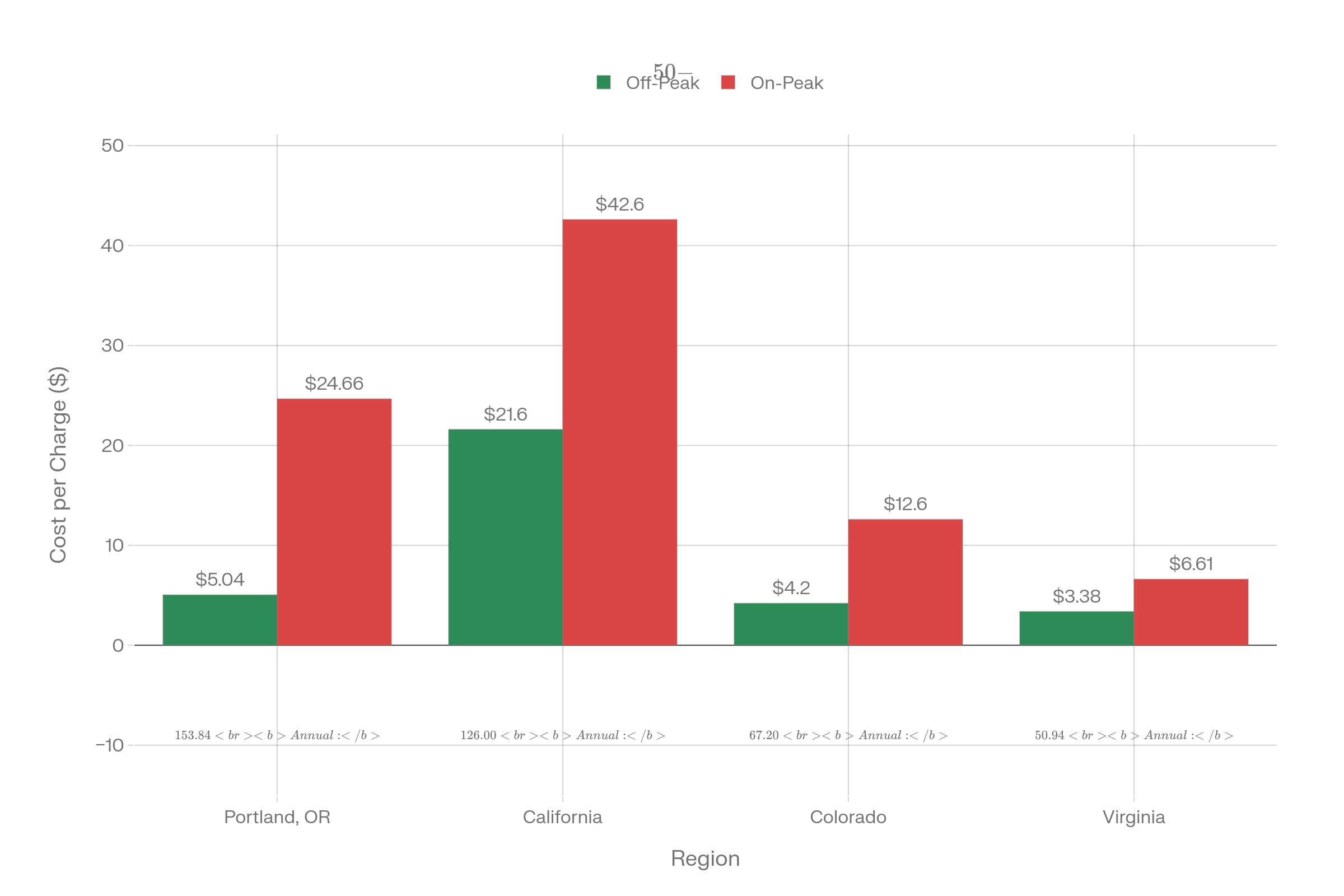
Strategies to Maximize Your TOU Savings
1. Install a Smart, Schedulable Charger
Standard Level 2 chargers cannot schedule charging to specific time windows. A smart Level 2 charger with scheduling capability can be programmed to charge only during off-peak hours, even if your car is plugged in during peak times. Many chargers come with apps that integrate your utility's TOU schedule.
2. Leverage Extended Off-Peak Windows
California's PG&E offers an exceptionally long off-peak window (12 AM–3 PM daily), allowing afternoon charging at lowest rates. In Colorado, new TOU rates extend off-peak hours by two hours daily compared to the previous schedule. Understanding your utility's exact windows maximizes opportunities.
3. Combine TOU with Solar and Battery Storage
For homeowners with rooftop solar, TOU plans become dramatically more valuable. Solar generation peaks midday, coinciding with partial-peak rates in many plans. Battery storage systems can store excess solar generation and then discharge during peak hours, avoiding peak-rate charges entirely. Federal tax credits cover 30% of battery storage costs for systems 3 kWh and larger.
4. Use Vehicle-to-Grid (V2G) Technology (Future Strategy)
As bidirectional charging becomes more common, some EV owners may eventually earn money by supplying stored battery energy back to the grid during peak demand hours. This technology is nascent but rapidly developing.
5. Adjust Household Practices During Peak Hours
Beyond EV charging, shift other energy-intensive tasks to off-peak windows: run dishwashers, laundry, and pool pumps during overnight or weekend hours. This maximizes overall household savings under TOU pricing.
Regional Recommendations for Different Areas
For Portland, Oregon residents: Enroll in Portland General Electric's TOU plan immediately. The 80% rate difference makes this plan an absolute no-brainer. Install a smart charger capable of scheduling to maximize the 9 PM–7 AM off-peak window.
For California residents: Compare PG&E's EV2-A and EV-B rates using PG&E's online tools. The extended midday off-peak window may benefit those who can charge during business hours or have solar systems.
For Colorado residents: Xcel Energy's simplified TOU structure effective October 2025 makes enrollment easy. The new structure is now default, so verify you're enrolled and take advantage of the extended 20-hour off-peak window.
For other states: Check whether your utility offers TOU plans—over 50% of U.S. customers already have access. Even regions with smaller rate differentials (49%) justify installing a smart charger.
Considerations and Potential Drawbacks
While TOU plans benefit most EV owners, some households may fare better on flat-rate plans:s
- Inflexible schedules: If you must charge during peak hours due to work or lifestyle constraints, savings diminish significantly.
-
Large energy users: Households with high overall consumption may see on-peak usage charges that offset off-peak savings.
-
Limited peak/off-peak difference: Some utilities offer smaller rate differentials (30–40%), making schedule shifting less critical.
Always calculate potential savings using your utility's online comparison tools before committing.
Conclusion
Time-of-Use electricity plans represent one of the highest-leverage cost-saving strategies available to electric vehicle owners. By simply scheduling charging to off-peak windows—a task made effortless by smart chargers—EV owners can reduce annual electricity costs by $600–$2,800 depending on their region. For Portland residents, the savings potential is exceptional; even in lower-differential regions, consistent off-peak charging produces meaningful annual savings exceeding the cost of upgraded charging infrastructure.
As utilities nationwide adopt TOU structures and electricity prices continue rising, understanding how to optimize your charging behavior isn't just economically prudent—it's essential for maximizing the financial benefits of vehicle electrification.