Introduction: The Garage as the New Energy Hub
For the past century, the home garage was merely a storage space for a mechanical machine. Today, that narrative is shifting. As the world moves toward "The Electrification of Everything," the garage is being reimagined as a critical node in a household’s energy network. The global transition to Electric Vehicles (EVs) has moved past the early-adopter phase and into the mass-market reality. However, this transition brings a significant challenge: how do we manage the massive electrical load of an EV without destabilizing the home or the grid?
The answer lies in Centralized Integration. In the very near future, an EV charger will no longer be a "dumb" appliance that simply passes current. It will be an intelligent, interactive component of a Home Energy Management System (HEMS). For a forward-thinking brand like Feyree, this represents both a technological evolution and a strategic opportunity to lead the market from simple connectivity to total ecosystem synergy.
1. The Current Landscape: The "Wi-Fi Era" of Feyree
Currently, the industry—and Feyree’s successful product lines like the G-mini, Pisces, and Taurus series—is firmly rooted in the Wi-Fi and App-control era.
The Foundation of Connectivity
At present, Feyree chargers provide essential "smart" features via stable Wi-Fi modules. This allows users to:
- Remote Scheduling: Start or stop charging sessions via a smartphone to take advantage of lower night-time electricity rates.
-
Real-time Monitoring: View voltage, current, and energy consumption in real-time.
-
Data Logging: Track historical energy usage for budgeting and environmental reporting.
While these features are transformative compared to basic "plug-and-play" units, they still operate within a "Siloed Data" model. The charger talks to the Feyree App, but it doesn't necessarily know if the household dishwasher is running or if the solar panels are over-producing. This is the gap that the next generation of integration will bridge.
2. Why Integration is the Inevitable Future
As we look toward 2027 and beyond, several global factors are making centralized home management a necessity rather than a luxury.
A. Dynamic Load Balancing (DLB)
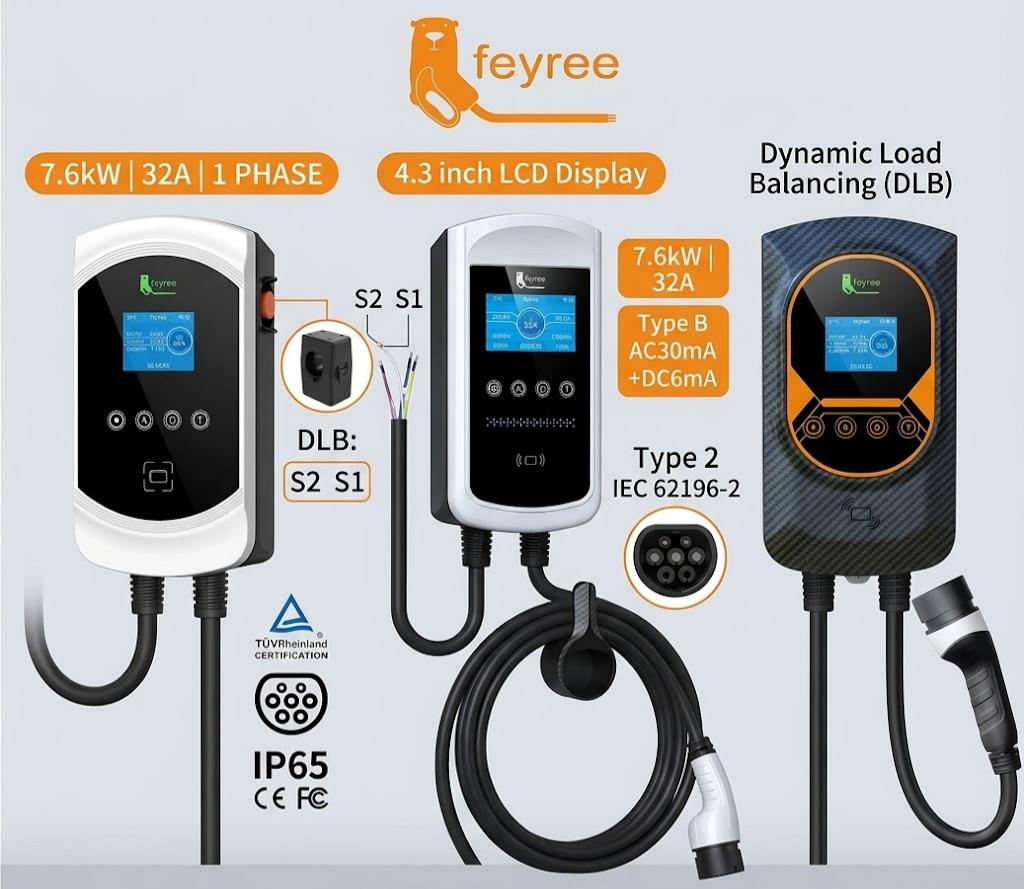
Most residential electrical panels are not designed to handle a 22kW (Europe) or 48A (North America) continuous load on top of existing appliances. Without integration, charging an EV while running an electric oven and a heat pump could trip the main breaker. Future integrated Feyree systems will communicate directly with the home’s smart meter. If the house’s total draw approaches its limit, the HEMS will automatically "throttle" the Feyree charger’s output, increasing it again only when other appliances are turned off. This eliminates the need for expensive electrical service upgrades for the homeowner.
B. Solar Synergy and Green Charging
In many of Feyree’s primary markets, such as Germany, France, and the United States, residential solar adoption is skyrocketing. An integrated charger can access data from the solar inverter. Instead of drawing expensive "grey" energy from the grid, the system can be set to "Solar Only" mode. The Feyree charger will then only activate when there is excess solar production, effectively allowing the user to "drive on sunshine."
C. The Rise of V2H (Vehicle-to-Home)
Looking further ahead, the EV battery itself will become a backup power source for the home. A centralized management system is required to coordinate this bidirectional flow of energy, turning the car into a giant power bank that can keep the lights on during a blackout.
3. Feyree’s Strategic Evolution: The Roadmap to Integration
You’ve noted that Feyree products currently utilize Wi-Fi but are not yet linked to broader management systems. This is a common and logical starting point. Here is how Feyree will evolve into the integrated future.
Transitioning to Universal Protocols: OCPP and Matter
The "language" of the future smart home will likely be dictated by two standards:
1.OCPP (Open Charge Point Protocol) 2.0.1: This is the gold standard for EVSE communication. By adopting OCPP, Feyree hardware can be managed by any third-party energy management software or utility provider.
2.Matter and Thread: As the smart home industry (led by Apple, Google, and Amazon) moves toward the Matter protocol, future Feyree chargers will likely include Matter-certified chips. This will allow a Feyree charger to appear in the "Apple Home" or "Google Home" dashboard alongside lights and thermostats, with zero configuration required.
Hardware Readiness
Feyree is already preparing its hardware architecture for this shift. By ensuring that our internal control boards (PCBs) have the processing overhead and modularity to accept future communication modules, we are future-proofing our users' investments. Whether it’s the Hero series or the Flying Cat, the internal logic is being designed to handle more complex "handshakes" between the vehicle and the home.
-52.jpg?w=1015&h=944)
4. Regional Analysis: Adapting to Global Ecosystems
A centralized management system is not a one-size-fits-all solution. Feyree’s global footprint requires a nuanced approach to integration.
The European Context: Grid Efficiency and AFIR
In Europe, where energy prices are among the highest in the world, the focus is on efficiency and regulation. The EU's AFIR (Alternative Fuels Infrastructure Regulation) is pushing for more transparent and manageable charging. Integrated Feyree systems in Europe will focus heavily on Dynamic Load Management to help households stay within their "subscribed power" limits (common in France and Italy) to avoid heavy penalties from grid operators.
The North American Context: The NACS Transition and High Amperage
In North America, the shift toward the NACS (Tesla) standard is the current focus, but integration follows closely behind. American homes often have higher power capacities but also higher consumption. Feyree’s future integrated units for the US and Canada will prioritize multi-device coordination, ensuring that a household with two or even three EVs can charge them all overnight without exceeding the transformer’s capacity.
5. A Day in the Life: The Integrated Feyree Experience (2030)
To understand the value of this integration, let’s imagine a typical day for a Feyree user in the near future.
07:00 AM: Your Feyree charger, integrated with your home management system, has ensured your car is at 80% charge. It used only "off-peak" wind energy from the grid between 2:00 AM and 5:00 AM, saving you 40% on your energy bill.
10:00 AM: You are at work. Your home’s solar panels are producing 5kW of power, but the house is only using 1kW. The system sends a notification: "Excess solar detected. Should I discharge the EV to the grid for a credit, or save the energy?"
06:00 PM: You arrive home and plug in. Usually, this is "Peak Hour" where electricity is most expensive. The HEMS recognizes this and places the Feyree charger in "Standby Mode."
07:30 PM: You decide to cook dinner and turn on the electric oven. The home’s total power draw spikes. Because your Feyree charger is integrated, it "knows" not to start charging yet, preventing any risk of a blown fuse.
11:00 PM: The grid price drops. The oven is off. The house is quiet. The HEMS gives the "Green Light" to the Feyree charger, which begins a high-speed 22kW charge to ensure you’re ready for the morning.
6. Feyree’s Commitment: Professional, Accessible, and Connected
Our brand philosophy has always been about bringing high-quality charging solutions to the masses. As we transition into the era of centralized management, our core values will remain:
- Plug and Play Simplicity: Even as the backend technology becomes more complex, the user experience must remain simple. Feyree will ensure that "integration" doesn't mean "complicated."
-
Localized Optimization: We will continue to tailor our integration strategies to match the specific grid requirements and plug standards (Type 2, Type 1, NACS) of our diverse markets.
-
Safety First: Centralized management isn't just about convenience; it’s about safety. By monitoring the thermal health of the connection and the load on the home’s wiring, Feyree provides an extra layer of protection for the family.
Conclusion: Driving into a Connected Tomorrow
The future of the electric vehicle is not just about the car; it’s about the environment in which that car lives. By moving beyond simple Wi-Fi connectivity and embracing full integration into Home Management Systems, Feyree is positioning itself as a vital partner in the sustainable home of the future.
While our current products provide the industry-leading reliability and app-based control our customers love today, our eyes are firmly on the horizon. We are building the bridges between your car, your home, and the sun. The integrated future isn't just coming—at Feyree, we are already building it.