As electric vehicles become mainstream, a key question for new and experienced EV owners alike is: what type of home charging setup is right for me? AC wallbox chargers fall into three main categories — socket, tethered, and portable. Each has distinct advantages and is better suited to different lifestyles and situations. This guide walks through real-world usage scenarios to help you make the right choice.
Understanding the Three Types
Before diving into scenarios, here is a quick overview of what sets each type apart.
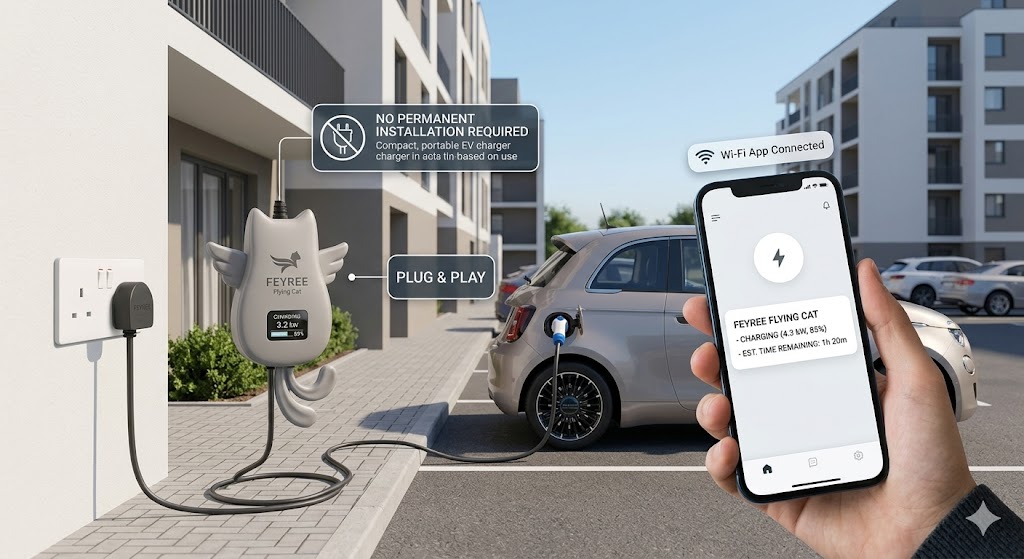
Socket wallbox: A wall-mounted unit with a built-in charging socket — no cable attached. You bring your own cable, which can be swapped to suit different vehicles or connector standards. A key advantage of modern socket wallboxes is adjustable power output: for example, the Feyree Draco EV-PRO Wi-Fi Wallbox supports 7.6 kW, 11 kW, and 22 kW, working across both single-phase and three-phase installations. The same unit adapts to your home's electrical supply without any hardware change.
Tethered wallbox: A wall-mounted charger with a permanently attached cable. You simply grab the cable and plug it into your car — no extra steps required.
Portable charger (Granny Cable / mobile EVSE): A compact unit that plugs into a standard household or industrial socket. No installation is needed, making it the most accessible option for renters, travellers, or anyone without a dedicated parking space.
Scenario 1: Daily Home Charging — Who Wins on Convenience?
For most households, arriving home after work and topping up overnight is the most common charging routine. Both tethered and socket wallboxes serve this scenario well, but they differ in day-to-day feel.
A tethered wallbox is marginally faster to use: the cable is always there, you just plug in and go. A socket wallbox requires you to retrieve a cable first — though many drivers keep it hanging near the charger, which makes the difference negligible in practice.
Where a socket wallbox like the Feyree Type 2 22 kW Wi-Fi Wallbox stands out is its power flexibility. You can dial in the right output — 7.6 kW for a standard overnight charge on single-phase, or up to 22 kW on three-phase for faster turnaround. Current can be adjusted step-by-step from the unit itself (8A, 10A, 13A, 16A, 20A, 25A, 32A) or fine-tuned amp-by-amp through the Tuya Smart app. This means one piece of hardware adapts to your home's electrical capacity today, and scales up if you upgrade your supply in the future.
Scenario 2: Multiple EVs or Planning to Change Cars
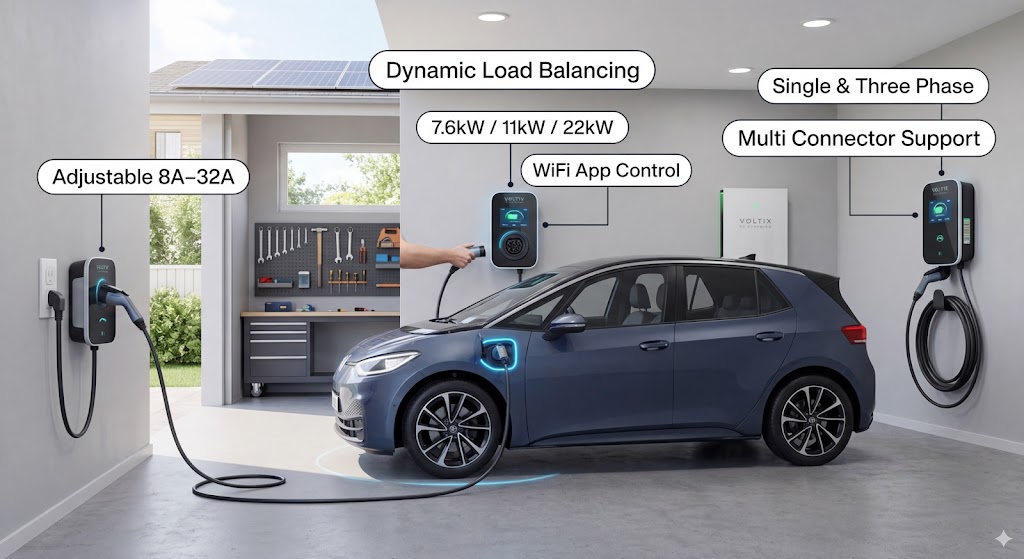
If your household runs two electric vehicles, or you expect to change cars in the next few years, a socket wallbox offers the best long-term flexibility — and this is where the design philosophy of a socket unit really pays off.
Because the cable is separate from the charger, you can use any compatible Type 2 cable — or swap to a different connector type using an adapter. The Feyree Draco EV-PRO takes this even further: it is a universal socket wallbox that supports NACS (Tesla North America), J1772 (North America Type 1), Type 2 (Europe), and GB/T (China), all from one unit. Whether you own a Tesla, a BMW, a Hyundai, or a VW, the charger hardware stays the same — only the cable changes.
Connector standards continue to evolve globally. Purchasing a socket wallbox with multi-connector compatibility is one of the best ways to future-proof your charging setup without needing to reinstall hardware when you next change vehicles.
For multi-EV homes, the Feyree Gemini wallbox adds Dynamic Load Balancing (DLB) on top of socket flexibility — it automatically monitors total household power consumption and adjusts the charging current in real time to prevent overloading your electrical circuit, even when multiple appliances are running simultaneously.
Scenario 3: Renters and Users Without Dedicated Parking
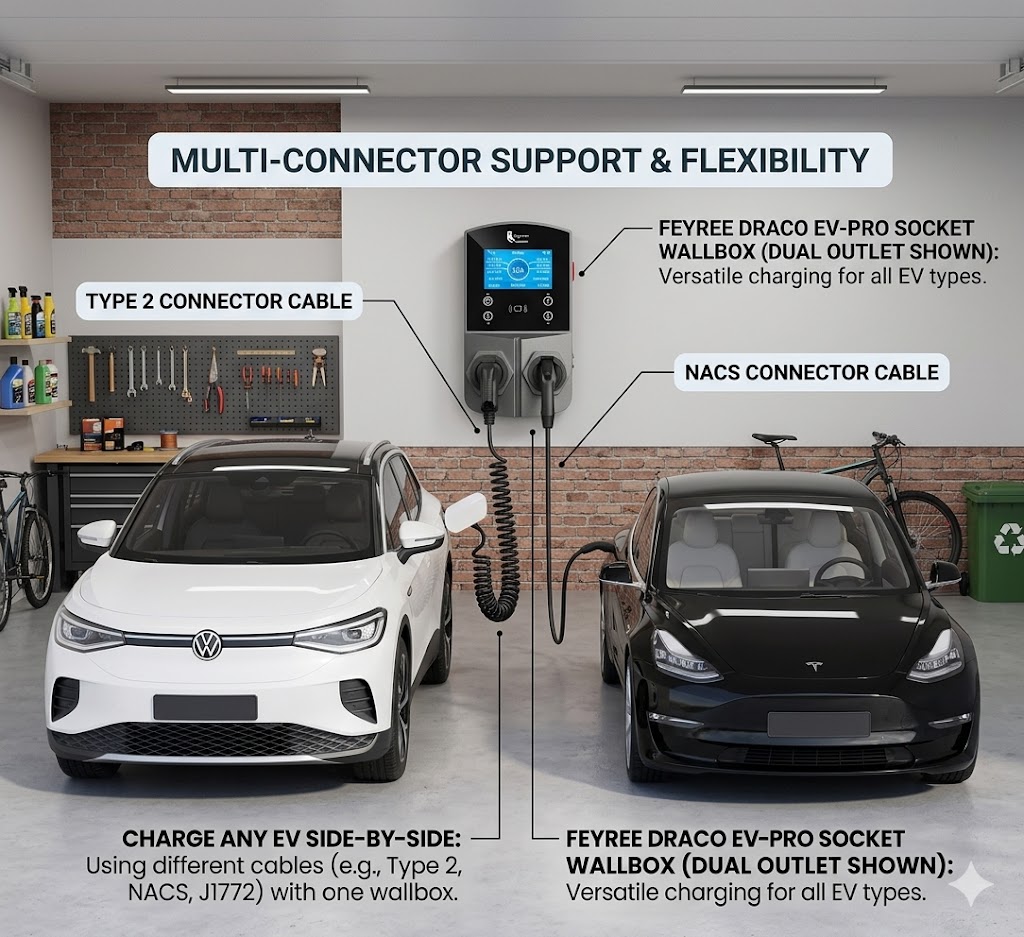
This is one of the most overlooked scenarios, but it affects a large number of EV drivers. If you live in rented accommodation or cannot install a fixed charger, a portable EV charger is often your only realistic option.
Portable chargers require no installation. They plug into a standard 13A household socket or a 32A industrial commando outlet and begin charging immediately. Feyree's portable range covers this use case from both ends: the Flying Cat is a compact 3.5 kW single-phase unit ideal for overnight top-ups, while the portable 22 kW three-phase model delivers the same high-speed charging as a fixed wallbox — in a unit you can carry in the boot and use anywhere.
The main trade-off for slower portable options is speed. A standard 13A socket delivers around 2.3 kW, which typically adds around 100 miles of range overnight. For renters, portable chargers are the essential starting point. For homeowners with a fixed wallbox already installed, a portable unit kept in the car serves as an invaluable backup — particularly useful on long trips or when away from home.
All Feyree portable chargers carry an IP66 waterproof rating and Type B leakage protection (AC 30 mA + DC 6 mA), making them safe for outdoor use in any weather.
Scenario 4: Homes with Solar Panels
For homeowners with a photovoltaic system, combining solar generation with EV charging is one of the most compelling opportunities in home energy management. In this scenario, a smart wallbox with scheduling and load management capability is essential — and a socket wallbox is the natural fit, since you choose the cable and power level to match your setup.
The Feyree Type 2 22 kW Wi-Fi Wallbox connects to the Tuya Smart platform via Wi-Fi and Bluetooth. Through the app, you can schedule charging to coincide with peak solar generation hours, avoiding grid draw during expensive rate periods. The built-in 4.3-inch LCD screen displays real-time output data — showing whether the unit is operating at 1-phase 7.6 kW or 3-phase 11/22 kW — along with a 12-month charging history log.
The Feyree Gemini and Taurus wallboxes add Dynamic Load Balancing on top of this, automatically adjusting the charger's current draw based on what the rest of the home is consuming. In practical terms, this means you can safely run the charger, the oven, and other high-draw appliances simultaneously, without risking a tripped circuit breaker.
Both models are available at 7.6 kW, 11 kW, and 22 kW output levels, giving solar-equipped homeowners the flexibility to match the charger's power to their inverter's export capacity.
Scenario 5: Charging in Shared or Commercial Car Parks
Some EV drivers park in shared residential car parks, workplace facilities, or commercial spaces where installing a dedicated wallbox is not possible. In these cases, a portable charger with high-power output is the most practical solution.
Many commercial and workplace parking areas include pre-installed industrial sockets (240V/32A or three-phase commando outlets). Feyree's 22 kW portable charger — which supports both single-phase and three-phase input — can deliver full-speed charging through these outlets without any permanent installation. Its compact design and included wall-mounting bracket mean it can be left semi-permanently at a workplace charging point and moved as needed.
The Wi-Fi and app control built into this model allows users to schedule sessions and receive charge-complete notifications remotely — practical when you are inside an office and cannot see your car.
How to Choose: A Four-Step Decision Guide
Run through these four questions to find the right setup for your situation:
• Do you own your home and have a fixed parking space where you can install a charger? If not, start with a portable charger. Feyree's portable range starts at 3.5 kW for basic home use and goes up to 22 kW three-phase for near-wallbox performance wherever you park.
• Do you own one EV and plan to keep the same connector type? A tethered wallbox gives you the most friction-free daily experience. If you also want power flexibility, consider a socket wallbox with adjustable output instead.
• Do you own multiple EVs, use different connector types, or expect to change vehicles? A socket wallbox is the smarter long-term investment. The Feyree Draco EV-PRO supports NACS, J1772, Type 2, and GB/T from a single unit — no hardware replacement needed when you change cars.
• Do you have solar panels, a smart meter, or want to optimise charging costs? Choose a Wi-Fi enabled socket wallbox with scheduling and load management. The Feyree Type 2 22 kW Wi-Fi Wallbox connects to the Tuya Smart app and supports time-of-use scheduling, while the Gemini and Taurus models add full Dynamic Load Balancing.
Our Range Covers Every Scenario
Our product catalogue spans all three charger types, with a particular depth in socket wallboxes that support multiple plug standards and adjustable power outputs — designed to serve every type of EV owner from first-time buyers to multi-vehicle households.
Key products from our range:
• Feyree Type 2 22 kW Wi-Fi Wallbox — Socket wallbox with 7.6/11/22 kW output, single and three-phase support, Tuya app control, 4.3-inch LCD screen, and adjustable current (8–32A). TUV & CE certified.
• Feyree Draco EV-PRO — Universal socket wallbox supporting NACS, J1772, Type 2, and GB/T connectors. 22 kW, 32A, single and three-phase compatible. The broadest multi-connector coverage in our range.
• Feyree Gemini / Taurus Wallbox — Smart socket wallboxes with Dynamic Load Balancing at 7.6 kW, 11 kW, or 22 kW. Ideal for homes with solar panels or multiple high-draw appliances.
• Feyree Pisces Series — 7.6/11/22 kW socket wallbox with 4.3-inch colour LCD, DLB, app control, and 12-month charging history. A well-rounded smart home charging solution.
• Feyree Flying Cat (Portable) — 3.5 kW single-phase portable charger with 5m cable. Compact and affordable — the essential backup charger for any EV owner.
• Feyree 22 kW Portable Charger — Full 22 kW three-phase portable EVSE with Wi-Fi app control, IP66 waterproofing, and adjustable current. Maximum power in a portable form factor — for users who need wallbox-level performance without permanent installation.
Choosing a charger is not about picking the most expensive or most feature-rich option. It is about matching your setup to your actual lifestyle. The unique advantage of today's socket wallboxes — particularly Feyree's multi-plug, multi-power range — is that a single piece of hardware can genuinely serve you across different vehicles, different homes, and different electrical supplies for years to come. Once you understand the core strength of each type, the right choice becomes clear.