
Picture this: it's a sweltering July afternoon, and you're stuck in highway traffic with your air conditioning on full blast. Your battery icon is creeping downward faster than usual, and by the time you reach your destination, your electric vehicle has lost noticeably more range than the same trip would cost you on a mild spring day. Sound familiar? This isn't a glitch — it's physics. And understanding the science behind it is the first step toward getting the most out of your EV's battery for years to come.
Battery thermal management might not be the most glamorous topic in the world of electric vehicles, but it is arguably the most important. The way your car manages heat — both generating it and dissipating it — has a direct, measurable impact on how far you can drive today, and how well your battery holds up five or ten years from now. This article breaks down how thermal management works, why it matters so much, and what it means for EV owners living in drastically different climates around the world.
The Battery and Heat: A Complicated Relationship
At the heart of every electric vehicle is a lithium-ion battery pack — a sophisticated arrangement of thousands of individual cells working in concert. These cells are electrochemical systems, meaning they rely on controlled chemical reactions to store and release energy. Like most chemical processes, these reactions are exquisitely sensitive to temperature.
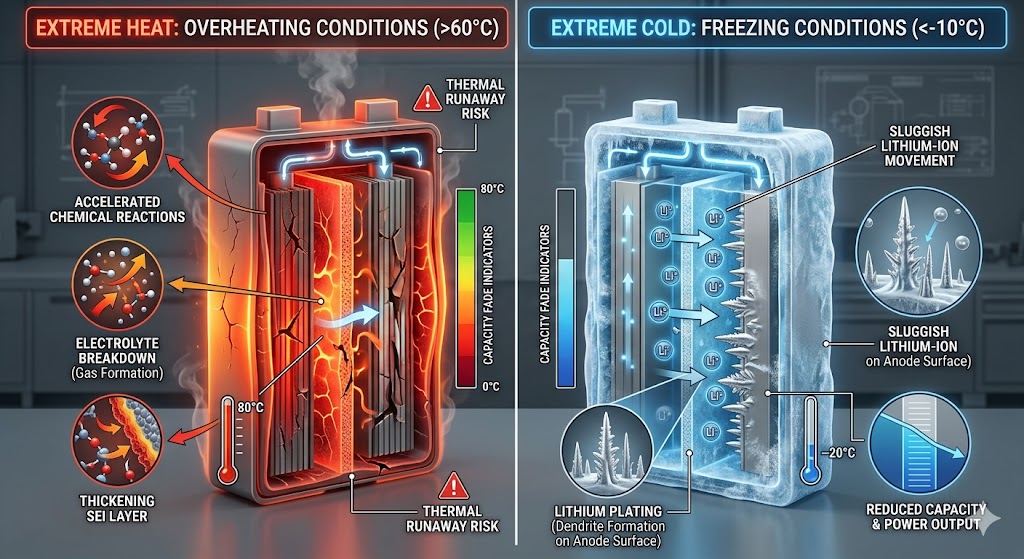
Lithium-ion cells operate best within a relatively narrow temperature window, generally between 15°C and 35°C (59°F to 95°F). Step outside that range — in either direction — and things start to go wrong. The problem, however, isn't just about performance in the moment. It's about the cumulative damage that builds up over time when cells are repeatedly pushed beyond their thermal comfort zone.
Heat accelerates a process called capacity fade. Inside every cell, the electrodes and electrolyte undergo microscopic changes over time — perfectly normal aging. But when temperatures are elevated, these changes accelerate dramatically. The electrolyte breaks down faster, a layer called the solid electrolyte interphase (SEI) grows thicker and consumes active lithium that can never be recovered, and in extreme cases, metal structures inside the cell can degrade or fracture. The result is a battery that holds less charge and delivers less power than it did when new — a process that is largely irreversible.
Cold temperatures bring their own challenges. When the mercury drops, lithium ions move more sluggishly through the electrolyte, reducing the battery's ability to deliver power quickly. Charging in the cold is particularly problematic: push too much current into a cold cell and lithium can plate out on the anode surface as metallic lithium rather than intercalating properly — a phenomenon known as lithium plating, which permanently reduces capacity and, in severe cases, can create internal short circuits.
How Thermal Management Systems Work
Modern EVs don't leave battery temperature to chance. Sophisticated Battery Thermal Management Systems (BTMS) continuously monitor and regulate cell temperatures, intervening whenever conditions drift outside safe parameters. These systems have evolved considerably over the past decade, and the differences between approaches have real-world consequences.
Air Cooling: Simple but Limited
The simplest form of battery thermal management uses air — either ambient air or air from the cabin HVAC system — blown across the battery pack. Air cooling is inexpensive and mechanically straightforward. Some early mass-market EVs used this approach. The downside is that air is a poor conductor of heat, making it difficult to remove heat quickly or maintain uniform temperatures across a large battery pack. Cells on the inlet side of the airflow run cooler than those on the outlet side, creating temperature gradients that can cause uneven aging and reduce the effective lifespan of the pack.
Liquid Cooling: The Current Industry Standard
The vast majority of modern EVs — particularly those intended for higher performance or longer-range applications — use liquid cooling. A network of channels or plates carrying coolant fluid (typically a glycol-water mixture) winds through the battery pack, absorbing heat from the cells and carrying it away to a radiator where it can be dissipated into the surrounding air. In cold conditions, the same circuit can be used in reverse: warming the coolant with a heater element and using it to bring cold cells up to operating temperature before driving or charging.
Liquid cooling offers dramatically better thermal conductivity than air, enables much tighter temperature control across the pack, and allows faster heat removal during high-power charging or spirited driving. The best liquid-cooled systems can maintain cell-to-cell temperature variation of less than 5°C even under demanding conditions — a feat that directly translates into more even aging and a longer-lived battery.
Refrigerant-Based and Phase Change Systems
The frontier of thermal management technology involves integrating the battery cooling circuit directly with the vehicle's refrigerant system — the same circuit used for cabin air conditioning. This allows the battery to be chilled below ambient temperature when necessary, providing an extra margin of protection during fast charging sessions or sustained high-power operation. Some manufacturers are also exploring phase-change materials (PCMs) embedded around the cells: substances that absorb large amounts of heat as they melt from solid to liquid, acting as a thermal buffer. These approaches are still maturing but represent the direction the industry is heading.
Climate Matters: Thermal Management Across the Globe
One of the most underappreciated aspects of battery thermal management is how dramatically the challenges change depending on where in the world you drive. An EV optimized for the mild, temperate climate of coastal California faces very different thermal stresses than the same vehicle operated in the scorching summers of the Arabian Peninsula or the deep-freeze winters of Scandinavia. Understanding these regional differences helps explain why thermal management isn't a one-size-fits-all problem.
Hot Climates: The Enemy Is Heat Accumulation
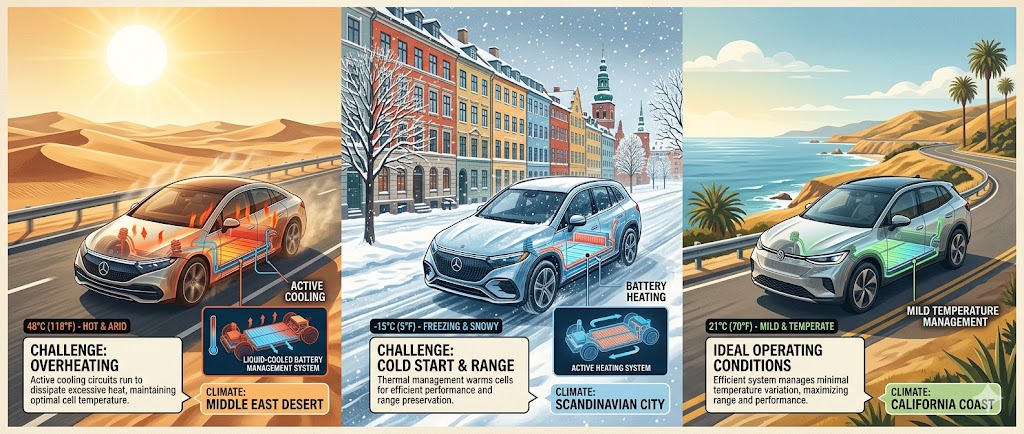
In hot climates — the Middle East, South and Southeast Asia, the American Southwest, parts of Australia, and sub-Saharan Africa — the primary challenge is keeping the battery from overheating. Ambient temperatures regularly exceed 40°C (104°F), and a vehicle parked in direct sunlight can see interior temperatures surge far higher. Even before the driver turns the key, the battery is already operating above its ideal range.
Under these conditions, the thermal management system must work continuously — sometimes even when the vehicle is parked and plugged in — to keep the pack from cooking. Fast charging, which generates substantial heat in its own right, becomes particularly stressful in hot weather, as the system must simultaneously remove the heat of charging and the heat absorbed from the hot environment. Studies of real-world EV battery degradation consistently show accelerated capacity loss in hotter climates when thermal management is inadequate.
Several automakers have responded by implementing "thermal preconditioning" features that allow the car to cool the battery to an optimal temperature before a scheduled charging session begins — drawing power from the grid rather than from stored battery energy. This seemingly simple feature can meaningfully reduce the degradation impact of repeated fast charging in hot environments.
Cold Climates: The Battle Against the Freeze
In cold climates — northern Europe, Canada, Russia, and high-altitude regions worldwide — the challenge flips. At temperatures below 0°C (32°F), lithium-ion batteries lose a significant fraction of their usable capacity, not because the energy is gone but because the electrochemical reactions simply slow down. EV drivers in Oslo, Helsinki, or Quebec know this reality well: a car that delivers 400 km of range on a mild autumn day might manage only 280 km when temperatures plunge to -20°C (-4°F).
The thermal management system addresses this by heating the battery before use — a process that consumes energy but is essential for both performance and longevity. Heating the pack before a drive improves range; heating it before charging is even more critical, because charging a cold lithium-ion battery is one of the fastest ways to cause permanent damage. Many modern EVs will refuse to accept fast charging currents until the battery has been warmed to a safe temperature, and the best implementations will automatically begin warming the pack when the driver sets a navigation destination that includes a fast-charging stop.
Temperate Climates: Don't Be Complacent
Owners in temperate climates might assume their batteries lead a charmed life, free from the extremes of desert heat or Arctic cold. And it's true that mild conditions are gentler on battery chemistry. But thermal management still matters here, because the stresses aren't always about ambient temperature. High-power fast charging, aggressive driving, and even regenerative braking can generate significant internal heat regardless of the weather outside. A well-designed thermal management system is what prevents these localized heat spikes from becoming damaging events.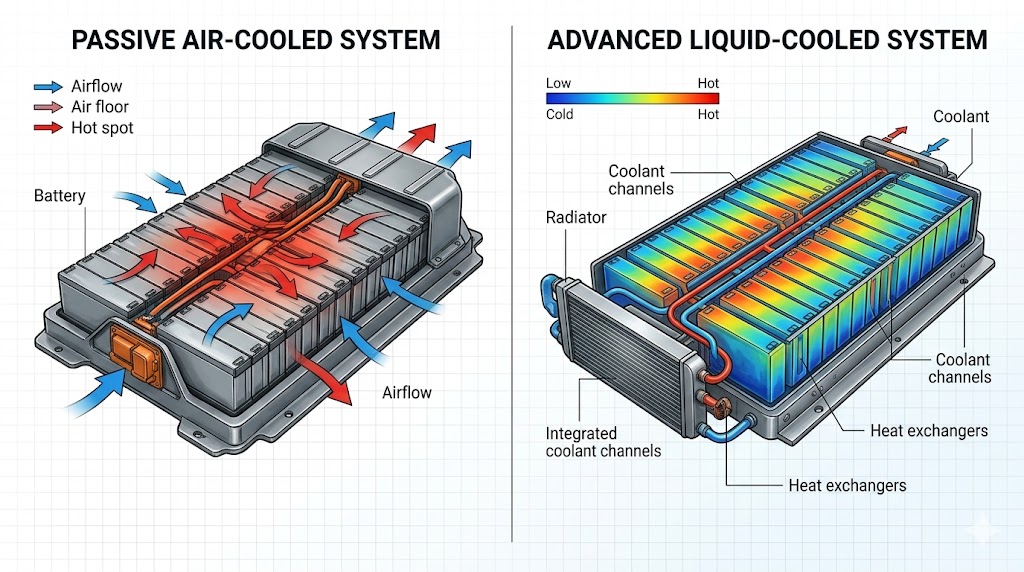
Seasonal Rhythms: How Your Battery Experiences the Year
Beyond geography, time — specifically the seasons — plays a profound role in how thermal management systems are stressed. An EV in a region with true four-season weather will cycle through dramatically different thermal conditions over the course of a year, and the cumulative effect of these cycles is a major determinant of long-term battery health.
Summer brings the double threat of ambient heat and increased air conditioning use (which increases the electrical load on the battery, generating more internal heat). The combination is particularly demanding for the thermal management system. Conversely, winter brings reduced range, increased heating loads, and the risks of cold-temperature charging. Spring and autumn are the battery's most comfortable seasons — and if you live somewhere with genuine seasons, this is when your battery ages most gracefully.
This seasonal variation has practical implications for owners. Experts generally recommend keeping the battery's state of charge lower during hot weather (heat degrades batteries faster at high states of charge) and avoiding leaving the car parked in direct sunlight for extended periods in summer. In winter, pre-conditioning the battery while still connected to a charger — rather than using stored battery energy to warm up — preserves range and reduces thermal stress.
The Real-World Impact: What Good Thermal Management Means for You
The practical consequences of effective thermal management are substantial. Studies comparing real-world battery degradation across different EV models have found striking differences that correlate strongly with the quality of the thermal management system. Vehicles with active liquid cooling systems typically show far less capacity fade over the first 100,000 miles than those relying on passive or air-based cooling, particularly in challenging climates.
For the average owner, this translates into a battery that retains more of its original range after five or eight years of ownership — and potentially the difference between needing a costly battery replacement before the end of the vehicle's useful life or not. Given that replacement battery packs can cost several thousand dollars, effective thermal management is not merely a technical nicety but a significant financial consideration.
There's also the matter of fast-charging capability. Batteries that have been well-maintained thermally accept fast charging more readily, maintain higher peak charging rates for longer into the charge session, and do so with less damage. In other words, good thermal management isn't just about longevity — it's about keeping the day-to-day experience of owning and using an EV as smooth and convenient as possible.
Tips for Owners: Working With Your Thermal Management System
You can't replace your car's thermal management hardware, but you can work with it rather than against it. A few habits make a meaningful difference:
- Use scheduled charging during cooler hours of the day in summer, and allow the car to pre-condition the battery before charging in winter.
-
Park in shade or a garage when temperatures are extreme — even a few degrees of ambient temperature reduction reduces the workload on the cooling system.
-
Take advantage of navigation-linked charging preconditioning if your vehicle offers it — this feature exists precisely to protect your battery during fast-charging stops.
-
Avoid routinely charging to 100% in hot weather; a charge limit of 80–90% reduces the heat stress on a full-to-bursting cell.
-
In cold climates, use remote start or preconditioning features to warm the cabin (and battery) while still plugged in before departure.
Conclusion: The Invisible Guardian of Your EV's Future
Battery thermal management is one of those technologies that works best when you don't notice it — quietly ensuring that every charge cycle, every fast-charging session, and every drive happens within conditions that protect the long-term health of the most valuable component in your car. But just because it's invisible doesn't mean it's unimportant.
Whether you drive in the baking heat of Arizona, the frozen landscapes of Finland, or the reliably mild streets of San Francisco, the principles are the same: keep the cells at the right temperature, minimize thermal stress during charging and discharging, and the battery will reward you with years of faithful service. Neglect the thermal environment, and degradation accelerates in ways that are difficult to reverse.
As EV technology continues to mature, thermal management systems will only become more sophisticated — smarter algorithms, better materials, tighter integration with charging infrastructure. But even today's systems, when used intelligently by informed owners, are capable of delivering battery packs that age gracefully and retain their performance for the long haul. Understanding why thermal management matters is the first step toward making the most of it.