
If you've ever wondered why electric vehicles run on lithium batteries specifically, you're not alone. It's one of those questions that sounds simple but opens up a surprisingly deep conversation about chemistry, engineering, and the realities of building something that actually works in the real world. The short answer is that lithium batteries happen to check all the right boxes for what a car needs. But let's dig into why that actually matters.
First, a Quick Word on What We're Actually Talking About
When people say "lithium battery," they usually mean lithium-ion batteries — a family of rechargeable batteries that store and release energy through the movement of lithium ions between two electrodes. There are several variations within this family, including lithium iron phosphate (LFP) and nickel manganese cobalt (NMC), and different EV manufacturers favor different chemistries depending on their priorities. But the underlying principle is the same across the board, and so are the core reasons they've become the go-to choice for electric vehicles.
Energy Density: Getting the Most Out of Every Pound
One of the biggest challenges in building an electric vehicle is the simple fact that a car is heavy. Add a battery, and you're adding even more weight. That's why energy density — how much energy you can pack into a given weight — is absolutely critical.
Lithium-ion batteries are among the best in the business when it comes to this. Compared to older technologies like nickel-metal hydride (NiMH) or lead-acid batteries, lithium-ion can store significantly more energy for the same amount of weight. This means an EV can carry a reasonably sized battery pack without becoming so heavy that performance and range suffer dramatically.
Think of it like packing for a trip. You want to bring everything you need, but you also don't want to be lugging around a suitcase that weighs more than you do. Lithium batteries let automakers pack in plenty of energy without the vehicle becoming impossibly heavy. Early EVs that used lead-acid batteries had terrible range partly for this reason — the batteries were just too heavy relative to how much energy they stored.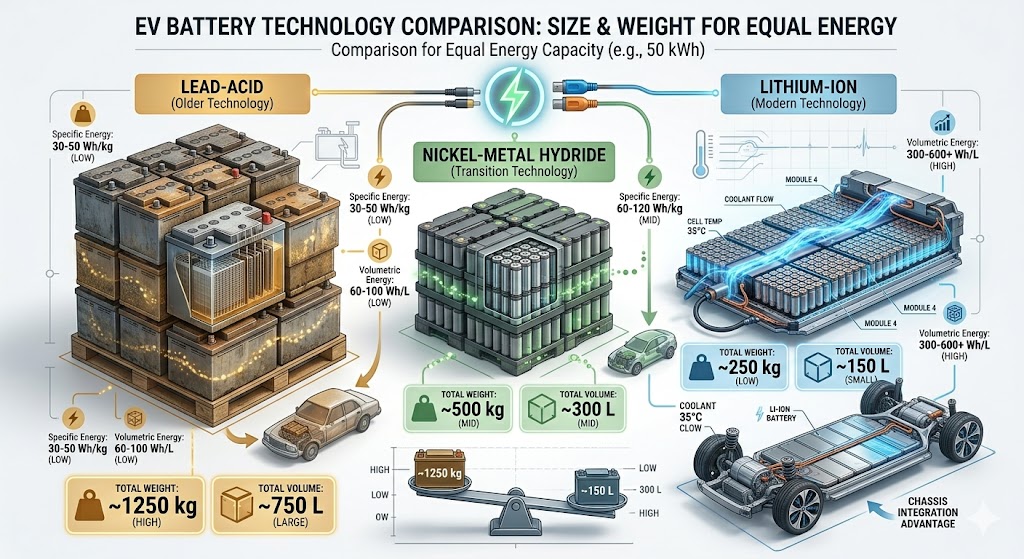
High Voltage Capability
Lithium has some useful electrochemical properties that allow lithium-ion cells to operate at a higher voltage per cell compared to alternatives. A typical lithium-ion cell runs at around 3.6 to 3.7 volts, while a NiMH cell operates closer to 1.2 volts. This might not sound like a huge deal, but it means you need fewer cells to achieve the same total voltage in a battery pack — and fewer cells generally means fewer potential points of failure, simpler engineering, and lighter weight.
For electric vehicles, which often run their drivetrain at hundreds of volts, this is a meaningful advantage. It translates into cleaner, more efficient systems that are easier to engineer and maintain.
Charging and Discharging Efficiency
An EV battery needs to do two things well: charge up quickly (or at least reasonably quickly), and discharge power smoothly and reliably when you need it. Lithium-ion batteries are genuinely good at both.
The round-trip efficiency of a lithium-ion battery — meaning how much of the energy you put in actually comes back out — is typically above 90%. That's quite high compared to other battery technologies. Lead-acid batteries, for instance, might only give you back 70 to 80% of what you put in. Over the lifetime of a vehicle, that difference adds up.
On the charging side, lithium batteries can accept relatively high charge rates, especially with modern fast-charging technology. While there are limits — charging too fast can stress the cells and reduce their lifespan — the technology has improved enormously, and modern EVs can recover significant range in 20 to 30 minutes at a high-power DC charger. That would simply not be possible with many other battery chemistries.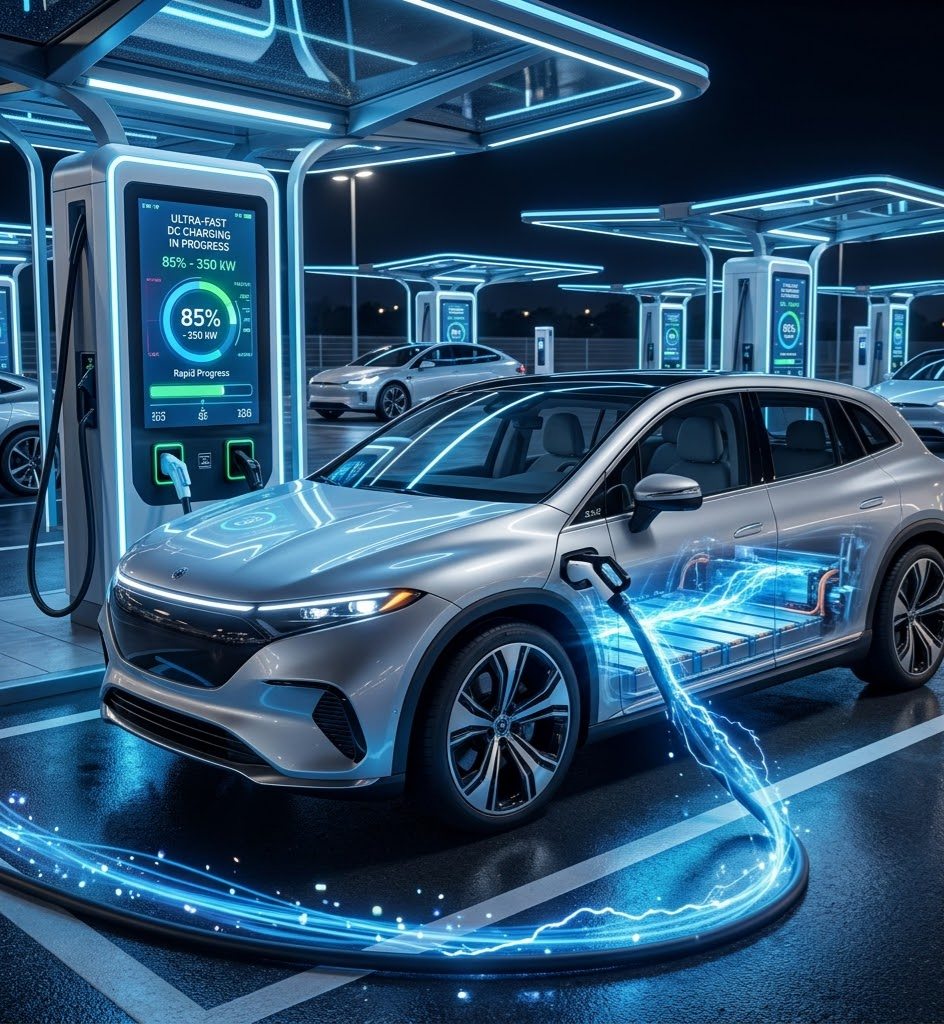
Long Cycle Life
A battery that wears out quickly is going to be a major problem in any application, but especially in a vehicle that people expect to last for years and drive for hundreds of thousands of miles. Lithium-ion batteries hold up reasonably well over many charge and discharge cycles — depending on the chemistry and how they're managed, they can go through hundreds or even thousands of cycles before capacity degrades to the point where it becomes a serious concern.
Battery management systems in modern EVs do a lot of work here, carefully monitoring temperature, charge rate, and depth of discharge to keep the cells in optimal condition and extend their useful life. The combination of inherently durable chemistry and smart management means most EV batteries last far longer than early skeptics predicted. Real-world data from fleet operators and long-term EV owners has shown many battery packs retaining 80% or more of their original capacity after well over 100,000 miles.
No Memory Effect
If you've ever used older rechargeable batteries — the kind that came with power tools or early cordless phones — you may remember the "memory effect." This was a frustrating phenomenon where batteries lost capacity if they weren't fully discharged before being recharged. NiMH batteries could suffer from a mild version of this.
Lithium-ion batteries don't have this problem. You can plug in your EV whenever you want, top it off from 40% to 80%, or charge it all the way to full — it doesn't matter. There's no penalty for partial charging in terms of memory effect. This makes EVs much more practical to live with day-to-day, since you don't need to follow any special charging rituals to keep the battery healthy.
Wide Temperature Operating Range (With Some Caveats)
Lithium-ion batteries work across a relatively wide range of temperatures, which is important for a vehicle that needs to function whether you're in a hot desert or a cold northern winter. That said, extreme temperatures do affect performance — cold weather in particular can temporarily reduce range and charging speed, and heat can accelerate long-term degradation.
Modern EV manufacturers have invested heavily in thermal management systems — essentially heating and cooling systems for the battery pack — to keep lithium cells operating within their ideal temperature window. This is one of the reasons why well-engineered EVs tend to handle cold weather significantly better than simpler or cheaper designs: the thermal management is doing a lot of work behind the scenes.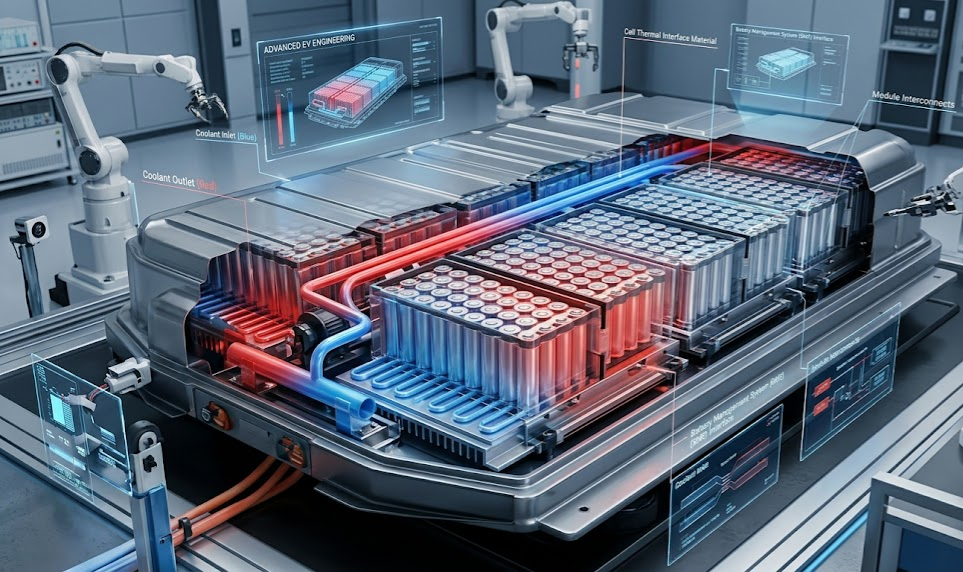
Scalability and Manufacturing Maturity
Here's something that doesn't get talked about enough: lithium-ion battery technology has been around in consumer electronics since the early 1990s. Decades of manufacturing experience, supply chain development, and continuous improvement have made these batteries available at scale in a way that simply isn't true for newer or more exotic battery chemistries.
When automakers started making EVs in earnest, they were able to draw on an existing industrial base for lithium-ion cells. Companies that had been making batteries for laptops and smartphones could adapt their processes and scale up for automotive applications. This is enormously valuable — it's one thing to make a battery chemistry work in a lab, and quite another to manufacture billions of cells reliably and affordably.
The cost of lithium-ion battery packs has fallen dramatically over the past fifteen years, dropping from over $1,000 per kilowatt-hour in the early days of modern EVs to well under $150 per kilowatt-hour in recent years. Much of this cost reduction has come from manufacturing scale and process improvements — exactly the kind of progress that comes from years of dedicated industry development.
Ongoing Innovation Within the Chemistry
One underappreciated aspect of lithium-ion technology is how much room there is for variation and improvement within the basic framework. Different cathode materials — like iron phosphate, nickel manganese cobalt, or nickel cobalt aluminum — offer different trade-offs between energy density, safety, cost, and longevity. Researchers and manufacturers are continuously refining these chemistries.
Solid-state lithium batteries, which replace the liquid electrolyte in conventional lithium-ion cells with a solid material, are widely seen as a promising next step. They could offer higher energy density, improved safety, and longer cycle life. Several automakers and battery companies are working toward commercializing solid-state batteries for vehicles, though significant engineering and manufacturing challenges remain.
The point is that choosing lithium-ion wasn't a dead end — it opened a rich technology pathway that continues to evolve.
Are There Downsides?
It would be unfair to talk about why lithium batteries are used in EVs without acknowledging the challenges. Lithium mining raises environmental and social concerns, particularly in regions where it's extracted under difficult conditions. The supply chain for materials like cobalt has also faced scrutiny. The industry is actively working on reducing reliance on problematic materials, developing lower-cobalt and cobalt-free chemistries, and improving battery recycling infrastructure.
There's also the raw cost. Even with dramatic price drops, battery packs still represent a significant portion of an EV's total cost. Bringing that down further remains one of the most important goals in the industry.
And then there's the question of what comes after lithium-ion. Sodium-ion batteries are attracting attention as a potentially cheaper alternative for some applications. Lithium-sulfur and lithium-air chemistries promise even higher energy densities but face serious practical obstacles. The future may look different from today, and that's not a bad thing.
Putting It All Together
So why do electric vehicles use lithium batteries? Because when you stack up all the things a car battery needs to do — store a lot of energy without too much weight, charge reasonably fast, last for years of daily use, work across varying temperatures, and be available at the scale needed for mass production — lithium-ion technology delivers on all of them better than the alternatives currently available.
It wasn't an arbitrary choice. Automakers, engineers, and battery scientists converged on lithium-ion because the evidence pointed there. And as the technology continues to improve, those advantages are only likely to grow.
The lithium battery isn't just a component in an electric vehicle. It's the heart of a new kind of transportation — one that's still evolving, but already delivering on its promise for millions of drivers around the world.