
In modern electronic device charging systems, temperature sensors play a crucial role. With the widespread adoption of lithium-ion batteries and fast charging technologies, temperature monitoring has become a key factor in ensuring charging safety, extending battery life, and optimizing charging efficiency. This article will explore in depth the multiple roles of temperature sensors in chargers and provide a detailed comparison of their different application characteristics in batteries versus charger units.
Basic Functions of Temperature Sensors
Safety Protection Function
The primary task of temperature sensors in charging systems is to provide safety protection. Heat is generated during the charging process, and if temperature exceeds safety thresholds, it may lead to battery damage, performance degradation, or even serious safety incidents such as fire or explosion. Temperature sensors monitor temperature changes in real-time, and when abnormal temperature rises are detected, they immediately trigger protection mechanisms, cutting off charging current or reducing charging power to prevent potential hazards.
Charging Efficiency Optimization
Temperature sensors also shoulder the important responsibility of optimizing charging efficiency. The battery's charging acceptance is closely related to temperature. Within an appropriate temperature range (typically 15-45°C), batteries can accept higher charging currents, enabling fast charging. By monitoring temperature data, chargers can dynamically adjust charging parameters to maximize charging speed and reduce charging time while ensuring safety.
Battery Life Extension
Long-term temperature management has a significant impact on battery life. High temperatures accelerate internal chemical reactions in batteries, leading to capacity degradation and shortened cycle life. Through continuous monitoring, temperature sensors help chargers implement gentle charging strategies, preventing batteries from remaining at high temperatures for extended periods, thereby effectively extending battery service life.
Temperature Sensors Applied to Batteries
Installation Location and Characteristics
Battery temperature sensors are typically installed directly inside battery cells or battery packs, in close contact with the cells or embedded within the battery pack. Common installation methods include adhering to the battery surface, placing near battery tabs, or integrating into the Battery Management System (BMS) circuit board. This arrangement ensures that sensors can accurately measure the actual temperature of the battery body.
Monitoring Target
The primary monitoring object of battery temperature sensors is the cell temperature. During charging, complex electrochemical reactions occur inside the battery, especially during high-current charging, generating substantial Joule heat and reaction heat. Sensors need to capture these temperature changes in real-time to provide accurate data for charging control.
Response Characteristics
Due to direct contact with the battery, these sensors respond relatively quickly to battery temperature changes, typically reflecting the true temperature state of the battery within seconds. This is particularly important for fast charging scenarios, as temperature can rise rapidly in a short period.
Control Strategy
Based on data from battery temperature sensors, chargers can implement multi-level temperature protection strategies. For example, when battery temperature reaches 40°C, reduce charging current; at 45°C, switch to trickle charge mode; and above 50°C, stop charging completely. Some advanced systems also predict temperature rise trends based on temperature curves and adjust charging parameters in advance.
Typical Application Scenarios
Battery temperature sensors are widely used in electric vehicles, smartphones, laptops, and other devices. Taking electric vehicles as an example, a battery pack may contain dozens or even hundreds of temperature sensors distributed at different locations, forming a complete thermal management network to ensure that each battery module operates within a safe temperature range.-6.jpg?w=1024&h=1024)
Temperature Sensors Applied to Chargers
Installation Location and Characteristics
Charger temperature sensors are primarily installed near critical heat-generating components within the charger, including power conversion circuits, power semiconductor devices (such as MOSFETs, diodes), transformers, and rectifier bridges. These sensors monitor the operating temperature of the charger itself, not the battery temperature.
Monitoring Target
Charger temperature sensors focus on the temperature of electronic components inside the charger. During operation, the charger generates considerable heat due to losses in the power conversion process. Especially in high-power charging scenarios, the temperature of power devices may rise rapidly, threatening the reliability and safety of the charger.
Response Characteristics
The response characteristics of charger temperature sensors depend on their distance from the heat source and thermal conduction path. Typically, these sensors have relatively slower response speeds because heat needs to conduct from the heating element to the sensor location. However, through proper thermal design and sensor placement, abnormal temperature rises can still be detected in time.
Control Strategy
Control strategies based on charger temperature primarily protect the charger itself. When the charger temperature is detected to be too high, the system will reduce output power to minimize heat generation or activate cooling fans to enhance heat dissipation. In extreme cases, over-temperature protection is triggered, pausing charging until the temperature drops to a safe range.
Typical Application Scenarios
Charger temperature sensors are applied in various charging devices, from small phone chargers to high-power industrial charging stations. For example, fast charging adapters typically contain multiple temperature sensors inside, monitoring the operating temperatures of different power stages to ensure that the charger will not overheat and be damaged during continuous high-power output.-16.jpg?w=1024&h=1024)
Comparative Analysis of Battery and Charger Temperature Sensors
Difference in Monitoring Objects
This is the most fundamental difference between the two. Battery temperature sensors monitor the temperature of the object being charged, reflecting the thermal state of the battery, while charger temperature sensors monitor the temperature of the power supply device, reflecting the operational state of the charger itself. The two are independent yet work synergistically to form a complete thermal management system.
Different Safety Concerns
The safety concerns of battery temperature sensors focus on preventing thermal runaway, combustion, or even explosion risks caused by battery overheating, which directly relates to user personal safety. Charger temperature sensors primarily focus on equipment damage risks, preventing chargers from failing or having shortened lifespans due to overheating. While this also involves safety, the degree of harm is relatively lower.
Temperature Threshold Settings
Due to different monitoring objects and material characteristics, the temperature threshold settings for the two differ. Battery temperature sensor alarm thresholds are typically set between 45-60°C, as lithium battery performance significantly deteriorates at high temperatures. Charger temperature sensor thresholds may be set at 70-90°C or even higher, as electronic components typically have better temperature resistance than batteries.
Data Processing Methods
Battery temperature data is typically processed by the Battery Management System (BMS), which comprehensively considers temperature, voltage, current, and other parameters to make charging decisions. Charger temperature data is primarily processed by control chips inside the charger, directly affecting the charger's output power regulation. The two systems may exchange information through communication protocols to achieve coordinated control.
Impact on Charging Performance
Battery temperature has a more direct and significant impact on charging performance. Low battery temperatures lead to slower charging speeds, while excessively high temperatures require reduced charging power. Charger temperature primarily affects its continuous power supply capability; when temperature rises, it may not maintain rated output power, but does not directly change charging strategies.
Sensor Type Selection
Different types of temperature sensors may be selected for the two application scenarios. Battery temperature sensors commonly use NTC thermistors or thermocouples, requiring small size, fast response, and high accuracy. Charger temperature sensors also commonly use NTC, but sometimes select semiconductor temperature sensors or bimetallic thermal switches, considering the balance between cost and reliability.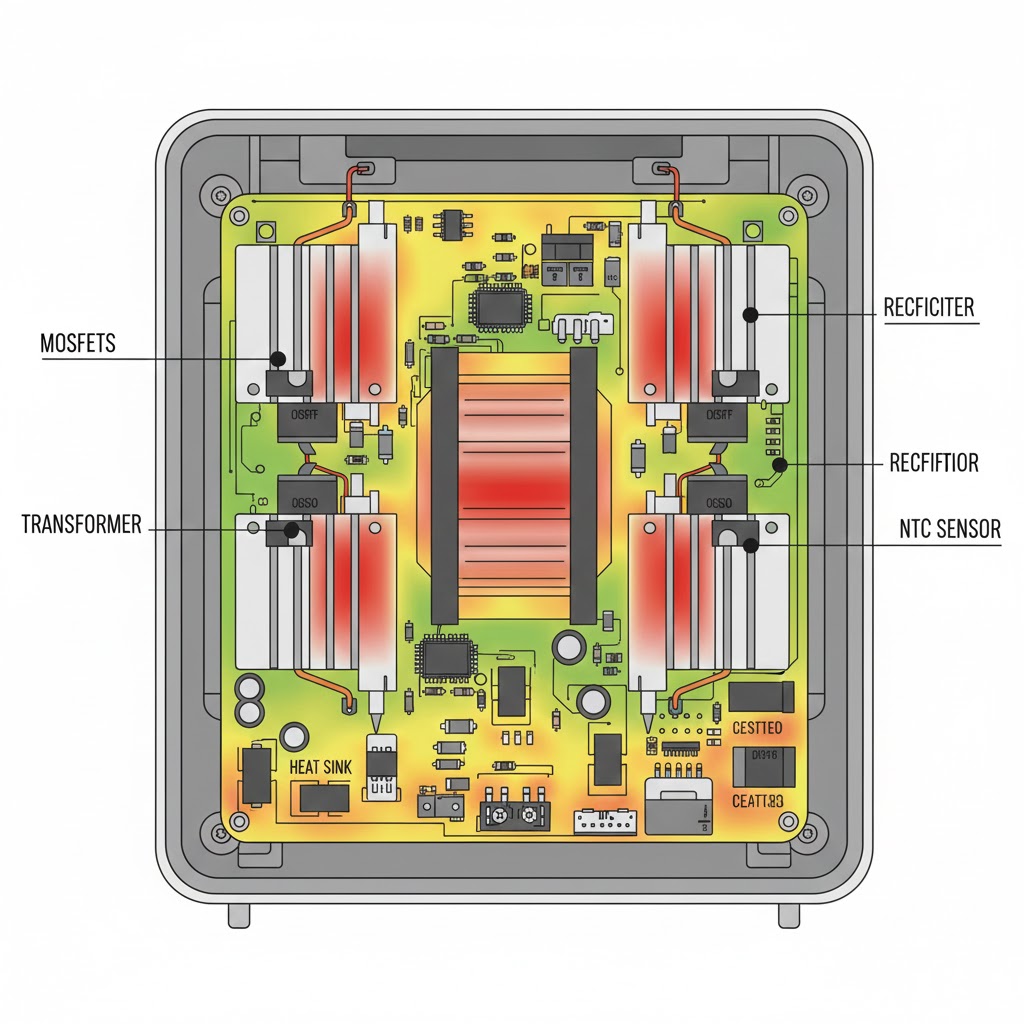
Collaborative Working Mechanism
In actual charging systems, temperature sensors for batteries and chargers do not work in isolation but form a collaborative monitoring network. Advanced charging systems adopt intelligent communication protocols (such as USB PD, fast charging protocols, etc.), enabling chargers and devices to exchange temperature information. For example, when battery temperature rises, the BMS notifies the charger to reduce output current; when the charger temperature is too high, it also proactively reduces output power, thus achieving temperature control at both levels.
Future Development Trends
With technological advancement, temperature sensing and management are moving toward more intelligent and precise directions. Multi-point temperature monitoring, temperature prediction algorithms, and adaptive thermal management technologies are becoming widespread. Future charging systems may integrate more sensors and employ artificial intelligence algorithms to analyze temperature data, achieving more refined temperature control and finding the optimal balance among safety, speed, and lifespan.
Conclusion
Temperature sensors play an irreplaceable role in both charger and battery systems. Although temperature sensors applied to batteries and chargers show significant differences in monitoring objects, safety concerns, and control strategies, they jointly constitute the safety defense line and performance optimization foundation of modern charging systems. Understanding the characteristics and differences of these two types of temperature sensors is of great significance for designing safer and more efficient charging solutions. With the continuous development of electrification and fast charging technologies, the importance of temperature sensing and thermal management technologies will become increasingly prominent, which will also drive continuous innovation and improvement of related technologies.