
Summer is an exciting time to hit the road. Road trips, beach days, weekend escapes — your electric vehicle is ready for all of it. But as the mercury rises, so do a few unique challenges that every EV owner should be aware of. Heat affects your battery, your charger, and even how long it takes to top up your vehicle. The good news? With a little preparation and the right habits, you can charge confidently all summer long.
This guide walks you through everything you need to know — from understanding why heat matters, to practical tips you can start using today. Think of it as a friendly conversation with someone who has already figured out the summer charging game, and wants to share what works.
Why Summer Heat Affects Your EV Differently
Before we dive into the tips, it helps to understand what is actually going on beneath the floor of your car — where the battery lives.
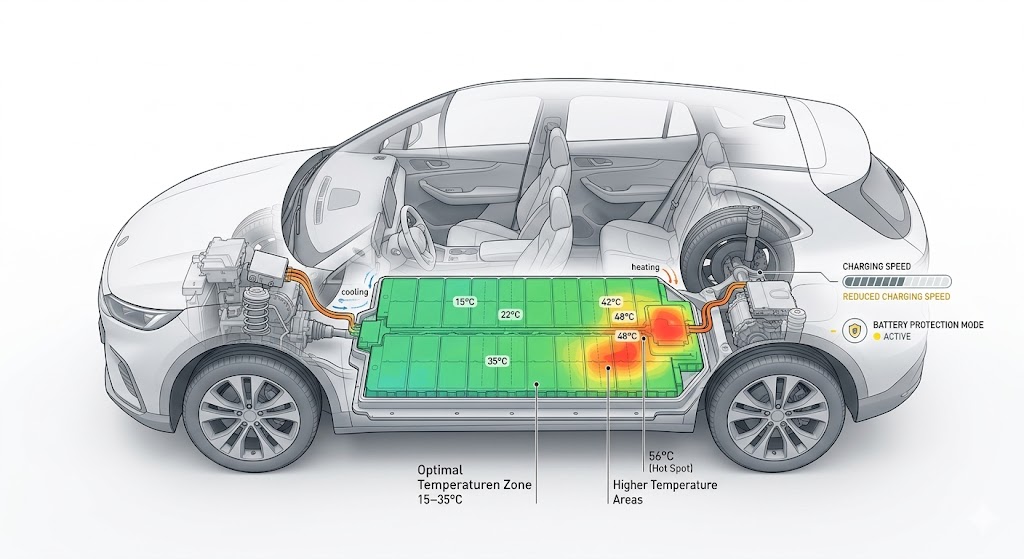
Electric vehicle batteries are remarkably sophisticated, but they have a comfort zone, much like you do. The ideal operating temperature for most lithium-ion battery packs sits between 59°F and 95°F (15°C–35°C). Once temperatures push above that range — which happens regularly during a summer afternoon in many regions — the battery management system (BMS) steps in to protect the pack.
This protection can mean slower charging speeds, reduced range estimates, or temporary limits on how much power the car will accept. None of these are signs that something is wrong. They are the system working exactly as intended. Knowing this in advance means you will not be caught off guard when your charging session takes a little longer than usual on a hot July afternoon.
Tip 1: Pre-Condition Your Battery Before You Charge
One of the smartest habits you can build in summer — and one that many EV owners never think to use — is battery pre-conditioning.
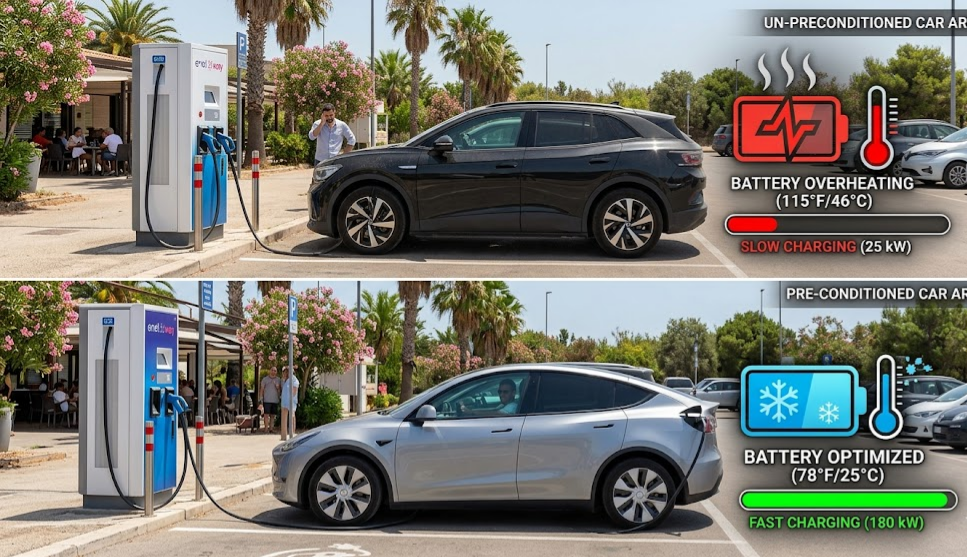
Most modern electric vehicles let you pre-condition the battery remotely through the car's companion app or a scheduled departure setting. In winter, this warms the battery up. In summer, it brings the temperature down to an optimal range before you begin charging.
Why does this matter? A battery that arrives at a charger already overheated will throttle its own charging speed to prevent damage. A pre-conditioned battery, by contrast, is ready to accept power efficiently from the very first minute — saving you time and reducing wear on the cells.
Tip 2: Choose the Right Time of Day to Charge
Timing your charge sessions around the heat of the day is not just good for your battery — it can save you real money too.
In many regions, electricity rates follow time-of-use pricing, with peak rates during the hottest part of the afternoon (typically 2 PM to 8 PM). Charging in the early morning, when temperatures are cooler and grid demand is lower, is often both cheaper and gentler on your battery.
For overnight home charging, set your vehicle to complete its charge just before your planned morning departure. This way, the battery finishes at full capacity right when you need it, rather than sitting at 100% for hours in the heat — which is not ideal for long-term battery health.
Tip 3: Seek Shade and Covered Charging Stations
It sounds almost too simple, but where you park while charging makes a genuine difference.
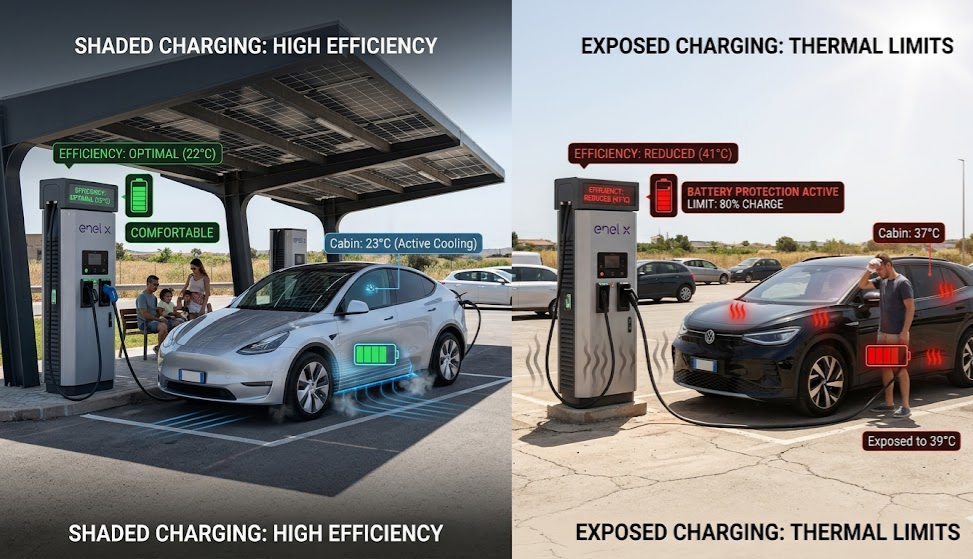
A car sitting in direct sunlight on a hot summer day can see interior and battery temperatures climb significantly higher than the ambient air temperature. If you have the option between a shaded charging spot and an exposed one, always choose shade — even if it means walking a few extra steps.
When using public charging networks, look for stations located in parking garages, under canopies, or alongside buildings that block the afternoon sun. Some newer charging installations are being designed with overhead shade structures specifically because operators understand the impact of heat on charging efficiency and driver comfort.
At home, if you have the ability to park in a garage or carport, make that your default charging setup during summer months.
Tip 4: Avoid Charging to 100% on Hot Days
For everyday driving, most EV manufacturers recommend keeping your battery between 20% and 80% state of charge. This range is often called the "sweet spot" for battery longevity — and it becomes especially relevant during summer.
A battery sitting at 100% charge in high heat experiences more electrochemical stress than one sitting at 80%. If you are not about to embark on a long trip that requires a full charge, there is simply no reason to max it out. Set your charge limit to 80% and let the car handle the rest.
For road trips where a full charge is genuinely needed to reach your next destination comfortably, absolutely go for it — just try to time your departure so you are not sitting in a hot parking lot for hours after the car finishes charging.
Tip 5: Know Your Charger's Limits in Extreme Heat
It is not just your battery that can be affected by summer heat — the charging equipment itself operates within temperature parameters as well.
DC fast chargers generate significant heat during operation. On extremely hot days, some units may automatically reduce output power to prevent overheating of their internal components. This is normal behavior designed to protect both the charger and your vehicle. If you notice a slower-than-expected charge rate at a public station on a very hot day, this could be why.
Level 2 home chargers are generally more resilient to heat, but even they benefit from being installed in shaded or ventilated locations. If your home charger is mounted outside and receives direct afternoon sun, consider adding a simple shade cover or repositioning it if possible.
Tip 6: Keep an Eye on Your Battery Health Indicator
Summer is a good time to take stock of your battery's overall health. Most EVs display a battery health or state-of-health (SoH) figure somewhere in the settings menu or companion app. This number tells you what percentage of original capacity your battery retains.
A small amount of degradation over the life of an EV is entirely normal. But if you notice a more significant drop — especially after a particularly hot season — it is worth having your vehicle's battery inspected by a certified technician. Many manufacturers offer battery health checks at no charge during warranty periods.
Staying aware of your battery's condition is not about anxiety — it is about making informed decisions. Knowing your car's range is reliable and predictable makes every summer drive more enjoyable.
Tip 7: Plan Your Road Trips Around Charging Stops
Long summer road trips are one of the great joys of EV ownership, but they require a bit more planning than a quick overnight charge. Heat reduces range — sometimes by 10 to 20 percent depending on the vehicle and conditions — so build that buffer into your trip planning.
Use your vehicle's built-in navigation or a dedicated EV trip planner app to map out charging stops in advance. Look for stations with amenities nearby — a coffee shop, a shaded picnic area, or an air-conditioned waiting room. This way, charging stops become part of the trip experience rather than an interruption.
One helpful mindset shift: think of charging stops the way you think about gas station breaks on a traditional road trip. You stop, you stretch, you grab a snack, and then you are back on the road. With the efficiency of modern fast chargers, a 20–30 minute stop can add 100 to 200 miles of range. Not bad for the time it takes to finish a coffee.
Tip 8: Stay Cool While You Charge
This one is for you, not just your car. Waiting in a vehicle with the engine off — or even with climate control running — while it charges on a hot summer day is uncomfortable at best and potentially unsafe at worst.
If you are charging at home, go inside and enjoy the air conditioning. At a public station, look for nearby shade, a café, or a shopping center where you can wait comfortably. Many EV apps will notify you when your charge is complete so you do not have to hover near the car.
If you do stay in the vehicle while charging, be aware that running the air conditioning at full blast will draw power from the battery and slow your net charge rate. It is a trade-off, but sometimes comfort wins — and that is perfectly fine.
A Final Word: Summer and Your EV Are a Great Match
Electric vehicles are genuinely well-suited to summer driving. They are quiet, smooth, and emit no exhaust — making them a pleasure on warm-weather roads. The challenges that heat presents are real, but they are manageable with a little awareness and preparation.
Think of the tips in this guide not as restrictions, but as good habits that happen to be most important in summer. Pre-condition before fast charging, charge during cooler hours, seek shade, and keep your daily charge limit around 80%. Follow these practices, and your EV will reward you with reliable, efficient performance all season long.
Enjoy the sunshine, enjoy the open road, and charge smart. Summer driving in an electric vehicle is one of the best experiences on the road today — and now you are fully prepared to make the most of it.