
The rapid expansion of electric vehicle adoption has created an increasing demand for flexible charging solutions that extend beyond traditional home installations. Portable EV chargers have emerged as essential accessories for modern electric vehicle owners, providing a practical answer to charging anxiety and offering convenience for those who travel frequently or lack access to fixed charging infrastructure. Unlike stationary home charging stations that remain permanently installed, portable EV chargers can be stored in your vehicle and deployed whenever needed, making them invaluable for road trips, emergency situations, and supplementary charging at unfamiliar locations.
Portable EV chargers operate on AC (alternating current) principles, similar to standard home charging systems but in a mobile format. Understanding how to properly select, install, and use these devices is critical for maximizing their benefits while maintaining safety and efficiency. This comprehensive guide explores the essential aspects of portable EV chargers, from their specifications and features to practical usage guidelines and maintenance recommendations.
Understanding Portable EV Charger Types and Power Levels
Level 1 and Level 2 Charging
Portable EV chargers are classified into two primary categories based on their power delivery capabilities: Level 1 and Level 2 charging systems. Level 1 chargers operate at 120 volts (single-phase) in North America and are typically the slowest option, adding approximately 3-5 miles of driving range per hour of charging. These chargers use standard household outlets without any special installation requirements, making them convenient for emergency situations or temporary charging scenarios.
Level 2 chargers, by contrast, operate at 240 volts and deliver significantly faster charging speeds, typically providing 12-32 miles of driving range per hour depending on the amperage and charger specifications. Most modern portable EV chargers fall into the Level 2 category, as this power level offers a practical balance between charging speed and accessibility. A Level 2 charger can typically restore a depleted battery to full capacity overnight, making it suitable for daily use and extending your vehicle's operational range considerably.
Power Output Specifications
Modern portable EV chargers come in various power configurations ranging from 3.5 kW to 22 kW, depending on their design specifications and intended applications. Entry-level portable chargers typically offer 3.5-7 kW output power with adjustable current settings ranging from 8 to 16 amperes. Mid-range models provide 7-11 kW output with current adjustments up to 32 amperes, while professional-grade portable chargers can deliver up to 22 kW using three-phase power systems with current settings reaching 32 amperes.
The relationship between voltage, amperage, and power output is fundamental to understanding charger performance. Most portable chargers feature adjustable current settings, allowing users to match the charger output to their local electrical infrastructure and vehicle requirements. This flexibility ensures compatibility with various power supplies while preventing potential electrical hazards from exceeding circuit capacity limits.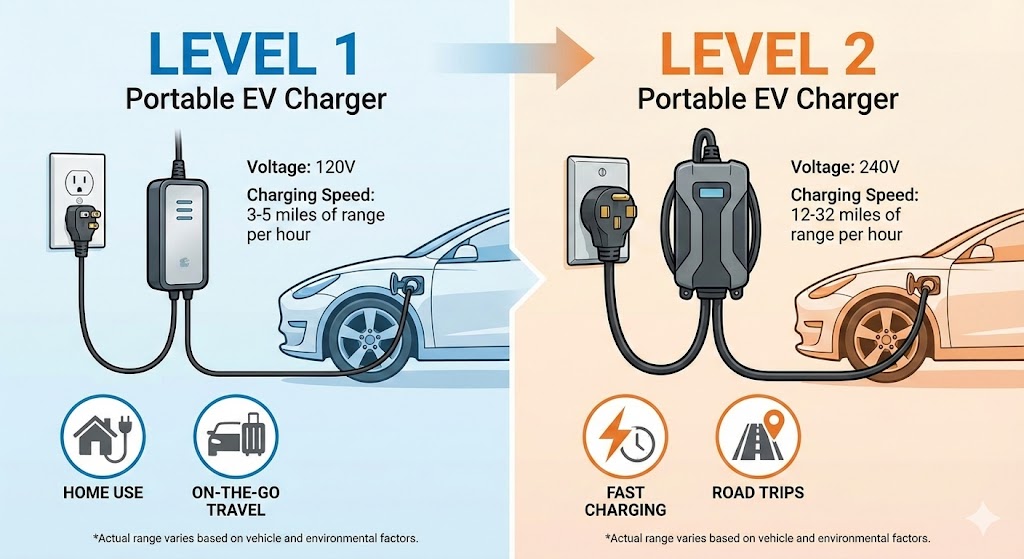
Essential Features and Technical Specifications
Display and Control Systems
Quality portable EV chargers incorporate sophisticated display and control systems that provide real-time charging information and user-friendly operation. Most modern models feature 1.8 to 2.8-inch LCD screens that display critical charging parameters including voltage readings, current flow, real-time temperature monitoring, power consumption in kilowatts, and remaining charging time. The control interface typically includes physical buttons for adjusting charging current, setting delayed charging times, and programming specific charging durations.
These display systems serve a dual purpose: they communicate the charger's operational status and allow users to monitor charging progress remotely. Real-time temperature monitoring is particularly important for safety, as it enables the charger to detect thermal anomalies and trigger protective systems when operating temperatures approach dangerous levels.
Smart Connectivity and App Control
Contemporary portable EV chargers increasingly incorporate Wi-Fi and Bluetooth connectivity features, enabling remote monitoring and control through dedicated mobile applications. Smart app integration allows users to schedule charging sessions during off-peak electricity hours, adjust charging parameters from their smartphone, receive notifications when charging completes, and track cumulative energy consumption. This connectivity feature is particularly valuable for users seeking to optimize electricity costs by charging during periods of lower utility rates.
The wireless connectivity functionality typically requires connection to a home or local Wi-Fi network for initial device configuration and operation. Users can download manufacturer-provided applications or compatibility with third-party smart home platforms that recognize standard protocols. Delay charging functionality permits users to program the charger to begin operation at a predetermined time, enabling sophisticated energy management and cost optimization strategies.-30.jpg?w=1024&h=559)
Safety Protection Systems
Safety represents a paramount consideration in portable EV charger design and operation. Premium portable chargers incorporate comprehensive multi-layer protection systems addressing various electrical hazards and operational risks. These protection mechanisms typically include:
Leakage Protection: Advanced residual current detection systems monitor for ground faults and leakage currents, automatically disconnecting power when unsafe leakage levels are detected. Type B protection systems provide both AC leakage (30 mA) and DC leakage (6 mA) detection, offering superior safety compared to conventional Type A systems.
Overvoltage and Undervoltage Protection: Automatic monitoring systems continuously verify that incoming voltage remains within acceptable operating parameters (typically 85V-264V). If voltage exceeds or falls below these thresholds, the charger automatically disconnects to prevent equipment damage and electrical hazards.
Overcurrent Protection: Current limiting systems prevent dangerous current surges by automatically disconnecting power when current flow exceeds safe operating limits. Progressive overcurrent detection provides graduated response, first attempting automatic recovery before permanent disconnection if dangerous conditions persist.
Thermal Management: Temperature monitoring systems track internal component temperatures continuously. When temperatures reach danger thresholds (typically 85°C), the charger automatically shuts down to prevent component damage and fire hazards. Modern chargers maintain operating temperatures between -30°C and +55°C for optimal performance and safety.
Additional Protections: Quality portable chargers incorporate lightning protection to guard against surge damage during electrical storms, ground fault detection to identify wiring defects, and overheat protection systems that monitor both internal and cable temperatures throughout the charging cycle.
Cable Design and Connector Standards
Portable EV charger cables represent critical components requiring careful selection and maintenance. Most models feature cables ranging from 3.5 to 5 meters in length, providing adequate reach from typical power outlets to vehicle charging ports while remaining compact for storage. Cable materials include high-grade thermoplastic rubber (TPU) that provides durability, flexibility, and weather resistance superior to standard vinyl alternatives.
Connector standards vary by geographic region and vehicle manufacturer. The SAE J1772 connector (Type 1) represents the North American standard for AC charging, compatible with most non-Tesla electric vehicles. European vehicles typically use Type 2 IEC-62196-2 connectors, which support three-phase charging and higher power delivery. Chinese vehicles may use GB/T connectors, while Tesla vehicles employ the proprietary NACS connector. Many portable chargers offer interchangeable connector options or come with multiple connection standards to maximize compatibility.
Professional-grade portable chargers feature IP66-rated connectors and cable assemblies, providing waterproof and dust-proof protection suitable for all-weather operation. Copper alloy contacts within connectors resist corrosion and maintain reliable electrical connection throughout the charger's service life.
Installation Requirements and Electrical Considerations
Pre-Installation Assessment
Before deploying a portable EV charger, users must verify compatibility between the charging device, available electrical outlets, and vehicle charging systems. Professional electricians recommend conducting a site assessment to evaluate electrical panel capacity, verify grounding integrity, and confirm that existing circuits can safely support the charger's power demands without exceeding capacity limits.
Users should verify that electrical outlets are properly grounded and functioning correctly before connecting any charger. Damaged, corroded, or loose outlets present fire hazards and should be repaired or replaced by qualified electricians before attempting to use a portable charger. Moisture contamination in outlets requires complete drying before use; contaminated plugs should be dried with clean, lint-free cloths and allowed to air-dry completely before establishing connections.
Grounding and Electrical Safety
All portable EV chargers must be properly grounded to ensure safe operation and provide an electrical path for current in emergency conditions. Users should verify that outlet grounding pins are present and functional before connection. Chargers should never be operated using extension cords or adapters not specifically rated for the charger's power delivery specifications, as improper extensions can introduce dangerous resistance and create fire hazards.
The electrical outlet's compatibility with the charger's plug type is essential. Most portable chargers in North America use NEMA 6-20, NEMA 10-30, or NEMA 14-50 outlet standards depending on the charger's power rating. Using incompatible plugs or forcefully adapting connections creates serious electrocution and fire hazards and voids manufacturer warranties.
Operating Guidelines and Best Practices
Pre-Charging Verification Steps
Before initiating any charging session, users should perform a systematic verification routine to ensure equipment integrity and safety. Inspect the charging cable carefully along its entire length for visible damage, cuts, cracks, or abnormal wear patterns. Examine the control box surface for signs of physical damage, cracks, or evidence of water intrusion. Verify that both the charger connector and vehicle charging port are clean and free from debris or moisture.
Test the power outlet by plugging in a known working device before connecting the charger. If the outlet fails to provide power, do not attempt using the charger with that outlet; identify and resolve the electrical problem before proceeding. When outlets are dirty or require moisture removal, disconnect the power supply, wipe the charger plug and outlet contacts with clean, dry cloths, and allow complete air drying before reconnecting.
Current Adjustment and Charging Configuration
Most portable chargers feature adjustable current settings that must be configured appropriately before beginning each charging session. The selected charging current should never exceed the electrical outlet's rated capacity or the vehicle manufacturer's specifications. Many chargers allow current adjustment from 8 amperes to 16, 25, or 32 amperes depending on the model, with higher amperage settings generally requiring 240-volt outlets or three-phase power systems.
Users should consult their vehicle's owner manual to identify maximum safe charging current specifications and adjust the portable charger accordingly. Attempting to charge at currents exceeding the vehicle's specifications can damage the battery management system and void manufacturer warranties. After making current adjustments, allow the charger to operate for 30 seconds before establishing vehicle connections to ensure settings are properly applied.
Charging Connection and Operation
To establish proper charging connection, users should plug the charger into the electrical outlet first, wait for the control box display to indicate ready status (typically shown through specific LED patterns or display messages), and then connect the charging connector to the vehicle's charging port with a deliberate, firm motion until it locks securely. Avoid inserting foreign objects into connector pins or attempting to force misaligned connections.
Once connected, the charger will typically cycle through initialization and detection phases before establishing charging current flow. This initialization process normally completes within 30-60 seconds. The display will indicate active charging status through specific voltage, current, and power readings. Users should monitor the initial charging phase to verify that displayed values appear reasonable and consistent with programmed settings.
Duration and Completion Management
Most portable chargers allow users to program specific charging duration limits, preventing unintended overnight charging or excessive battery stress. Setting reasonable duration limits—typically 8-12 hours for full battery restoration—optimizes battery longevity while ensuring adequate charge for daily use. The charger will typically provide advance warning notifications (through app alerts or display messages) when approaching programmed duration limits.
Charging completion can be managed through multiple methods depending on charger design. Many chargers automatically terminate charging when the vehicle battery reaches full capacity, as detected through communication protocols. Alternative termination methods include manual shutdown through the control interface, app-based commands, or mechanical stop buttons on the vehicle itself. Users should never attempt to manually disconnect the charging connector while active current flow is occurring; always initiate proper shutdown sequence first.
Post-Charging Disconnection
After charging completes or when stopping a session, users must follow proper disconnection protocols. First, disable charging through the control interface or app, allowing the charger to terminate active current flow. Wait for confirmation that charging has fully stopped before proceeding. Then disconnect the charging connector from the vehicle by gently pulling with steady, even pressure until the connector releases. Finally, unplug the charger from the electrical outlet.
Proper disconnection procedures prevent arc faults and connector damage that can compromise future reliability. Never yank or apply excessive force to connectors, as this can damage internal contacts and compromise waterproofing. After disconnection, allow the connector to cool for several minutes before storage if it feels warm to the touch.
Storage and Maintenance Protocols
Cable Storage and Protection
Proper cable storage significantly extends portable charger service life and maintains safety performance. Store the charging cable in a dedicated storage bag or protective container that protects it from moisture, direct sunlight, dust contamination, and extreme temperatures. Avoid storing cables in rolled or tightly coiled configurations that can damage internal insulation; instead, use figure-eight or loose spiral storage methods that minimize tension on the conductor insulation.
Inspect the stored cable periodically for signs of moisture intrusion, pest damage, or degradation. If moisture contamination occurs, place the affected charger in a warm, dry location for 24-48 hours to allow complete evaporation before attempting to use it again. Never store portable chargers in wet conditions or environments prone to condensation formation.
Routine Maintenance and Inspection
Before each use, perform quick visual inspections of the entire charger assembly, paying particular attention to the connector, cable termination points, and control box surface. Clean connector contacts quarterly using specialized contact cleaner or isopropyl alcohol applied to clean cloths—never immerse connectors in liquid solutions. Allow complete air drying before establishing connections.
Verify that all safety feature indicators (LED lights, display notifications) function correctly. Test the control interface buttons and confirm that menu navigation operates smoothly. If any components show signs of degradation or malfunction, discontinue use and contact the manufacturer's technical support team before attempting additional charging sessions.
Environmental Operating Considerations
Portable EV chargers operate safely within specific environmental parameters typically ranging from -30°C to +55°C. Users in cold climates should allow chargers to warm to operating temperature before use in winter conditions. Those in extremely hot climates should avoid charging during peak heat hours when ambient temperatures approach maximum specifications. Never use portable chargers during heavy rain or when water exposure is likely, as moisture ingress can compromise safety and cause electrical damage despite waterproof ratings.
Troubleshooting Common Issues
Display Error Messages and Diagnostic Procedures
Modern portable chargers display specific error codes that guide users through diagnostic procedures. Common error messages include "Over Voltage" (indicating excessive incoming power), "Under Voltage" (indicating insufficient power), "Over Current" (indicating excessive current draw), and "Over Temp" (indicating dangerous temperature levels). Electrical leakage errors indicate ground faults requiring immediate professional attention.
When error messages appear, users should immediately cease charging, disconnect the charger, and investigate the underlying cause. Voltage errors typically indicate problems with the electrical outlet or building's power supply; contact an electrician to verify electrical system integrity. Temperature errors usually suggest charger overheating from environmental factors or internal component stress; allow the device to cool completely before attempting to use it again.
Technical Support Resources
Manufacturers provide comprehensive technical support through email, phone, and online documentation channels. Users experiencing persistent issues should document the specific error messages, environmental conditions, and charging parameters in effect when problems occurred. Providing this information to technical support specialists significantly accelerates diagnostic and resolution processes. Most portable chargers include 12-month warranties covering manufacturing defects, and many manufacturers provide lifetime technical support for qualified customers.
Conclusion
Portable EV chargers represent essential tools for modern electric vehicle owners, providing flexibility and peace of mind for everyday driving and extended travel scenarios. By understanding the technical specifications, safety features, operating procedures, and maintenance requirements outlined in this comprehensive guide, users can maximize the reliability and effectiveness of their portable charging solutions while maintaining the highest safety standards.
Whether selecting a new portable charger or optimizing the performance of an existing device, proper education regarding installation requirements, operational procedures, and maintenance protocols ensures years of safe, efficient service. As electric vehicle adoption continues to accelerate and charging infrastructure expands, portable EV chargers will remain valuable backup solutions that complement fixed infrastructure investments and extend vehicle accessibility to locations lacking traditional charging facilities.
Investing time to thoroughly understand your portable charger's capabilities and limitations represents one of the most important steps toward confident, comfortable electric vehicle ownership. By following the guidelines and best practices presented throughout this guide, you can enjoy the considerable advantages that portable EV charging solutions offer while maintaining complete peace of mind regarding electrical safety and equipment performance.