
As electric vehicles (EVs) become increasingly mainstream, one of the most common questions prospective buyers ask is: do I need to purchase my own home EV charger? The answer is far from universal. It depends heavily on a person's lifestyle, housing situation, daily commuting habits, and — critically — where in the world they live. While some EV owners find a dedicated home charger indispensable, others get by perfectly well relying on public charging networks. This article provides a thorough examination of these different scenarios, exploring both the personal and geographic dimensions of EV charging access.
Understanding EV Charging Levels
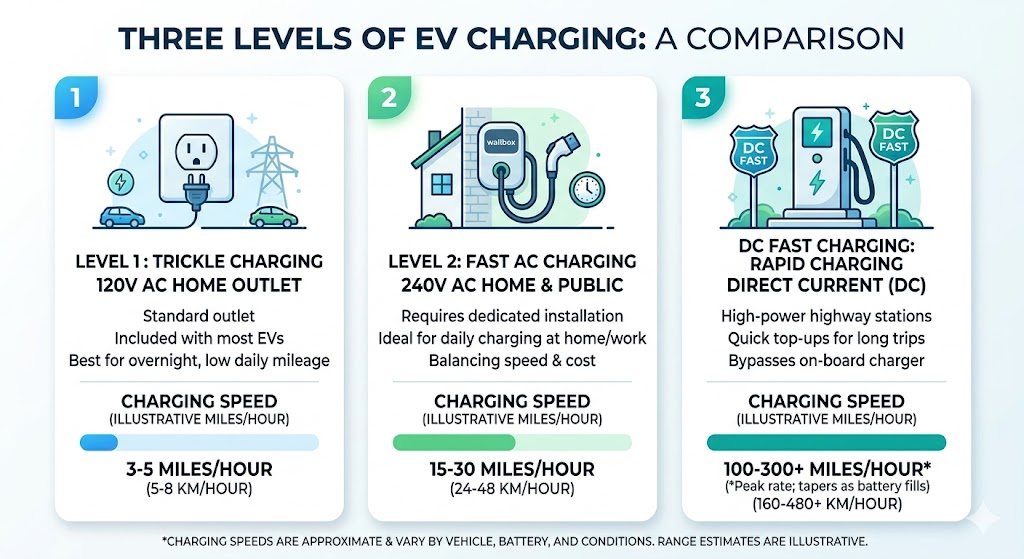
Before diving into the question of necessity, it helps to understand the three main types of EV charging. Level 1 charging uses a standard 120-volt household outlet, adding roughly 3–5 miles of range per hour. It is slow but requires no special installation. Level 2 charging uses a 240-volt outlet and can add 20–30 miles of range per hour, making it the most practical choice for home use. Level 3 charging, also known as DC Fast Charging (DCFC), is typically found at public stations and can charge an EV to 80% in 20–45 minutes.
For most daily drivers, a Level 2 home charger offers the greatest convenience. However, whether this convenience is a necessity or a luxury depends greatly on individual circumstances.
Different EV Owner Profiles: Do They All Need a Home Charger?
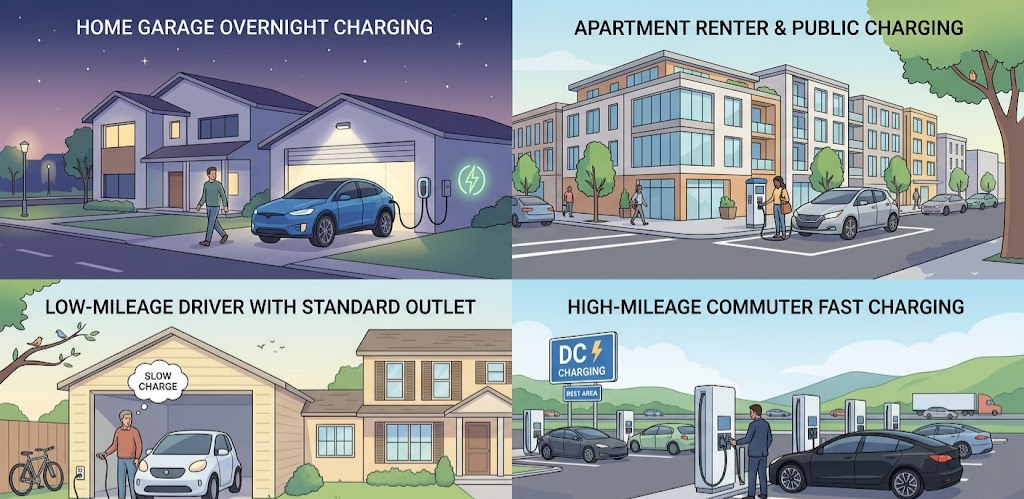
1.Homeowners with a Private Garage or Driveway
This group has the clearest case for purchasing a home EV charger. Homeowners with dedicated parking can install a Level 2 charger (often called an EVSE — Electric Vehicle Supply Equipment) at a relatively modest cost. In the United States, installation typically runs between $500 and $1,500, including the unit and labor, and federal tax credits may offset part of the cost. The benefits are compelling: overnight charging ensures a full battery every morning, eliminates detours to public stations, and is generally cheaper than public charging on a per-mile basis.
For homeowners who drive more than 30–40 miles per day, a Level 2 home charger is not just convenient but practically essential. Relying solely on Level 1 (wall outlet) charging means it could take 20+ hours to replenish a large battery pack — a significant inconvenience for high-mileage drivers.
2. Apartment Dwellers and Renters
Urban renters face a fundamentally different challenge. Without control over their parking infrastructure, installing a personal home charger is often impossible. Even where landlords are willing, retrofitting apartment buildings with charging infrastructure involves electrical upgrades, permitting, and cost-sharing arrangements that many building managers are reluctant to undertake. For this group, public charging or workplace charging becomes the primary — and sometimes only — option.
Some EV manufacturers offer Level 1 charging cables as standard equipment, and renters with access to an outdoor outlet near their parking space may find this sufficient for low-mileage use. However, for a renter who commutes long distances, a car with a relatively small battery range, or limited nearby public chargers, the lack of home charging access can be a genuine barrier.
In recognition of this gap, some cities and states are enacting "right-to-charge" laws that require landlords to accommodate EV charging requests from tenants. As these policies spread, the situation for renters is gradually improving — but remains inconsistent across markets.
3. Short-Distance Commuters and Occasional Drivers
Not every EV owner has high daily mileage needs. A retiree who drives 10–15 miles per day for errands, or a second-car EV owner who uses the vehicle only a few times per week, may find that Level 1 charging from a standard outlet is entirely adequate. In these cases, purchasing and installing a dedicated Level 2 charger may not deliver a meaningful return on investment.
For occasional drivers, a combination of Level 1 home charging and occasional top-ups at public stations may be all that is needed. These users arguably represent the segment for whom a dedicated home charger is least necessary.
4. Long-Distance Commuters and High-Mileage Drivers
On the opposite end of the spectrum, drivers who regularly travel 80–150+ miles per day place heavy demands on their EV's battery. For these individuals, a Level 2 home charger is effectively non-negotiable. Without one, they face the prospect of lengthy daily stops at public fast-chargers, which not only takes time but also costs more and accelerates battery degradation with repeated DC fast charging.
High-mileage EV owners also benefit from the predictability of home charging — waking up to a fully charged vehicle every day without having to plan around public station availability, queuing, or potential equipment downtime.
5. Fleet Owners and Commercial Users
For businesses operating EV fleets — delivery companies, taxi services, corporate car pools — on-site charging infrastructure is not a question of convenience but of operational necessity. The economics of fleet management demand reliable, fast, cost-efficient charging, which public networks cannot consistently provide at scale. These operators almost invariably invest in dedicated Level 2 or even Level 3 charging depots.
Regional Differences in Public Charging Infrastructure
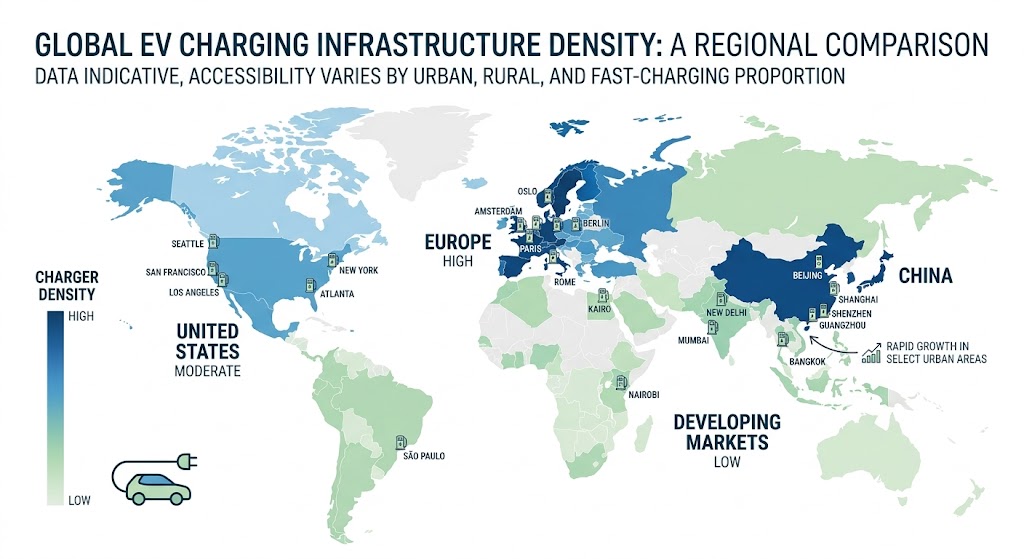
Perhaps the most significant variable in the home charger debate is geography. The adequacy of public charging networks varies enormously between countries, and even between cities and rural areas within the same country.
United States
The United States presents a highly fragmented landscape. Major metropolitan areas on the coasts — particularly in California, which leads the nation with over 100,000 public charging ports — have relatively dense charging networks, making it feasible for some urban EV owners to rely primarily on public infrastructure. Tesla's Supercharger network, now partially open to non-Tesla vehicles, has also improved corridor charging significantly.
However, rural America tells a very different story. Vast stretches of the Midwest, Mountain West, and rural South have sparse charging coverage. For drivers in these regions, public charging is often impractical for daily use, and a home charger is essentially a requirement. The federal government's National Electric Vehicle Infrastructure (NEVI) program is investing billions to close these gaps, but meaningful rural coverage remains years away.
Europe
Europe's charging infrastructure maturity varies widely. Countries like the Netherlands, Norway, and Germany have invested heavily in public charging networks and typically have high charger-to-EV ratios. Norway, where EVs make up a majority of new car sales, has achieved a relatively functional balance between home and public charging — though even there, home charging is strongly preferred among those with the option.
In contrast, Eastern and Southern European countries have noticeably thinner public charging coverage, and range anxiety remains a concern for drivers venturing outside major cities. EU regulations mandating charging station deployment along major highways are improving the situation, but coverage is uneven.
China
China has the world's largest EV market and has built a correspondingly massive public charging network, with millions of public charging connectors across the country. Major cities like Beijing, Shanghai, and Shenzhen boast dense fast-charging coverage that rivals or exceeds anything available in the West. For urban Chinese EV owners — many of whom live in high-rise apartments without home charging access — the public network is a genuine alternative to home charging. That said, the quality and reliability of public chargers can vary, and off-peak home charging remains the preferred option for those who can access it.
Developing Markets
In many emerging economies across Southeast Asia, Latin America, and Africa, public EV charging infrastructure is still in its infancy. In these markets, the practical ability to charge at home — or at a reliable workplace charger — may be the single biggest factor determining whether EV ownership is feasible at all. Without robust public infrastructure, the barriers to EV adoption are considerably higher for buyers who lack home charging access.
The Economic Case: Home Charger vs. Public Charging
From a purely financial perspective, home charging is almost always cheaper than public charging. In the United States, for example, the average residential electricity rate is around 12–16 cents per kWh, while public Level 2 chargers typically charge 30–50 cents per kWh, and DC fast chargers can run 40–70 cents per kWh or more. For a driver covering 12,000 miles per year, this cost difference can amount to hundreds of dollars annually.
Moreover, many utilities offer time-of-use (TOU) rates that allow EV owners to charge overnight at significantly reduced prices — sometimes as low as 5–8 cents per kWh. This economic advantage is only available to those with home charging capability and amplifies the financial incentive for homeowners with high-mileage needs.
The upfront cost of a Level 2 charger and installation can be recovered in energy savings over 2–4 years for a typical driver, making it a sound long-term investment for those who plan to own their EV for several years.
When Home Chargers Are Not Necessary
Despite the benefits outlined above, there are clear scenarios in which purchasing a home EV charger is unnecessary or impractical. Urban apartment dwellers in cities with excellent public charging networks — such as Amsterdam, Oslo, or certain neighborhoods of Los Angeles or New York — can rely entirely on public infrastructure, especially if they are low-mileage drivers. Similarly, people who drive short distances infrequently and have access to workplace charging may find that their needs are fully met without a home unit.
As battery ranges continue to improve — with many 2024–2026 models exceeding 300–400 miles per charge — the urgency of frequent charging diminishes for average drivers. A single weekly visit to a fast charger may be sufficient for drivers who cover less than 200 miles per week, particularly if those chargers are conveniently located near shopping centers, offices, or other destinations.
Conclusion
The question of whether an EV owner needs a home charger does not have a single answer. For homeowners with high daily mileage, a Level 2 home charger is a wise and often essential investment that pays for itself in convenience and savings. For apartment dwellers or low-mileage drivers in cities with strong public charging networks, it may be entirely optional. Regional infrastructure gaps — particularly in rural America, developing markets, and parts of Eastern Europe — make home charging a near-necessity for many drivers simply because the alternative is not reliable enough.
Ultimately, the decision hinges on an honest assessment of one's parking situation, daily driving habits, local infrastructure, and budget. As public charging networks continue to expand and improve globally, the home charger may gradually shift from a practical necessity toward a convenience premium — but for the majority of EV owners today, it remains one of the smartest investments they can make alongside their vehicle.