
There's something quietly revolutionary happening at the edge of town — past the last traffic light, beyond the reach of fast broadband, and far from the nearest shopping center. Farmers, small-business owners, and everyday families in rural areas are beginning to embrace electric vehicles. And yet, the infrastructure that should support them is lagging far behind. For millions of people who live outside major cities, the promise of clean, affordable transportation runs headfirst into a very practical wall: where do you charge?
This isn't just an inconvenience. It's an equity issue, an economic issue, and increasingly, an urgent policy issue. Across Europe and North America, governments, utilities, and private companies are wrestling with what it truly takes to bring reliable EV charging to communities that have historically been last on the infrastructure priority list. The challenges are real — but so are the solutions beginning to emerge.
The European Landscape: A Patchwork of Progress
Europe has long positioned itself as a leader in the clean energy transition, and its EV ambitions are no exception. The European Union's target to phase out new internal combustion engine vehicles by 2035 has sent a clear signal: electrification is not a question of if, but when. But when you drive out of Paris, Munich, or Amsterdam and into the rural heartlands — the rolling hills of Bavaria, the farm country of Poland, the coastal villages of Portugal — the picture changes dramatically.
Rural Europe faces a power grid that was, in many areas, built for a different era. Older electrical infrastructure in countries like Romania, Bulgaria, and parts of southern Italy simply wasn't designed to handle the simultaneous demand that comes with widespread EV charging. Grid upgrades are expensive and slow, and the economics don't always favor investment in sparsely populated areas where the number of potential users — and thus the return on investment — is limited.
Germany offers a telling example. While urban centers like Berlin and Hamburg boast dense networks of public chargers, rural communities in states like Brandenburg and Mecklenburg-Vorpommern have seen far slower rollout. A 2023 analysis found that charging point density in Germany's rural districts was roughly one-sixth of that in major cities — a gap that carries real consequences for residents who may drive 30 or 40 kilometers to work each day and have no realistic alternative to their car.
Scandinavian countries tell a more encouraging story. Norway, which leads the world in EV adoption per capita, has made a deliberate effort to build charging infrastructure even in remote fjord communities and Arctic towns. The government has subsidized charging station installation in areas where private operators wouldn't otherwise venture, and this public investment has helped normalize EV ownership far beyond the urban core. Norway's approach is increasingly being studied as a model — not just for its ambition, but for its recognition that rural communities cannot simply be left behind.
North America: Long Distances, Big Stakes
If Europe's rural challenge is partly about upgrading aging infrastructure, North America's is partly about sheer scale. The United States and Canada contain vast stretches of land where the nearest town might be an hour's drive away, where highways cut through desert, mountain, and prairie with few stops in between. For an EV driver, these stretches can trigger what the industry calls "range anxiety" — the very real fear of running out of power far from help.
The U.S. federal government has taken notable steps to address this. The Bipartisan Infrastructure Law passed in 2021 allocated $7.5 billion specifically for EV charging infrastructure, with a mandate that funds be used not just in cities but along rural highway corridors and in underserved communities. The goal of building out a national network of 500,000 chargers by 2030 is ambitious — but the mechanics of actually getting there are proving complicated.
One fundamental issue is where the power comes from. In rural America, electricity is often delivered by small electric cooperatives — member-owned utilities that serve areas too remote or too low-density for traditional investor-owned utilities to find profitable. Many of these co-ops operate on tight margins and lack the technical expertise or capital to upgrade their systems for EV-scale demand. Partnering with them, rather than bypassing them, has become a key focus for federal and state programs seeking real rural penetration.
Canada faces its own version of these obstacles, amplified by its northern geography. Provinces like Saskatchewan and Manitoba have harsh winters that can significantly reduce EV battery range, and charging networks thin out rapidly once you leave cities like Saskatoon or Regina. The federal government's Zero Emission Vehicle Infrastructure Program has directed funding toward rural and remote communities, including Indigenous communities that have historically lacked even basic utility infrastructure — a stark reminder that energy equity and EV equity are deeply intertwined.
Why Charging Infrastructure Is No Longer Optional
It's worth pausing to ask: why does this matter so urgently now? The answer lies in the changing demographics of EV adoption. For years, electric vehicles were largely a product for urban professionals — people who could charge at home in their garage, who had short daily commutes, and who could afford a new Tesla or comparable vehicle. That picture is changing. As vehicle prices gradually come down and as more affordable EV models reach the market, rural buyers are beginning to consider the switch in growing numbers.
Rural drivers, in many ways, stand to benefit enormously from EVs. They often drive older, less fuel-efficient vehicles and spend more of their income on gasoline. Lower fuel and maintenance costs could be transformative for a farmer or a small-town contractor who puts 25,000 miles a year on a pickup truck. But those potential benefits evaporate if the charging infrastructure isn't there to support the lifestyle — if every long drive becomes a logistical puzzle.
This is where the concept of "essential infrastructure" becomes important. Just as we don't debate whether rural areas deserve roads or phone lines, the emerging consensus is that EV charging infrastructure must be treated as a basic necessity — not a luxury amenity confined to highway rest stops near cities. Industry analysts, policymakers, and community advocates are increasingly aligned on this point: the buildout of rural charging isn't discretionary. It's foundational to making the clean transportation transition work for everyone.
Evolving Solutions: Innovation Meets Necessity
The good news is that the rural charging challenge has begun to spark genuinely creative responses. Across both Europe and North America, communities, entrepreneurs, and governments are testing approaches that go beyond simply replicating urban charging models in rural settings.
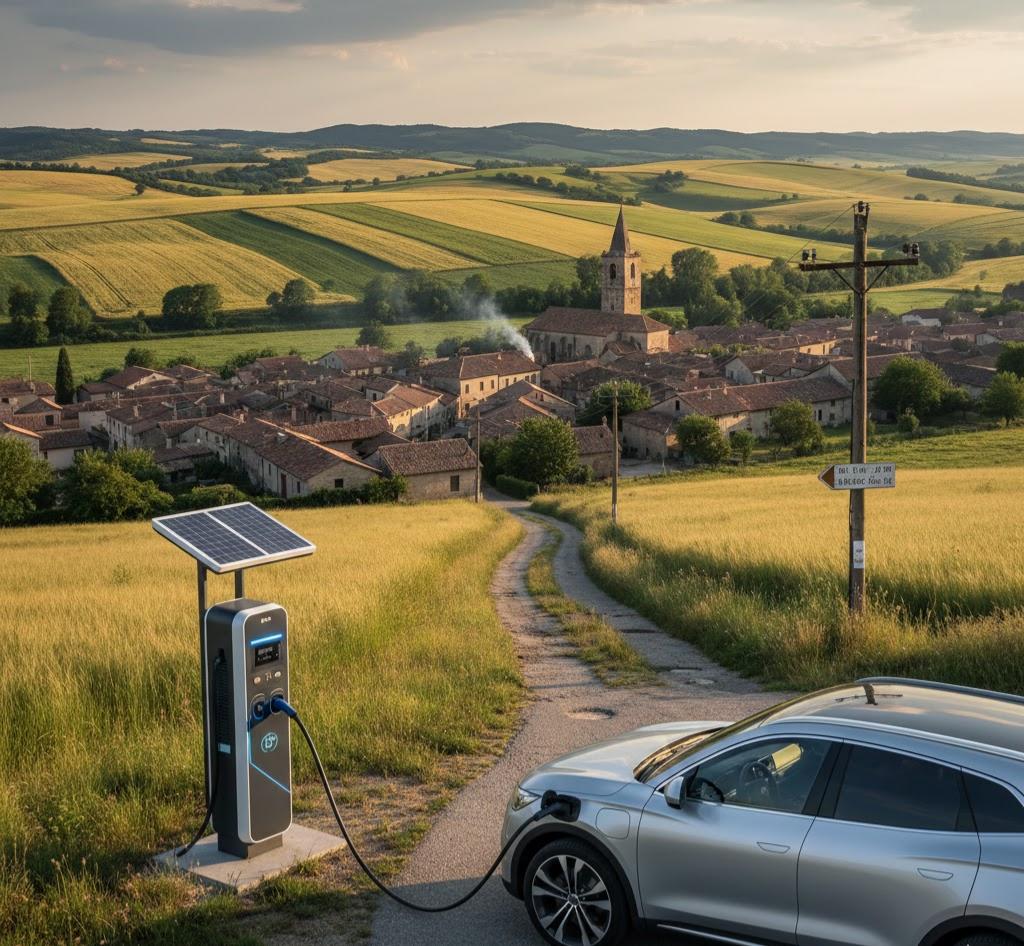
Solar-paired charging stations are gaining traction in areas where grid connections are expensive or unreliable. By combining photovoltaic panels with battery storage, these systems can operate semi-independently from the grid, making them viable in locations where extending utility infrastructure would otherwise be prohibitively costly. Pilot programs in rural France and in the American Southwest have demonstrated that solar-charged EV stations can be both technically feasible and financially sustainable over time.
Destination charging — placing chargers at hotels, restaurants, campgrounds, and other places where people naturally stop for extended periods — is proving particularly well-suited to rural environments. Unlike fast-charging stations that require expensive high-power connections, Level 2 destination chargers are relatively affordable to install and can generate revenue for small businesses while providing a valuable service to travelers. In rural Montana, for example, a network of destination chargers at dude ranches and fly-fishing lodges has quietly extended the practical range of EVs through country where highway chargers are scarce.
Smart charging technology is also playing a growing role in managing the grid impact of rural EV adoption. By scheduling charging during off-peak hours — overnight, when demand is low and electricity is often cheaper — smart chargers can significantly reduce the strain on rural electrical systems. Some utilities are partnering with EV owners through vehicle-to-grid programs, essentially turning electric vehicles into distributed batteries that can feed power back to the grid during periods of high demand, helping to stabilize systems that might otherwise struggle.
Community-led initiatives are perhaps the most heartening development. In several Nordic countries, rural municipalities have taken matters into their own hands — pooling resources, applying for government grants, and installing shared charging hubs that serve entire villages. This model of community ownership resonates with rural cultures that have long managed shared resources cooperatively, from irrigation systems to grain elevators, and it ensures that the benefits of clean transportation are distributed equitably rather than concentrated in the hands of large commercial operators.
-38.jpg?w=945&h=1020)
The Road Ahead
The transformation of rural transportation won't happen overnight, and there are no simple solutions to the very real technical, financial, and logistical barriers that remain. Grid upgrades take years and billions of dollars. Regulatory frameworks need updating. Business models that work in dense urban markets often fail in the countryside. And the communities most in need of affordable clean transportation are frequently the ones with the least political voice to demand it.
But the momentum is building. Across Europe and North America, the conversation has shifted from whether rural communities deserve EV infrastructure to how quickly and effectively it can be delivered. Policy frameworks are maturing, funding streams are expanding, and the technology itself is becoming more flexible and affordable with each passing year.
For the farmer who drives 60 miles to the nearest city for supplies, for the nurse who commutes through mountain passes to reach a regional hospital, for the family that hasn't been able to afford a new vehicle in a decade — the promise of affordable, reliable electric transportation is not an abstract policy goal. It's personal. Getting the charging infrastructure right in rural communities isn't just about meeting emissions targets or satisfying regulatory mandates. It's about making sure that the clean energy future being built is one that belongs to everyone — not just those lucky enough to live close enough to a city charger.