
The transition to electric vehicles represents one of the most significant shifts in transportation history, and understanding the economics of charging is crucial for both current EV owners and prospective buyers. While the environmental benefits of electric vehicles are widely acknowledged, the practical consideration of charging costs often determines whether consumers make the switch from traditional gasoline vehicles. The choice between home charging and public charging stations carries dramatically different cost implications that vary significantly across global regions, influenced by factors including electricity prices, government policies, infrastructure development, and energy sources.
The Fundamental Cost Structure
At the most basic level, home charging typically costs around $0.17 per kilowatt-hour in the United States, making a full charge for a 40 kWh battery approximately $6.80. This translates to roughly five cents per mile driven. In contrast, public charging can cost more than twice as much, with annual costs reaching about $1,234 compared to $589 for home charging for average driving distances. This fundamental disparity between home and public charging forms the baseline for understanding regional variations worldwide.
The cost difference stems from several factors beyond raw electricity prices. Public charging stations must recoup significant infrastructure investments, including the purchase and installation of charging equipment, ongoing maintenance costs, property rental or ownership expenses, and grid connection fees. Additionally, public charging operators must generate profit margins to sustain their business operations. Home charging, conversely, benefits from residential electricity rates that are typically subsidized compared to commercial rates and requires only a one-time installation investment for Level 2 charging equipment.
North American Landscape
The North American market presents a striking example of the home charging advantage. In the United States, residential electricity rates range from $0.15 to $0.16 per kWh on average, though this varies considerably by state, with California charging as much as $0.31 per kWh and Washington as little as $0.11 per kWh. This regional variation creates vastly different economics for EV owners depending on their location.
For American drivers covering the average annual distance, home charging costs between $506 and $720 per year, representing substantial savings compared to gasoline vehicles that would cost approximately $1,600 to $2,100 annually for the same mileage. However, public Level 2 charging stations charge between $0.20 to $0.25 per kWh, while DC fast chargers can reach $0.40 to $0.60 per kWh. This pricing structure means that relying primarily on public charging could cost between $770 and $2,300 annually, potentially approaching or exceeding gasoline costs in some scenarios.
The situation becomes particularly interesting when examining DC fast charging, which is essential for long-distance travel. On-road DC fast charging used for road trips can often be pricier than gasoline, depending on how high or low gas prices may be at the time of the drive. This reality underscores why approximately 80% of EV charging in North America occurs at home, with public charging reserved primarily for long trips and emergency situations.
Canada mirrors many of these trends, with similarly high percentages of home charging usage. The geographic vastness of both countries and the prevalence of single-family homes with private parking spaces make home charging particularly practical and economically advantageous for most EV owners in North America.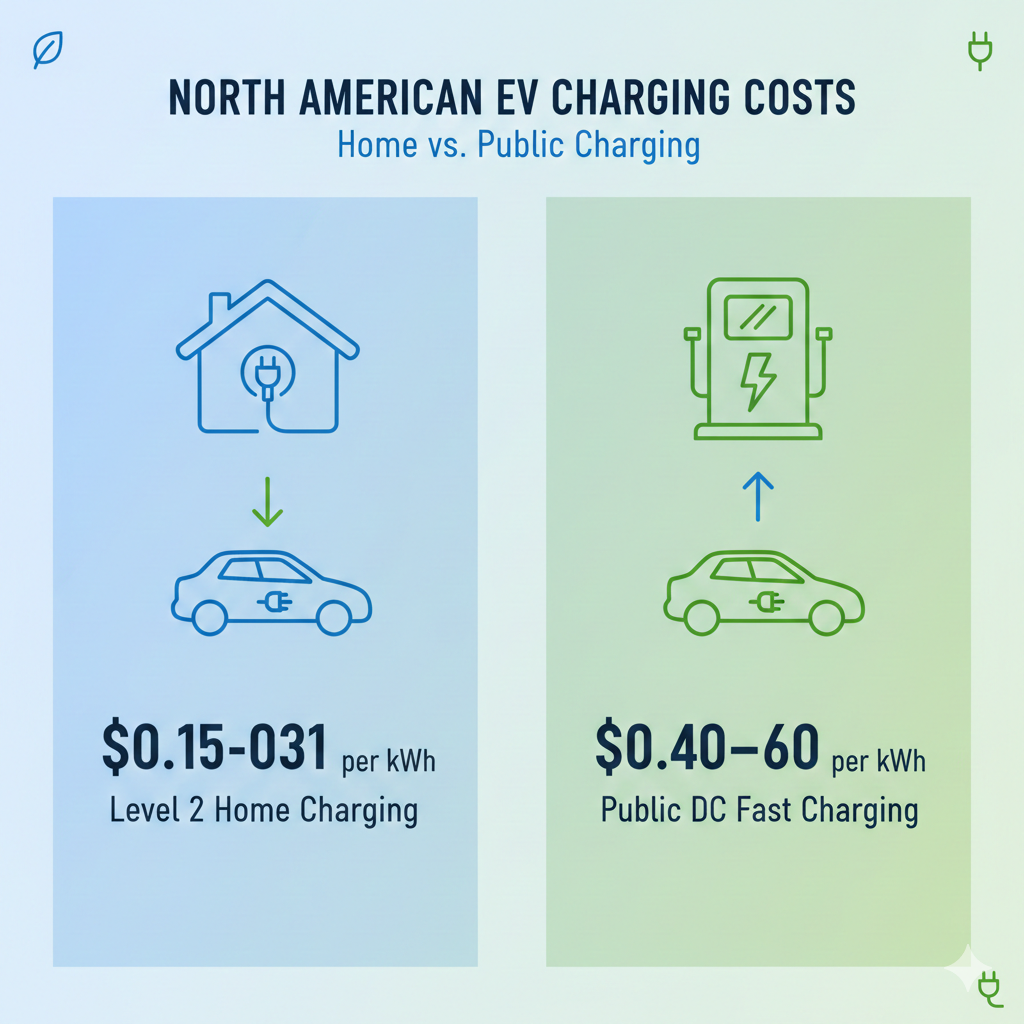
European Complexity
Europe presents a more complex and varied landscape for EV charging costs, with dramatic differences between countries reflecting diverse energy policies, renewable energy adoption, and taxation structures. Iceland emerges as the cheapest location in Europe for public charging at €2.89 per 100 kilometers, followed closely by Portugal at €3.18. Iceland's position as the most affordable charging destination stems directly from its abundant renewable energy resources, particularly geothermal and hydropower, which provide exceptionally low-cost electricity.
At the opposite extreme, Norway stands out as the most expensive location by far, with public charging costs reaching €18.93 per 100 kilometers—approximately six times higher than Iceland. This situation presents a fascinating paradox: Norway leads Europe in EV adoption, with electric vehicles representing over 80% of new car sales, yet charging costs remain extraordinarily high due to substantial taxes and network fees that inflate electricity prices despite the country's abundant hydropower resources.
The central European countries including Germany, France, Denmark, and Sweden cluster around the middle range, with costs between €7 to €10 per 100 kilometers for public charging. These moderate costs reflect a balance between renewable energy investments, established infrastructure networks, and tax policies that neither heavily subsidize nor penalize electric vehicle charging.
Southern Europe demonstrates interesting patterns as well. Spain offers relatively affordable public charging at €7.11 per 100 kilometers, while Italy, Greece, Malta, and Cyprus range between €9 to €10. Portugal stands out in this region for its commitment to renewable energy development, particularly wind and solar power, which has successfully driven down charging costs to make it one of Europe's most economical locations for EV operation.
Home charging in Europe typically remains significantly cheaper than public charging, with residential electricity rates varying considerably by country. In Europe, more than 70% of charging occurs at home or at work, where lower power output and longer charging times translate into lower prices. The European market has also embraced time-of-use pricing more extensively than many other regions, allowing EV owners to further reduce costs by charging during off-peak hours when electricity demand and prices are lowest.
Asian Dynamics
Asia, led by China, represents the world's largest and fastest-growing EV market, with unique charging cost dynamics shaped by government policy, massive infrastructure investments, and varying levels of home charging accessibility. In China, the national average EV charging costs amount to 0.973 RMB per kWh with home chargers and 1.148 RMB per kWh without home chargers, demonstrating a smaller gap between home and public charging compared to Western markets.
China's charging landscape reflects remarkable provincial variation, with differences reaching up to 147% between regions, primarily due to disparities in electricity prices and vehicle usage patterns. The Chinese government's strategic focus on EV adoption has driven unprecedented infrastructure development, with China now possessing about 65% of global charging infrastructure and 60% of the world's electric vehicle stock. This massive scale has helped moderate public charging costs through economies of scale and government support.
However, China faces a unique challenge regarding home charging accessibility. In China, only 20% of EV owners have access to a home charger due to the prevalence of apartment buildings. This limitation means the majority of Chinese EV owners rely more heavily on public charging infrastructure than their counterparts in North America or many European countries, making the cost and availability of public charging particularly critical for the Chinese market.
In China, public fast charging costs around twice as much as home charging, but it would still offer savings for EV owners compared with driving a conventional car. This calculation reflects China's lower gasoline prices and the government's efforts to keep public charging costs reasonable to support widespread EV adoption goals.
Japan presents a starkly different picture within Asia. Despite being a major automotive manufacturing hub, Japan's EV adoption has remained relatively low, with penetration rates around 4% of new vehicle sales. One factor contributing to Japan's reluctance to embrace EVs is the high proportion of Japanese living in apartment complexes, resulting in limited access to home charging facilities. This residential pattern, combined with persistent concerns about public charging infrastructure development, has created a chicken-and-egg situation where limited charging access suppresses EV adoption, which in turn reduces incentives for infrastructure investment.
Public charging costs in Japan reflect this less mature market status. Full charges in Japan cost ¥1,500 to ¥3,000, representing a significant expense compared to China's more developed and competitive charging market. The Japanese market does show signs of change, with government investment in public charging infrastructure increasing and the introduction of mini-EVs (kei cars) that require less energy and are better suited to Japan's urban environment and limited home charging access.
India represents an emerging market with its own unique characteristics. Charging costs in India range from ₹300 to ₹400 for a Tata Nexon EV, with ongoing investments in charging infrastructure aimed at improving affordability. The Indian government has set ambitious targets for EV adoption, which will require substantial expansion of both public and residential charging capabilities to support market growth.
Infrastructure and Access Considerations
Beyond pure cost comparisons, the practical accessibility of home charging fundamentally shapes the economics of EV ownership across regions. In North America, where single-family homes with private garages are common, approximately 80-83% of charging occurs at home. This high percentage reflects both the cost advantage and the convenience of overnight charging using standard residential electrical connections.
Europe presents more variation in housing patterns. While overall home charging remains dominant at over 70% of total charging activity, countries vary significantly. Dense urban areas with high proportions of apartment dwellers face greater challenges installing home charging infrastructure, often requiring building-wide electrical upgrades and landlord cooperation. This challenge particularly affects countries like Germany, where less than half the population lives in owner-occupied housing, creating additional barriers to home charging installation.
The availability and quality of public charging infrastructure also influences the practical economics of EV ownership. The Netherlands leads Europe with over 154,000 public charging points, providing extensive coverage that reduces range anxiety and makes EV ownership viable even for residents without home charging access. However, this extensive infrastructure comes at a cost, with public charging prices reflecting the substantial investment required to build and maintain such a comprehensive network..png?w=1024&h=945)
Cost Optimization Strategies
Understanding regional cost variations enables EV owners to develop strategies for minimizing charging expenses. Time-of-use electricity rates represent one of the most effective cost-reduction tools, particularly in markets where such pricing is widely available. Many utility companies offer special EV charging rates with significantly reduced prices during overnight hours when overall electricity demand is low. These programs can reduce home charging costs by 30-50% compared to standard residential rates.
Solar panel integration offers another path to cost reduction, effectively enabling free charging during daylight hours for homeowners with rooftop solar systems. This approach proves particularly attractive in regions with high electricity costs but excellent solar resources, such as California and parts of Australia. The combination of solar panels, home battery storage, and EV charging creates an integrated energy ecosystem that can dramatically reduce or eliminate charging costs while providing grid independence.
Public charging cost management requires different strategies. Many charging networks offer subscription plans that reduce per-kilowatt-hour costs in exchange for monthly fees, making economic sense for drivers who regularly use public charging. Apps that compare real-time pricing across different charging networks help drivers identify the most cost-effective options when away from home. Additionally, many workplaces now offer free or subsidized charging for employees, representing a valuable benefit that can substantially reduce overall charging costs.
Future Outlook
The economics of EV charging continue to evolve rapidly as the market matures and technology advances. Battery costs have declined substantially over the past decade and continue falling, enabling vehicles with larger batteries and longer ranges that reduce reliance on public charging. Charging speeds continue increasing, with ultra-fast chargers now capable of adding hundreds of kilometers of range in minutes, though these convenience-focused chargers typically command premium prices.
Government policies play crucial roles in shaping charging costs across regions. Subsidies for home charging installation, tax incentives for public charging infrastructure development, and time-of-use rate structures all influence the relative costs of different charging options. As EV adoption increases and becomes mainstream rather than niche, policy support may shift, potentially altering cost structures in various regions.
The expansion of charging networks in emerging markets promises to improve both availability and affordability through increased competition and economies of scale. Countries like India, Brazil, and Southeast Asian nations are investing heavily in charging infrastructure to support their EV adoption goals, creating new regional markets with their own unique cost structures and challenges.
Conclusion
The cost comparison between home charging and public charging reveals a consistent global pattern: home charging offers substantial cost advantages across virtually all regions, typically costing half or less compared to public charging options. However, the magnitude of this advantage and the absolute costs vary dramatically based on regional factors including electricity prices, energy sources, government policies, and infrastructure development.
For prospective EV buyers, access to home charging represents not merely a convenience but a fundamental economic consideration that can save thousands of dollars annually compared to reliance on public charging. Regional variations mean that the same EV driven the same distance may cost dramatically different amounts to charge depending on location, with differences between regions sometimes exceeding the variations between EVs and gasoline vehicles.
As the global transition to electric mobility accelerates, understanding these regional cost dynamics becomes increasingly important for consumers, policymakers, and industry stakeholders. The future of EV charging costs will be shaped by technological advances, infrastructure investments, policy decisions, and the ongoing development of renewable energy resources, all of which will continue to create both opportunities and challenges across different regions worldwide.