
If you've recently installed a home EV charger or upgraded to a smart EV charger, you might have wondered: does this thing keep drawing power even when my car isn't plugged in? It's a fair question, and honestly, one that more EV owners should be asking. The short answer is yes—most residential EV charging stations do use some electricity when they're just sitting there idle. But before you panic and start unplugging everything, let's dive into what this really means for your safety, your wallet, and the longevity of your charging equipment.
The Reality of Standby Power Consumption
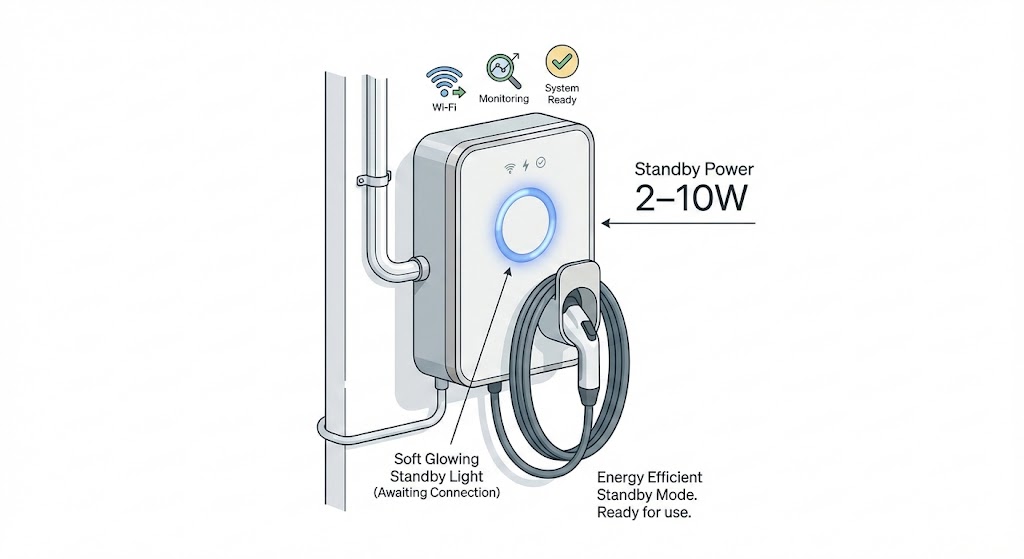
Here's the thing: modern smart EV chargers and home charging stations are essentially sophisticated computers that happen to charge your car. Even when they're not actively pumping electrons into your vehicle, they're still doing stuff behind the scenes. Your smart charger is maintaining its internet connection (via Wi-Fi or Ethernet), keeping its display lit up, monitoring for updates, and staying ready to spring into action the moment you plug in your car.
Think of it like your TV or computer on standby mode—it's not doing its main job, but it's not completely asleep either. Most residential Level 2 EV chargers and home charging units draw somewhere between 2 to 10 watts when they're idle. Smart EV chargers with advanced features like Wi-Fi connectivity, touchscreen displays, and mobile app integration tend to draw on the higher end of this range. That might not sound like much, and in the grand scheme of things, it really isn't. But over time, those watts add up, and it's worth understanding what you're dealing with.
Safety Concerns: Should You Be Worried?
Let's address the elephant in the room first: is it safe to leave your home EV charger plugged in all the time? The good news is that modern EV charging equipment, whether it's a basic Level 2 charger or an advanced smart charging station, is built with safety as a top priority. They've gone through rigorous testing and certification processes (think UL listing, CE marking, etc.) specifically to be safe when left plugged in continuously.
However—and this is important—that doesn't mean there are zero risks. Any electrical device that's constantly drawing power has the potential for problems, especially if something goes wrong. Here are the realistic safety considerations you should keep in mind:
Overheating risks: While rare, components in your charger can degrade over time. If cooling systems fail or dust accumulates in the wrong places, there's a theoretical risk of overheating. Most quality chargers have thermal protection built in, but it's not foolproof.
Electrical surge damage: Your charger is continuously exposed to your home's electrical system. Lightning strikes, power surges, or grid fluctuations can potentially damage the internal components. A charger that's unplugged is completely protected from these events.
Wear and tear on components: Electronic components have lifespans. Capacitors, in particular, can degrade faster when they're constantly powered, even at low levels. This doesn't mean your charger will fail immediately, but continuous operation does put more stress on these parts than if they were completely powered down.
Fire hazards: Let's be real—the risk is extremely low with certified equipment, but any device drawing power has some fire risk. Faulty wiring, manufacturing defects, or installation issues can all contribute to problems. The key is that keeping the charger powered does maintain that small level of risk continuously.
The bottom line on safety? For quality chargers that are properly installed, the risk is minimal. But it's not zero, and it's worth being aware of these considerations.
The Cost Factor: Is Standby Power Killing Your Budget?
Now let's talk money, because that's what a lot of people really want to know. How much is that idle charger costing you?
Let's do some quick math. If your charger draws about 5 watts on standby (a reasonable average), and your electricity costs around $0.13 per kWh (roughly the U.S. average), you're looking at:
- Daily cost: About $0.016 (less than 2 cents)
-
Monthly cost: Around $0.47 (not even half a dollar)
-
Yearly cost: Approximately $5.70
So we're talking about the cost of a fancy coffee per year. Not exactly budget-breaking stuff. However, if you have a particularly power-hungry smart charger with lots of features, a big color display, and constant connectivity, you might see double or even triple these numbers. Popular smart EV chargers from brands like ChargePoint, JuiceBox, or Wallbox with advanced features can draw 8-10 watts on standby. Still, we're probably talking $15-20 per year at the absolute most.
But here's where it gets interesting: that standby power consumption is actually serving a purpose. If your home charging station has smart features like scheduling, load balancing, or remote monitoring through a mobile app, keeping it powered means these features are always available. You can take advantage of off-peak electricity rates, get notifications about your charging sessions, and have the charger update its firmware automatically.
The question becomes: is the convenience worth the cost? For most people, the answer is probably yes. But if you're really tight on budget or if you have multiple chargers (maybe at a vacation home you rarely visit), those costs can add up.
-18.jpg?w=1024&h=1024)
Impact on Your Charger's Lifespan
This is where things get a bit more nuanced. Does keeping your charger plugged in 24/7 affect how long it will last? The honest answer is: possibly, but it's complicated.
On one hand, continuous operation means continuous stress on components. Electronic parts don't last forever, and keeping them powered—even at low levels—does contribute to wear. This is especially true for smart EV chargers with more complex electronics and connectivity features. Capacitors in particular can have reduced lifespans when subjected to constant low-level charging cycles.
On the other hand, cycling equipment on and off repeatedly can actually be more stressful than leaving it on. Every time you power up a device, there's an inrush of current that creates thermal stress. If you're constantly unplugging and replugging your home charging station, you might actually be doing more harm than good.
Most quality residential EV chargers are designed to operate continuously for 10-15 years or more. The standby power consumption is factored into their design life. But cheaper units with lower-quality components might not fare as well over time.
There's also the environmental factor to consider. While the standby power draw is small, it does represent wasted energy on a global scale. Millions of EV chargers sitting idle and drawing power collectively consume a significant amount of electricity that's not actually doing useful work.
Best Practices: What Habits Should You Develop?
So what should you actually do? Here are some practical habits that strike a balance between convenience, cost, safety, and equipment longevity:
For daily users: If you charge your EV regularly (a few times a week or more), just leave the home charger plugged in. The convenience of having it ready to go, plus the benefits of smart charging features like scheduled charging and energy monitoring, outweigh the minimal costs and risks. Just make sure to inspect it visually every month or so for any signs of damage, unusual warmth, or wear.
For occasional users: If you only charge once a week or less, consider unplugging the charger when you know you won't be using it for several days. This eliminates standby draw and any associated risks, while the infrequent cycling shouldn't impact longevity significantly.
Install a dedicated circuit breaker: Having the ability to easily switch off power to your Level 2 charging station is ideal. If you're going on vacation or won't be using the charger for an extended period, flip the breaker. This gives you the safety and cost benefits of unplugging without the wear and tear of physically disconnecting cables.
Use power monitoring: Consider installing a smart plug or power monitor on your charger circuit. This lets you track exactly how much power it's using in standby mode and helps you make informed decisions about whether to leave it on.
Keep it clean and well-ventilated: Dust accumulation can contribute to overheating issues. Every few months, gently clean your charger with a dry cloth and make sure nothing is blocking ventilation slots.
Schedule smart features wisely: If your smart EV charger has scheduling capabilities, use them. You can often set the charger to enter a deeper sleep mode during times when you definitely won't be charging, reducing standby consumption while maintaining smart features when you need them. Many modern home charging stations allow you to customize power-saving settings through their mobile apps.
Regular safety checks: Make it a habit to check your charger periodically. Feel if it's unusually warm when idle, look for any discoloration or damage to the casing, and listen for any strange sounds. These simple checks can catch problems before they become serious.
The Bottom Line
Do home EV chargers and smart charging stations use electricity when not charging? Yes, they do. Should you lose sleep over it? Probably not. The standby power consumption is minimal, the costs are negligible for most users, and safety risks are low with properly installed, quality equipment.
The key is to be intentional about your usage. Understand your own charging patterns, know your equipment, and make decisions that make sense for your situation. For most daily EV users, the convenience of leaving the Level 2 home charger plugged in far outweighs any downsides. But if you're cost-conscious, safety-minded, or an infrequent user, taking a few simple steps to manage your charger's power consumption can give you peace of mind.
At the end of the day, EV charging is still far more efficient and environmentally friendly than filling up with gasoline, and the standby power of your charger is a tiny fraction of the energy your car actually uses while driving. So charge on, and don't overthink it too much—just stay informed and use common sense.