A Comprehensive Overview of Plug Standards, Voltage Differences, and Practical Travel Tips
When you travel across Europe, one of the most overlooked yet practically critical differences between countries is the type of power outlet used. Unlike the United States, which has a unified plug and socket standard, Europe is home to a surprising variety of outlet types — each with its own shape, pin configuration, voltage, and safety features. Understanding these differences is essential not only for travelers packing their adapters, but also for homeowners, electricians, and anyone working in electrical installation or appliance design. This guide provides a thorough breakdown of the major European outlet types, their geographic distribution, technical specifications, and key features.
Why Europe Has So Many Different Outlet Types
The diversity of power outlet standards in Europe is largely a product of history. Electrical infrastructure across the continent was developed independently in each country during the late 19th and early 20th centuries, long before any effort at standardization. As a result, each nation adopted its own plug configuration based on whatever technology was most available and commercially dominant at the time. Even today, despite decades of European integration, no single universal standard has been adopted across all member states — though significant progress has been made, particularly with the Type F (Schuko) outlet becoming a de facto standard in much of continental Europe.
The voltage used across Europe is generally 220–240V at 50Hz, which differs significantly from North America's 110–120V at 60Hz. This means that appliances designed for European use carry a higher voltage, and travelers from North America must use voltage converters unless their devices are dual-voltage (which most modern electronics are). The frequency difference of 50Hz versus 60Hz is generally less of an issue for most consumer electronics, but can matter for older devices with AC motors.
The Major European Outlet Types Explained
Type C — The "Europlug" (CEE 7/16)
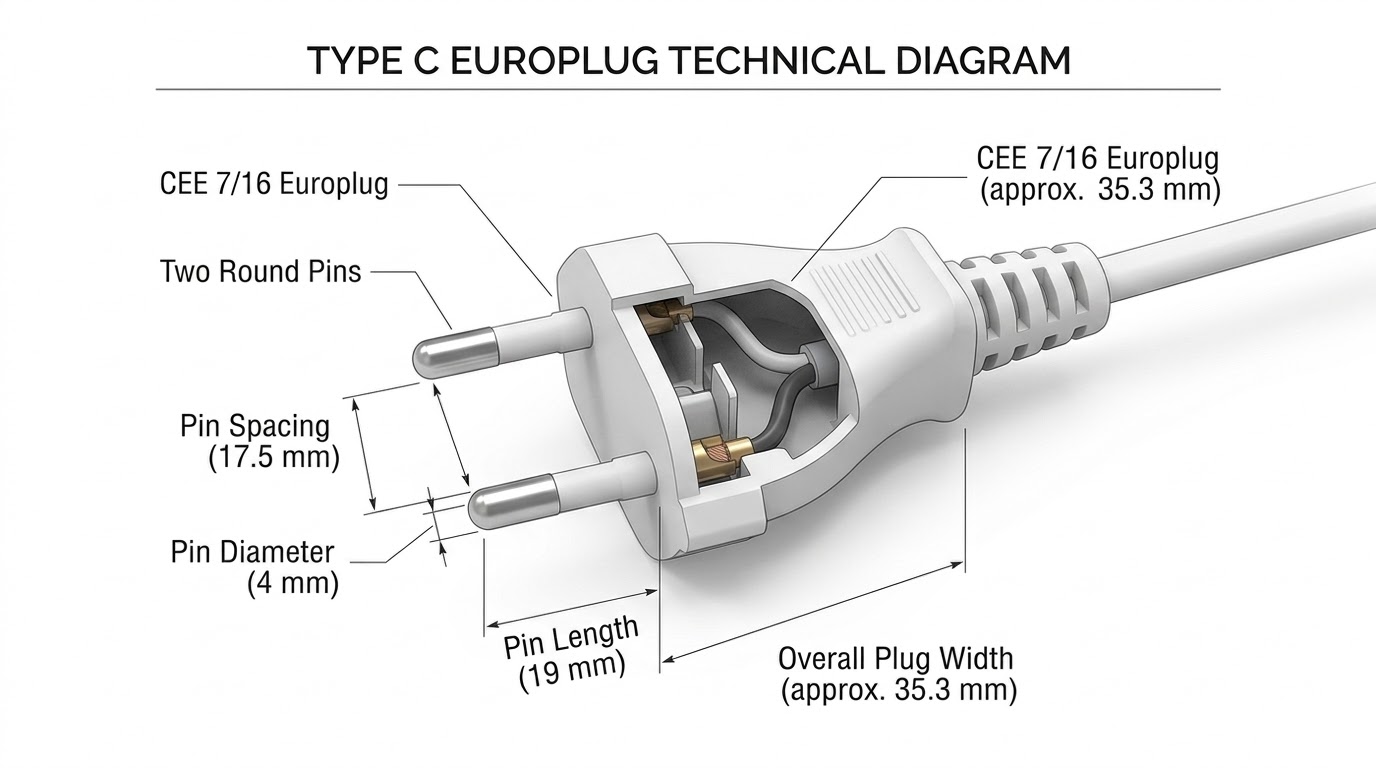
Type C, commonly called the Europlug, is the most widely used plug type in Europe and is found across the vast majority of continental European countries. It features two round pins, 4.0–4.8 mm in diameter, set 19 mm apart. This plug is defined under the CEE 7/16 standard and is designed for low-power, unearthed applications — meaning it does not include a ground (earth) pin.
Key features of Type C:
• Two round pins, no grounding conductor
• Rated for up to 2.5 amps (typically used for small appliances, phone chargers, and lamps)
• Compatible with Type E and Type F sockets due to its round pins
• Used in over 50 countries across Europe, Asia, South America, and Africa
• Considered the baseline European plug; most European travelers carry Type C adapters
While the Type C plug is extremely versatile, its lack of grounding makes it unsuitable for high-powered appliances. It is primarily intended for Class II equipment (double-insulated devices that do not require a ground connection).
Type E — The French Standard (CEE 7/5)
Type E is the standard outlet used in France, Belgium, Poland, Slovakia, the Czech Republic, and several other countries. It is characterized by two round holes for the plug's pins plus a round male grounding pin that protrudes from the socket itself. This is the inverse of most other grounding systems, where the earth pin is on the plug rather than the socket.
Key features of Type E:
• Two round holes plus a protruding earth pin from the socket
• Rated for 16 amps at 220–240V
• The socket's protruding earth pin ensures grounding before electrical contact is made
• Type E and Type F plugs are mutually compatible in most cases
• Common in France, Belgium, Poland, Czech Republic, and Slovakia
One notable characteristic of Type E outlets is that they are non-polarized, meaning the plug can be inserted in either direction. This design was deliberate: unlike the UK system, French engineers at the time did not prioritize polarity in the consumer socket. Modern installations increasingly include polarity considerations, but legacy Type E sockets remain unpolarized in millions of homes.
-45.jpg?w=1376&h=768)
Type F — The "Schuko" Standard (CEE 7/4)
Type F, universally known as "Schuko" (short for the German Schutzkontakt, meaning "protective contact"), is the most widespread outlet standard in continental Europe. Originally developed in Germany in the 1920s, it has since become the dominant standard across Germany, Austria, the Netherlands, Spain, Portugal, Sweden, Norway, Finland, and many other nations.
Key features of Type F:
• Two round pins (4.8 mm diameter) set 19 mm apart, with two grounding clips on the sides
• Rated for 16 amps at 220–240V
• Side grounding clips provide earth connection — a distinctive feature not found in Type C
• Symmetrical design means it is non-polarized
• Widely compatible: Type C Europlugs fit into Schuko sockets
The Schuko design is often praised for its safety and reliability. Because the grounding contacts engage before the live pins do, there is an inherent safety advantage during plug insertion. In recent decades, Germany has also introduced child-protection shutters in new socket installations, further improving safety. The CEE 7/7 hybrid plug (which combines elements of both Type E and Type F) allows a single plug to work in both French and German/Schuko sockets, effectively bridging the two most common European standards.
-17.jpg?w=1376&h=768)
Type G — The British Standard (BS 1363)
Type G is the standard used in the United Kingdom, Ireland, Hong Kong, Malta, Malaysia, Singapore, and a handful of other countries with historical British influence. It is one of the most distinctive and arguably safest plug designs in the world, featuring three large rectangular pins arranged in a triangular pattern.
Key features of Type G:
• Three rectangular pins: live (L), neutral (N), and earth (E)
• Rated for 13 amps with a fuse built into the plug itself
• Mandatory shutters on live and neutral slots — sockets are inherently child-safe
• Polarized design: live and neutral are clearly differentiated
• The largest and heaviest consumer plug in common European use
The built-in fuse in the Type G plug is a unique safety feature: each plug contains a 3A or 13A fuse that protects the appliance and the cable in the event of a fault. This means that a faulty device will blow its own plug fuse before it can cause more widespread damage. Critics point out that the bulkiness of Type G makes it impractical for certain applications (such as phone chargers that need to sit flat against a wall), but from a safety engineering perspective, it is one of the most robust standards in the world.
-13.jpg?w=1376&h=768)
Type L — The Italian Standard (CEI 23-50)
Type L is used primarily in Italy, Chile, and a few other countries. It features three round pins in a straight line — live, neutral, and earth — which is a distinctive configuration not seen in other European standards. Italy uses this plug in two sub-variants: a 10-amp version with smaller, more closely spaced pins, and a 16-amp version with larger, more widely spaced pins.
Key features of Type L:
• Three round pins in a horizontal line (live, neutral, earth)
• Available in 10A and 16A versions with different pin spacings
• Grounded design provides good safety for high-powered appliances
• Not compatible with Type C, E, or F plugs without an adapter
• Found primarily in Italy — visitors often need a specific Italian adapter
Italy is unusual in Europe in that it has not adopted the Schuko standard, despite being a central European nation. Italian sockets are incompatible with Schuko plugs, which can be a significant inconvenience for travelers. Italy is gradually moving toward wider adoption of multi-standard sockets that accept both Type L and Type C/F plugs, particularly in hotels and modern construction.
-9.jpg?w=1024&h=572)
Regional Overview: Who Uses What in Europe
To summarize the geographic distribution of outlet types across Europe: Germany, Austria, the Netherlands, Sweden, Norway, Finland, Spain, Portugal, and most of Eastern Europe use Type F (Schuko). France, Belgium, and Poland use Type E. The United Kingdom and Ireland use Type G. Italy uses Type L. Switzerland uses a unique Type J (not covered above), featuring three round pins in a triangular arrangement. Denmark uses Type K, with two round pins and a U-shaped earth pin.
This patchwork of standards means that a traveler moving between Germany, France, the UK, and Italy would technically need four different adapters — though in practice, the Type C Europlug functions in both Type E and Type F sockets (though without grounding), making it the most practical choice for low-power appliances. Multi-adapter travel plugs that cover all of these standards are widely available and highly recommended for international travelers.
Safety Features and Modern Developments
Modern European electrical standards have evolved significantly in terms of safety. One of the most important developments is the introduction of socket shutters — spring-loaded covers inside the socket that prevent children from inserting foreign objects. The UK's Type G sockets have required shutters since the 1990s, and many European countries have followed suit for new installations. In Germany and the Netherlands, child-proof shutters on Schuko sockets are now standard in new builds.
Another important development is the push toward IP-rated (Ingress Protection) sockets in bathrooms and outdoor spaces. Under EU regulations, sockets installed near water sources must meet specific IP ratings to prevent electric shock. Type F Schuko sockets with IP44 or IP55 ratings are used in outdoor and bathroom settings across much of Europe.
The European Union has also been working on the Type E+F hybrid CEE 7/7 plug, which is now the most commonly manufactured plug for new appliances sold across the EU. This hybrid plug works in both Type E (French) and Type F (Schuko) sockets, effectively harmonizing the two most common standards. While it does not resolve the incompatibility with the UK's Type G or Italy's Type L, it is a significant step toward a more unified European electrical ecosystem.
Practical Tips for Travelers and Homeowners
For travelers visiting Europe, here are the most important practical considerations:
• Always check the voltage rating of your devices before plugging in. Most modern electronics (laptops, phones, tablets) are dual-voltage (100–240V) and only need a plug adapter, not a voltage converter.
• A universal travel adapter that covers Type C, E, F, G, and L will handle nearly all European countries. Look for models with USB-A and USB-C charging ports built in.
• Do not use ungrounded Type C adapters with high-powered appliances such as hairdryers, irons, or electric kettles — always use a properly grounded adapter or the appliance's native plug.
• In the UK and Ireland, remember that Type G sockets operate at 230V and use a completely different pin layout from the rest of Europe. A UK adapter is essential.
• In Italy, many older sockets accept only the 10A Type L plug. Check whether your hotel room has modern multi-standard sockets or you'll need a specific Italian adapter.
• For homeowners renovating or installing new sockets, always consult national electrical codes. While Schuko (Type F) is the most interoperable standard for new construction in most of continental Europe, local regulations may specify requirements for socket placement, grounding, and child protection.
Electric Vehicle Charging Connectors in Europe
As electric vehicles (EVs) become increasingly common across Europe, understanding the different charging connector standards is just as important as knowing your household plug types. European EV charging infrastructure involves a distinct set of standards that differ from both domestic outlets and from the connectors used in North America and Asia. While regular household sockets can technically be used for slow EV charging, dedicated EV connectors are designed to handle much higher power loads safely and efficiently.
Mode 2 Charging: Using Domestic Sockets (Schuko / Type F)
The simplest form of EV charging is Mode 2, which uses a standard domestic outlet — most commonly the Type F (Schuko) socket across continental Europe — via an In-Cable Control Box (ICCB). This method is also called 'granny charging' due to its slow speed. The ICCB contains protective electronics to monitor the connection and prevent overheating.
• Uses standard Type F (Schuko) or Type G (UK) household sockets
• Typical charging speed: 1.4–2.3 kW (6–10 amps at 230V single phase)
• Full charge time for a typical 60 kWh EV battery: 24–40 hours
• Suitable for overnight top-ups but not primary charging for long daily distances
• The ICCB cable communicates with the vehicle via a pilot signal to negotiate safe current draw
• Not recommended as the sole charging method due to the sustained load on household wiring
While Mode 2 charging via a Schuko socket is legally permitted and widely practiced in Europe, electrical authorities generally recommend installing a dedicated wall box (Mode 3 charger) for regular home charging. Continuous high-current draw through a standard Schuko outlet over many hours can stress household wiring and sockets not rated for such sustained loads.
Type 2 (Mennekes) — The European EV AC Standard (IEC 62196-2)
Type 2, commonly known as the Mennekes connector (after the German company that developed it), is the dominant EV charging standard across the European Union. In 2014, the EU mandated that all new public charging points must use the Type 2 connector, effectively standardizing EV charging infrastructure across member states in a way that domestic outlets never achieved. The Type 2 plug features seven pins in a flat-topped circular housing and supports both single-phase and three-phase AC charging.
• 7-pin connector: 3 phase pins, 1 neutral, 1 protective earth, 1 pilot, 1 proximity
• AC charging: up to 7.4 kW on single phase (32A), up to 22 kW on three-phase (32A)
• Some commercial installations support up to 43 kW AC three-phase
• Mandatory standard at all public AC charging stations in the EU since 2014
• Used by the vast majority of European EVs including Volkswagen, BMW, Mercedes, Renault, and others
• Cable can be either tethered (fixed to the charger) or untethered (driver brings their own cable)
• Built-in communication pins enable smart charging features and load management
The Type 2 standard's support for three-phase AC charging is a significant advantage in European contexts, where three-phase power is more commonly available in residential and commercial buildings than in North America. A three-phase Type 2 connection at 22 kW can charge a compatible EV from near-empty to full in approximately 2–4 hours, making it ideal for home wall boxes and workplace charging installations.
CCS2 (Combined Charging System) — DC Fast Charging
The Combined Charging System Type 2 (CCS2, also called CCS Combo 2) is the European standard for DC fast charging. It extends the Type 2 connector by adding two large DC power pins below the standard AC socket, creating a combined connector that handles both AC and DC charging in one port. CCS2 is the standard for DC rapid charging across Europe and is used by nearly all European and American EV manufacturers selling in the EU market.
• Combines the 7-pin Type 2 AC section with 2 additional DC power pins (9 pins total)
• DC charging capacity: typically 50 kW to 350 kW depending on the charger and vehicle
• Enables 10–80% charging in as little as 15–30 minutes at high-power stations
• Mandatory at all new DC public charging points in the EU
• Compatible vehicles include: Volkswagen ID series, BMW i series, Hyundai IONIQ, Ford Mustang Mach-E, and more
• High-power CCS2 charging (150–350 kW) requires liquid-cooled cables due to high current
CCS2 stations are rapidly expanding across Europe, with networks such as Ionity, Allego, and national motorway service areas deploying high-power CCS2 chargers along major travel corridors. The EU's Alternative Fuels Infrastructure Regulation (AFIR) mandates minimum charging power of 150 kW at CCS2 stations along the core Trans-European Transport Network (TEN-T) from 2025 onward.
CHAdeMO — The Japanese DC Standard (Declining in Europe)
CHAdeMO is a DC fast-charging standard developed by Japanese manufacturers (primarily Toyota, Nissan, and Mitsubishi) and was one of the first DC rapid charging systems available in Europe. It uses a large, rounded connector with a unique locking mechanism and supports DC charging up to 100 kW in its most common European implementation, with newer CHAdeMO 2.0 versions supporting up to 400 kW.
• Circular connector with two large DC pins and locking lever mechanism
• Supports DC charging up to 62.5 kW (standard) or 400 kW (CHAdeMO 2.0)
• Primarily used by Nissan LEAF (older generations), Mitsubishi Outlander PHEV, and some Kia models
• Declining rapidly in Europe as manufacturers shift to CCS2
• Many new European charging stations no longer include CHAdeMO connectors
• Nissan and Honda have announced plans to transition to CCS2 in future European models
CHAdeMO's market share in Europe is shrinking significantly. As of 2024, the majority of new EVs sold in Europe use CCS2 for DC charging, and many charging networks have begun removing CHAdeMO connectors from their stations to make room for additional CCS2 points. Owners of CHAdeMO-equipped vehicles such as the older Nissan LEAF may find it increasingly difficult to locate rapid chargers in less densely served areas.
Tesla Connector and Supercharger Network in Europe
Tesla vehicles sold in Europe use the standard Type 2 AC connector (rather than Tesla's proprietary connector used in North America), allowing them to charge at any public Type 2 or CCS2 station. Tesla's Supercharger network in Europe uses a CCS2 connector, and since late 2022, Tesla has been opening its Supercharger network to non-Tesla vehicles across Europe, significantly expanding the utility of the network.
• European Tesla vehicles use Type 2 for AC charging — fully compatible with all EU public charging points
• Tesla Superchargers in Europe use CCS2 for DC fast charging
• Supercharger V3 stations provide up to 250 kW for compatible Tesla models
• Non-Tesla EVs with CCS2 ports can access Tesla Superchargers via the Tesla app in most European countries
• Tesla's adoption of Type 2 and CCS2 in Europe was driven by EU regulatory requirements
Tesla's decision to adopt the Type 2 and CCS2 standards in Europe stands in contrast to the North American market, where Tesla's NACS (North American Charging Standard) connector became the dominant standard after major automakers adopted it in 2023. In Europe, however, the regulatory environment left no room for proprietary charging connectors in public infrastructure.
Quick Reference: EV Connector by Charging Scenario
Here is a quick reference of EV charging connector usage across different scenarios in Europe:
• Home slow charging (overnight): Type F Schuko socket via Mode 2 ICCB cable, or dedicated Type 2 wall box
• Public AC destination charging (car parks, hotels, offices): Type 2 (Mennekes), up to 22 kW
• Public DC rapid charging (motorways, urban hubs): CCS2, typically 50–350 kW
• Legacy DC rapid charging (older Nissan/Mitsubishi models): CHAdeMO, but availability is declining
• Tesla Supercharger network: CCS2 (open to all compatible EVs across Europe)
• Three-phase home installation: Type 2 wall box at 11 kW or 22 kW, requires three-phase supply
The standardization of Type 2 and CCS2 across the European Union represents a remarkable success in electrical harmonization — one that the domestic outlet market never fully achieved. For EV owners and prospective buyers in Europe, the practical message is clear: ensure your vehicle supports CCS2 for DC fast charging, and you will have access to virtually all public rapid charging infrastructure on the continent.
Conclusion
Europe's diverse landscape of power outlet standards reflects the continent's complex electrical history — a patchwork of national systems developed independently over more than a century. From the ubiquitous Schuko socket of Germany to the unique three-pin system of the UK and the distinctive Italian Type L, each standard has its own technical rationale, safety features, and geographic footprint. In the realm of electric vehicle charging, however, Europe has achieved a degree of standardization that domestic outlets never managed: Type 2 and CCS2 now form a unified charging backbone across the EU, giving EV drivers a consistent experience whether charging at home, at work, or at a motorway rapid charger.
Whether you are a frequent traveler, a homeowner planning a renovation, or simply curious about how electricity reaches your appliances, understanding these differences is both practically useful and a fascinating window into how historical decisions shape our daily infrastructure. With the right adapter and an awareness of voltage requirements, powering your devices across Europe need not be a source of confusion — and may even become a small point of interest as you observe the different socket shapes on your next European adventure.
Note: Electrical standards and regulations may be updated. Always consult local regulations and a qualified electrician before installing or modifying electrical systems.