1. Introduction: Why EMC Matters for EV Chargers
If you've ever had your car radio cut out near a power substation, or noticed your Wi-Fi acting up when a microwave is running — you've experienced electromagnetic interference (EMI) firsthand. Now imagine that same kind of disruption happening inside an electric vehicle charger, or worse, spreading out from one to affect nearby medical devices, communication systems, or even other vehicles. That's exactly why Electromagnetic Compatibility (EMC) testing exists — and why it's such a big deal in the EV industry.
Electric vehicle chargers — whether Level 1 home units, Level 2 AC chargers, or DC fast chargers — are sophisticated power electronics devices. They convert, regulate, and deliver large amounts of electrical energy, and in doing so, they inevitably generate electromagnetic noise. Without proper EMC design and testing, this noise can leak out and cause all sorts of problems. EMC testing ensures that a charger plays nicely in the electromagnetic environment: it doesn't disturb others, and it can handle disturbances thrown at it.
2. What Exactly is EMC? Breaking Down the Basics
EMC stands for Electromagnetic Compatibility. At its core, it's a simple concept: every electronic device should be able to operate in its intended environment without either (a) causing interference to other devices around it, or (b) being disrupted by interference from those devices. Think of it like noise levels in an apartment building — each tenant (device) should keep their own volume down, and should be able to function even when others are being a bit noisy.
EMC is built on two complementary pillars:
- Emissions: The electromagnetic noise a device radiates outward — either through the air (radiated emissions) or back through the power lines (conducted emissions). Standards set maximum limits on how much emission is acceptable.
- Immunity (or Susceptibility): How well a device tolerates external electromagnetic disturbances without malfunctioning. A charger that stops working every time a nearby radio transmitter fires up is simply not fit for the real world.
3. The Physics Behind the Noise: How EMI is Generated in EV Chargers
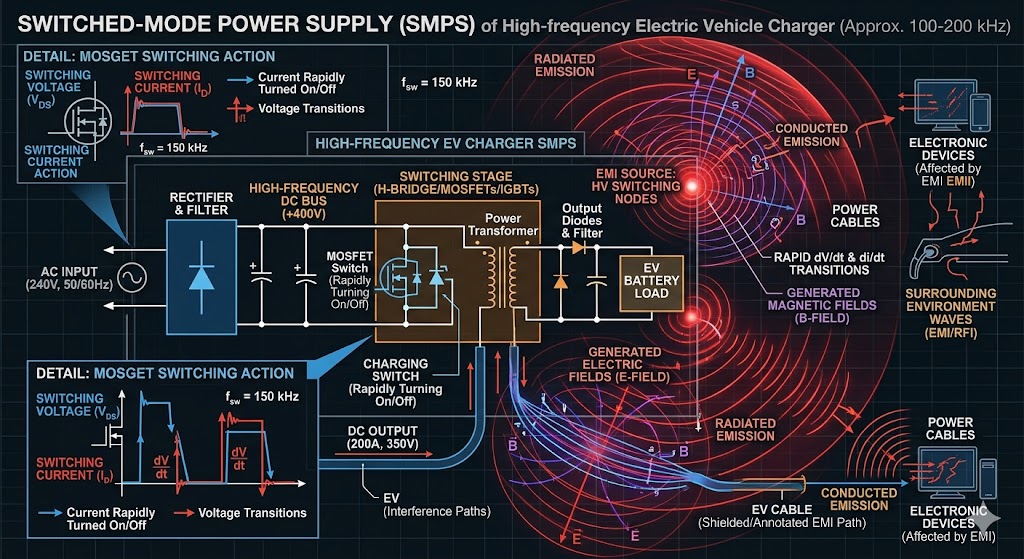
To appreciate why EMC testing is so challenging for EV chargers, it helps to understand where the electromagnetic noise actually comes from. Modern EV chargers — particularly DC fast chargers — rely heavily on switched-mode power supplies (SMPS) and high-frequency switching circuits. Here's what's happening inside:
3.1 High-Frequency Switching
Power converters in EV chargers switch electrical current on and off at extremely high frequencies — sometimes hundreds of kilohertz. Every time a switch opens or closes, it creates an abrupt change in voltage or current. These rapid transitions are like throwing a stone into a pond: the ripples (in this case, electromagnetic waves) spread outward in all directions. The faster the switching, the broader and more intense the electromagnetic spectrum these ripples cover.
3.2 Conducted vs. Radiated EMI
The electromagnetic noise travels in two fundamental ways. Conducted EMI flows along the power cables and back into the electrical grid — think of it like vibrations traveling through a pipe. Radiated EMI, on the other hand, travels through the air like radio waves. Both types require separate measurement and mitigation strategies, and both are covered under EMC standards.
3.3 Harmonic Distortion
EV chargers also draw current from the grid in a non-sinusoidal fashion, introducing harmonic distortion. These harmonics are multiples of the fundamental power frequency (50 or 60 Hz) and can cause voltage fluctuations on the grid, overheat transformers, and interfere with neighboring equipment. Controlling harmonic content is a key part of the EMC design challenge.
4. The Regulatory Framework: Standards You Need to Know
EMC testing for EV chargers isn't optional — it's a legal requirement in most markets worldwide. Different regions have their own regulatory frameworks, though many share common technical foundations:
- CISPR 11 / EN 55011: The foundational standard for industrial, scientific, and medical (ISM) equipment emissions — widely applied to EV chargers. It defines limits for both radiated and conducted emissions.
- IEC 61851-21-1 / -21-2: Specifically designed for EV conductive charging systems. Part 21-1 covers EMC requirements for on-board chargers, while 21-2 addresses off-board (infrastructure) chargers — exactly what you find at charging stations.
- IEC 61000 Series: A comprehensive set of standards covering everything from electromagnetic environment definitions to immunity test methods. IEC 61000-4-x standards define specific immunity tests (ESD, surges, fast transients, etc.).
- FCC Part 15 (USA): Governs unintentional radiators in the United States, setting emission limits for devices including EV charging equipment.
- EU EMC Directive 2014/30/EU: The overarching European legislative framework requiring all electrical equipment placed on the EU market to meet EMC requirements. CE marking cannot be achieved without EMC compliance.
5. Inside the Test Lab: What EMC Testing Actually Involves
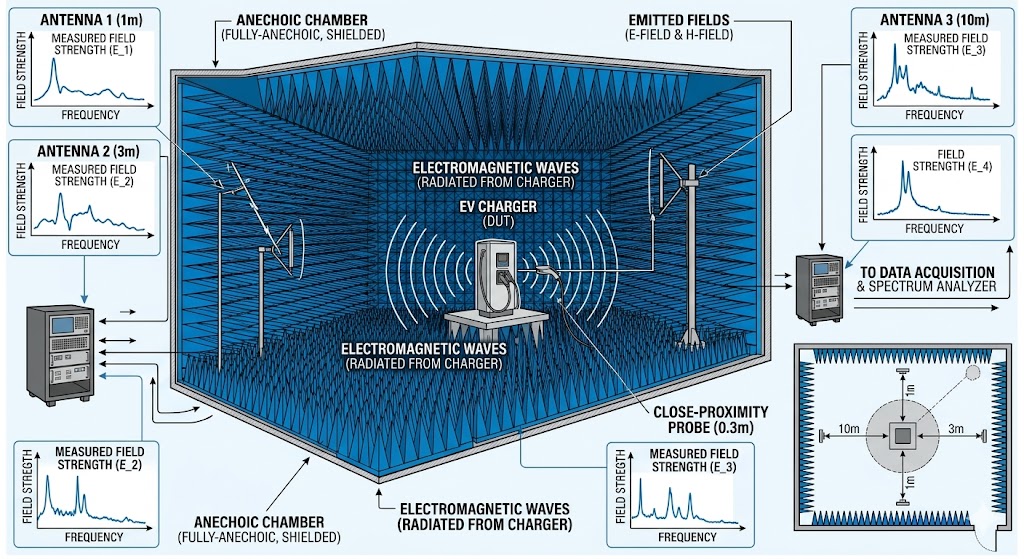
Walking into an EMC test lab for the first time is a memorable experience. The star of the show is typically a large, specially shielded room called an anechoic chamber — its walls lined with pyramid-shaped foam absorbers that prevent electromagnetic reflections. This controlled environment allows engineers to measure exactly what a device is emitting, without any outside interference corrupting the results.
5.1 Radiated Emissions Testing
The EV charger is placed in the anechoic chamber and powered up to simulate real operating conditions. Antennas positioned at specific distances and heights scan through a range of frequencies, measuring the electromagnetic field strength radiating from the device. The results are compared against the applicable limits. If any frequency exceeds the limit, the charger fails — and design changes are needed.
5.2 Conducted Emissions Testing
Here, the focus shifts to the noise traveling back through the power cable into the electrical network. A Line Impedance Stabilization Network (LISN) — a specialized passive network — is inserted between the charger and the power supply. The LISN provides a standardized impedance and allows engineers to measure conducted noise in the frequency range of typically 150 kHz to 30 MHz.
5.3 Immunity Testing
This is where the charger gets put through its paces as a victim rather than a source. A variety of standardized disturbances are deliberately applied to see how the charger responds. Common immunity tests include Electrostatic Discharge (ESD) — simulating a person touching the device; Electrical Fast Transient (EFT) bursts — mimicking the noise from switching inductive loads; Surge immunity — replicating lightning-induced voltage spikes; and Radiated immunity — exposing the charger to strong radio frequency fields.
6. Real-World Consequences: What Happens When EMC Goes Wrong
It might be tempting to think of EMC as just a box-ticking regulatory exercise. But the consequences of poor EMC performance in EV chargers are very real and can range from mildly inconvenient to genuinely dangerous.
- Interference with Vehicle Systems: Modern vehicles are packed with sensitive electronics — everything from ADAS sensors to infotainment systems. A noisy charger could disrupt these systems during charging, potentially causing errors or unexpected behavior.
- Grid Pollution: Conducted emissions feeding back into the grid can propagate far and wide. In areas with high concentrations of EV chargers, cumulative conducted noise can affect grid quality and interfere with other grid-connected equipment.
- Safety System Interference: In commercial and industrial settings, chargers operating near safety-critical systems — such as emergency communication equipment or industrial control systems — must not interfere with those systems. The stakes can be quite high.
- Charger Malfunction: Poor immunity means the charger itself can be disrupted by external interference. Imagine a charger stopping mid-session because a nearby radio transmission tripped an internal fault. That's both frustrating and potentially harmful if it causes unexpected behavior.
7. Designing for EMC: Building It In from the Start
The most effective and cost-efficient approach to EMC compliance is to design for it from the very beginning, rather than trying to fix problems at the end. Experienced engineers refer to this as 'designing EMC in' rather than 'bolting it on.' Here are the key strategies:
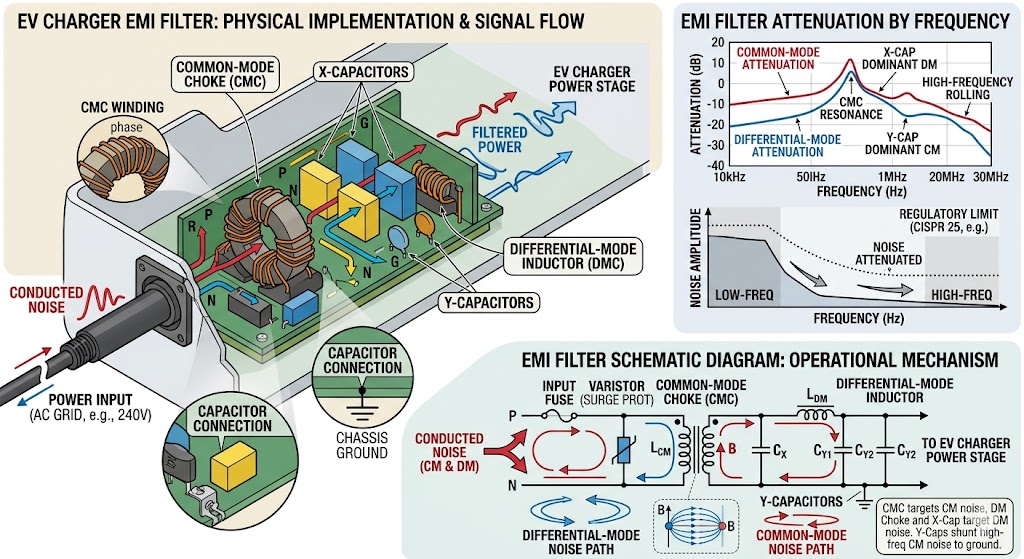
- EMI Filters: Installing properly designed filters at the power input prevents conducted noise from escaping onto the grid. Common filter topologies use combinations of inductors (common-mode chokes) and capacitors to attenuate noise across a wide frequency range.
- PCB Layout Discipline: At the circuit board level, careful placement of components, thoughtful routing of high-current loops, and proper grounding can dramatically reduce EMI generation. Keeping switching nodes away from sensitive analog circuits is fundamental.
- Shielding: Metal enclosures and shielded cables contain radiated emissions. The effectiveness of shielding depends on the material, construction quality, and — critically — the integrity of any seams or openings, which can act as slots antennas if not managed carefully.
- Spread Spectrum Techniques: Some modern chargers deliberately modulate their switching frequency slightly — spreading the emission energy across a broader frequency range. This reduces the peak emission at any given frequency, making it easier to meet emission limits.
8. The Bigger Picture: EMC and the Future of EV Infrastructure
As EV adoption accelerates globally, the density of charging infrastructure is growing rapidly. Charging hubs with dozens of high-power DC fast chargers in close proximity create electromagnetic environments that simply didn't exist a decade ago. This makes EMC not just a device-level concern, but a systemic infrastructure challenge.
Vehicle-to-Grid (V2G) technology — where EVs can feed energy back into the grid — adds another layer of complexity. Bidirectional power flow means bidirectional EMI pathways, and standards are still evolving to address these scenarios comprehensively. Engineers and regulators are working together to ensure that the EMC frameworks keep pace with the technology.
Wireless charging (inductive power transfer) presents perhaps the most interesting EMC frontier. By definition, these systems are designed to transfer energy wirelessly — but this also means they radiate energy. Balancing power transfer efficiency with strict emission control is a genuinely hard engineering problem, and one that the industry is actively solving.
9. Conclusion: EMC as a Quality Commitment
EMC testing for EV chargers is far more than a regulatory hurdle. It's a commitment to quality, safety, and responsible engineering. When a manufacturer invests seriously in EMC — not just to pass the minimum tests, but to genuinely understand and control the electromagnetic behavior of their product — the result is a charger that is more reliable, more resilient, and more trustworthy.
For consumers, that means a charging experience that just works — no mysterious faults, no interference with other devices, no surprises. For the broader ecosystem, it means an EV infrastructure that integrates cleanly into our existing electrical and electronic environment. And as that infrastructure scales to support millions of vehicles worldwide, getting the electromagnetic fundamentals right becomes more important than ever.
In the end, EMC is really about one thing: making sure that as we build the connected, electrified world of the future, all the pieces work together harmoniously — not just mechanically or electrically, but electromagnetically too.