
Battery charging is not simply a matter of plugging in a power source and waiting. Behind every charging session lies a carefully orchestrated sequence of electrical control strategies designed to maximize efficiency, protect battery health, and ensure safety. Among the various charging methods developed over the decades, Constant Current (CC) and Constant Voltage (CV) charging stand out as the two foundational approaches. Together, they form the backbone of modern battery management systems — and they are especially central to how electric vehicles (EVs) are charged today.
Understanding these two methods, how they work individually, how they complement each other, and how they are applied in real-world EV charging infrastructure, provides valuable insight into the science and engineering that powers the electric mobility revolution.
What Is Constant Current (CC) Charging?
Constant Current charging, as the name suggests, delivers a fixed current to the battery regardless of the battery’s changing terminal voltage. The charger’s control circuit continuously monitors and adjusts its output to maintain the target current level throughout this phase.
During CC charging, the battery’s voltage rises gradually as energy is stored in the cells. For lithium-ion batteries — the dominant chemistry in modern EVs — the charging current in this phase typically ranges from 0.5C to 1C (where C represents the battery’s capacity in ampere-hours). A 100 Ah battery pack, for example, would receive 50 A to 100 A during constant current charging.
The main advantage of CC charging is speed during the early phase. When a battery’s state of charge (SOC) is low, CC mode can pump in energy quickly and efficiently because the battery readily accepts current at this stage. The power delivered increases as voltage climbs, meaning more energy is transferred over time within this phase.
However, CC charging cannot be used indefinitely. As the battery approaches its upper voltage limit — around 4.2 V per cell for most lithium-ion chemistries — continuing to force a high current becomes dangerous. Overvoltage can cause lithium plating on the anode, electrolyte decomposition, gas generation, and in severe cases, thermal runaway. This is where constant voltage charging takes over.
What Is Constant Voltage (CV) Charging?
Constant Voltage charging holds the charger output voltage at a fixed target level — typically the battery’s maximum rated voltage — while allowing the current to taper naturally as the battery fills up. In this phase, the driving force behind ion movement within the cell gradually diminishes as the electrochemical potential difference between the charger and the battery decreases. As a result, the current drawn by the battery declines exponentially over time.
CV charging is gentle and inherently self-regulating. The closer the battery gets to full charge, the less current flows, which greatly reduces the risk of overcharging. Most charging protocols define the end of a full charge cycle as the point when the current during CV phase drops below a threshold — often 0.05C or 0.1C — at which the battery is considered fully charged.
The trade-off is time. CV charging becomes progressively slower as the battery fills, making it inefficient to rely on CV alone from the very start. That is why it is almost always used in combination with CC charging, not as a standalone method.
The CC-CV Charging Protocol: The Industry Standard
In practice, virtually all serious battery charging systems — from smartphones to electric vehicles — use a combined CC-CV protocol, which blends the speed advantages of constant current with the safety benefits of constant voltage.
The process unfolds in two main stages:
Stage 1 — Constant Current Phase: The charger applies a fixed current to the battery. The battery voltage climbs steadily. This phase accounts for roughly 70% to 80% of the total energy delivered and completes relatively quickly.
Stage 2 — Constant Voltage Phase: Once the battery voltage reaches the target ceiling, the charger locks the voltage at that level and allows the current to taper off gradually. This phase tops up the remaining 20% to 30% of capacity and ensures the battery is brought safely to full charge without stress.
Some advanced chargers also include a pre-conditioning stage before CC begins — a trickle charge or low-current phase applied when a battery is deeply discharged, to safely bring the cells to a voltage level where standard CC charging can begin without risk of damage.
The CC-CV method strikes an effective balance: fast enough to be practical, gentle enough to protect battery longevity, and safe enough for high-energy applications like electric vehicles.
-54.jpg?w=1408&h=768)
How EV Chargers Apply CC-CV: From Home Outlets to DC Fast Chargers
Electric vehicle chargers come in several categories, and the way each implements the CC-CV protocol differs significantly depending on power level and hardware design.
Level 1 and Level 2 AC Charging (On-Board Charger)
For home and workplace charging using AC power, the conversion from AC to DC and the CC-CV regulation all happen inside the vehicle itself through the on-board charger (OBC). The EV’s battery management system communicates with the OBC to dictate the appropriate current and voltage limits based on battery temperature, current SOC, and cell health. The charging station on the wall simply provides AC power and basic communication signals. CC-CV control is fully managed on the vehicle side.
Level 1 charging (120 V in North America) delivers around 1.4 kW, while Level 2 (240 V) typically provides 7 kW to 22 kW. These methods are slow but convenient for overnight charging and, because of the gentle current levels, are very friendly to long-term battery health.
DC Fast Charging (Level 3 / DCFC)
DC fast chargers — including CHAdeMO, CCS (Combined Charging System), and Tesla’s Supercharger network — bypass the vehicle’s on-board charger entirely. They deliver high-voltage direct current straight to the battery pack, with the CC-CV regulation controlled by the charging station itself in close communication with the vehicle’s BMS.
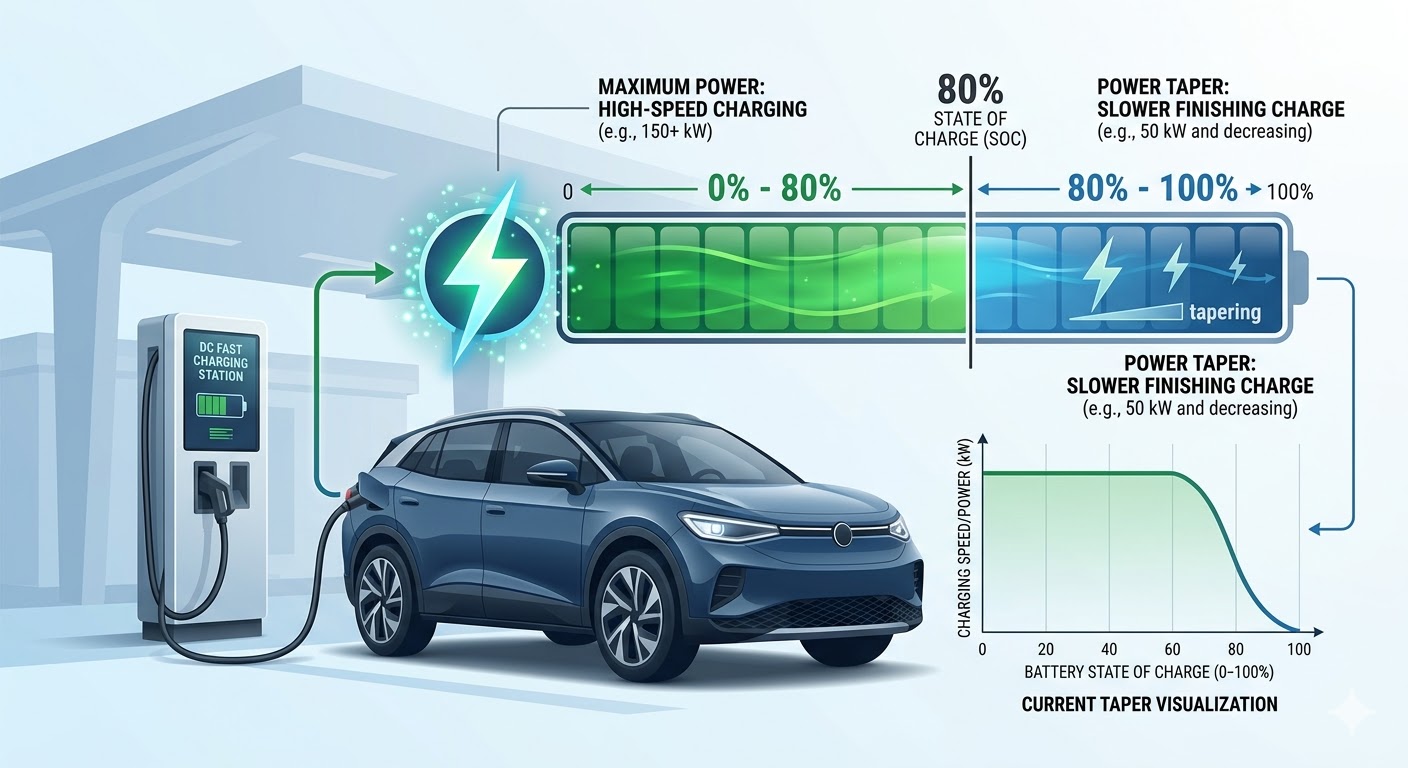
This is where the CC-CV protocol operates at its most dramatic scale. A modern DC fast charger can deliver 50 kW to 350 kW, pushing hundreds of amps into the battery during the CC phase. For example, a 150 kW charger supplying a 400 V battery pack delivers approximately 375 A of constant current in the initial phase. The BMS continuously monitors cell voltages, temperatures, and internal resistance, feeding this data back to the charger to dynamically adjust current levels in real time.
Once the battery reaches around 80% SOC, the charger transitions to the CV phase and the current begins to taper. This is why EV manufacturers and charging networks often advertise “charge to 80% in 20–30 minutes” — the first 80% is filled during the high-power CC phase, while the final 20% takes comparably longer during the CV phase. Charging to 100% via a DC fast charger is significantly slower than reaching 80%, and repeatedly charging to 100% using high-power fast chargers can accelerate battery degradation over time.
Bidirectional and Smart Charging Considerations
Emerging technologies like Vehicle-to-Grid (V2G) and Vehicle-to-Home (V2H) are introducing bidirectional charging systems where the EV battery can discharge back into the grid or home. These systems still fundamentally rely on CC-CV principles, but with added layers of control to manage discharge current and voltage safely. The CC-CV framework adapts naturally to this bidirectional role, demonstrating its enduring relevance as battery applications grow more complex.
-55.jpg?w=1408&h=768)
Why CC-CV Matters for Battery Longevity
The choice of charging method is not just about speed — it has long-term consequences for battery health. Lithium-ion batteries degrade through several mechanisms: calendar aging, cycle aging, lithium plating, and electrolyte breakdown. Poorly managed charging accelerates all of these.
CC-CV charging, when properly implemented, minimizes stress by avoiding overcharging (managed by the CV phase cutoff), reducing excessive heat generation (by tapering current as the battery fills), and preventing deep overvoltage events. Thermal management systems work alongside CC-CV protocols to keep cell temperatures within optimal ranges, since both charging speed and battery chemistry are highly temperature-dependent.
Manufacturers typically recommend keeping EV batteries between 20% and 80% SOC for daily use, and only charging to 100% when a long trip requires it. This practice effectively keeps the battery operating primarily within the CC phase and the early CV phase — the gentlest part of the charge curve — which significantly extends the usable life of the pack.
Conclusion
Constant Current and Constant Voltage charging are not competing philosophies — they are complementary stages of a single, elegant solution to one of energy storage’s most fundamental challenges: how to fill a battery quickly without harming it. The CC phase delivers speed; the CV phase delivers safety and completeness. Together as CC-CV, they define the standard across virtually every serious battery charging application, from consumer electronics to multi-hundred-kilowatt EV fast chargers.
As electric vehicles become more capable, charging networks more powerful, and battery chemistries more sophisticated, the underlying CC-CV framework continues to evolve — accommodating higher voltages, smarter thermal management, and real-time adaptive control. But the core principle remains unchanged: give the battery what it can handle, when it can handle it, and no more.
1 commentaire