
Installing an EV charger at home offers convenience and cost savings, but the regulatory landscape varies dramatically across the globe. The simple answer is: in most developed regions, yes, you need a permit—at least for Level 2 chargers that require electrical modifications. However, the specifics depend heavily on your location, the type of charger, and local regulations. Understanding these regional differences is crucial before proceeding with installation, as bypassing permit requirements can result in safety hazards, insurance complications, and substantial fines.
Understanding EV Charger Types and Permit Triggers
Before examining regional regulations, it's important to understand why permits are needed in the first place. EV chargers come in three main categories: Level 1 (120V), Level 2 (240V), and DC fast chargers. Level 1 chargers can typically plug into any standard household outlet and rarely require permits. However, Level 2 chargers represent the most common residential installation and almost always require permits because they demand significant electrical modifications.
A Level 2 charger operates on 240 volts, pulling 40-48 amps continuously, which requires a dedicated circuit, a higher-capacity circuit breaker, and potentially an upgrade to your home's electrical panel. These electrical modifications trigger local building codes and safety regulations, necessitating permit approval and inspection by qualified officials. This distinction between charger types is critical to understanding regional permit requirements, as many jurisdictions only mandate permits for installations exceeding certain power thresholds.
North America: United States and Canada
United States
The United States implements a decentralized permitting system where local governments maintain primary authority over EV charger installation requirements. In the U.S., most cities and counties require electrical permits for Level 2 charger installations due to the necessity of modifying home electrical systems.
The permitting process typically follows these steps: First, homeowners must check with their local building or permitting department—either online or by phone—to understand specific requirements for their jurisdiction. Second, they must hire a licensed electrician to perform the installation, as most municipalities require professional work. Third, applicants submit a permit application alongside relevant documentation, including a site plan showing charger location, electrical schematics, the charger's manufacturer specifications, and the electrician's load calculations confirming the electrical panel can safely handle the additional demand. Fourth, homeowners pay permit fees, which typically range from $50 to $300 depending on location and installation complexity.
After installation, a final inspection by local authorities ensures compliance with the National Electrical Code (NEC) and local building codes. This inspection verifies safe installation, proper labeling, GFCI/AFCI protection, and overall code compliance.
Some states have streamlined this process. California and New York have established state-level guidelines to help local jurisdictions expedite approvals. For instance, the Los Angeles Department of Building and Safety (LADBS) offers an online permit portal with same-day approval for installations not requiring major electrical panel upgrades. Similarly, Miami-Dade County in Florida provides an express residential permit process allowing digital submission with approval within a few business days.
However, utility companies complicate the process further. Because Level 2 chargers draw substantial power, many electric utilities require separate approval before installation to ensure grid capacity can accommodate the demand. Some utilities may even require notification or assessment to determine whether grid upgrades are necessary, particularly in areas already experiencing peak demand issues.
Bypassing permits carries severe consequences: unpermitted installations can void homeowner insurance, result in fines if discovered by authorities, lower property value if discovered during sale, and create serious safety hazards including electrical fires and equipment damage.
Canada
Canada's permitting requirements vary by province, but all require some form of electrical approval. Ontario, Canada's most populous province, requires an Electrical Safety Authority (ESA) permit for residential EV charger installations.
The Ontario process involves several steps: First, a licensed contractor performs a site evaluation assessing electrical panel capacity, wiring routes, and charger location feasibility. Second, the contractor applies for an ESA permit before beginning work. Third, the licensed electrician installs the charger in compliance with the Canadian Electrical Code. Fourth, the ESA conducts an official inspection to verify safety and code compliance before final approval.
Similar requirements exist throughout Canadian provinces. Skipping the permit process in Canada creates significant risks: insurance companies may deny claims for electrical fires or malfunctions resulting from unpermitted work, warranty claims on the charger may become invalid, and homeowners may face legal consequences.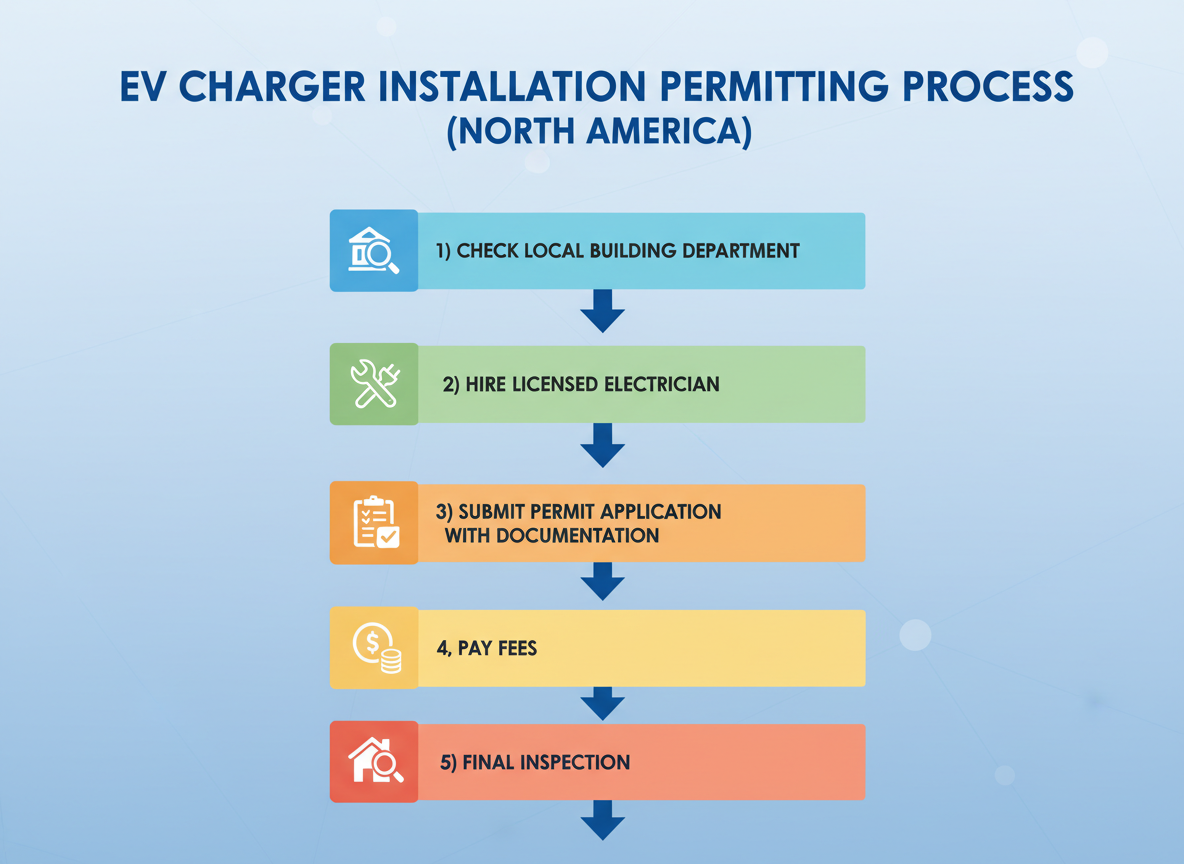
Europe: United Kingdom and European Union Countries
United Kingdom
The UK implements a comprehensive approval system distinct from other regions. While traditional permits aren't always called "permits," the regulatory framework is extensive. To install a home EV charger in the UK, you must either own the property or obtain written landlord permission before installation begins.
The UK distinguishes between two parking scenarios. For homeowners with off-street parking (garage, driveway), the installation process is relatively straightforward. For those with on-street parking, the process becomes significantly more complex, requiring cross-pavement charging solutions (like Kerbo Charge or ChargeArm) and local planning authority approval.
Additional UK requirements include:
- Wi-Fi or 4G connectivity at the installation location to enable smart charging features required by The Electric Vehicles (Smart Charge Points) Regulations 2021
-
OZEV-approved, accredited installers (such as NICEIC or Safe Contractor registered professionals)
-
Distribution Network Operator (DNO) approval to verify adequate electricity supply and grid capacity
-
Compliance with specific safety standards: BS EN 61851, BS 7671 (IET Wiring Regulations), The IET Code of Practice for Electric Vehicle Charging Equipment Installations, The Electricity Safety, Quality and Continuity Regulations 2002, and BS 8300 accessibility standards
-
Physical charger specifications: EV chargers must be mounted at 0.75-1.2 meters height from ground and cannot be within 2.5 meters of metal objects connected to power supplies
The typical lead time for home EV charger installation in the UK is 2-4 weeks from application to completion, with the physical installation itself taking 2-3 hours, though this varies based on complexity and DNO response times. Costs typically range from £650 to £2,000 for a 7kW charger installation, depending on equipment quality and installation complexity.
European Union
The EU has implemented region-wide regulations through the Alternative Fuels Infrastructure Regulation (AFIR) and related directives. As of January 2025, new EU legislation requires that all non-residential buildings with more than 20 parking spaces must have at least one EV charging point installed.
For residential installations, regulations vary by country, but general principles include:
- Registration requirements with local electricity distributors for chargers up to 11kW capacity
-
Permit requirements for chargers exceeding 11kW capacity, which may require three-phase electrical supply upgrades
-
Compliance with local building codes and regulations, which differ between countries
-
Grid connection agreements and Distribution System Operator (DSO) approval
In Germany, residential EV charger installation follows specific protocols. For chargers up to 11kW, registration with the network operator or energy supplier is sufficient. For installations exceeding 11kW, formal permits are required. Germany's Federal Building Code (Baugesetzbuch) defines when installations are permit-free versus when permits are mandatory, varying by municipality and regional regulations.
The Charging Station Ordinance (Ladesäulenverordnung) regulates technical aspects, including safety requirements and Type 2 connector standards for AC chargers of 3.7kW or greater. Authorities can verify compliance on a regular basis, and Charge Point Operators must provide documentation proving technical standards are met.
Australia: Stringent Safety Standards
Australia implements some of the most stringent residential EV charger installation requirements globally. For chargers exceeding 3.6kW, permits are frequently required, though this varies by state and local authority.
The Australian process involves several mandatory steps:
- Licensed electrician installation, as DIY installation is not permitted
-
Site assessment and load analysis to ensure the electrical system can safely accommodate the charger
-
Compliance with AS/NZS 3000 Wiring Rules (Australian/New Zealand electrical standards)
-
Dedicated circuit requirement, where no other appliances can share the same circuit as the EV charger
-
Pre-installation permit application with local council or electricity distributor
-
Post-installation inspection by local authorities to verify compliance with electrical safety standards
Installation costs in Australia typically range from AUD $1,200 to $2,500 for both equipment and labor, with timelines varying from a single day for basic installations to several days for complex setups requiring switchboard upgrades or underground trenching.
Australian regulations emphasize grid protection and electrical safety, reflecting concerns about overloading local electricity infrastructure. Some installation companies streamline the permitting process on behalf of homeowners, though homeowners remain responsible for ensuring all regulatory requirements are met.
Japan: Professional Licensing Requirements
Japan implements a unique regulatory framework centered on professional qualifications rather than traditional municipal permits. EV charger installations in Japan require first-class or second-class electrician qualifications.
For standard charging station installations, electrician certification is the primary requirement. However, if the project contract amount exceeds 5 million yen (approximately USD $33,000), an additional construction industry license is mandated separately. This requirement significantly impacts the Japanese market, as rapid charging station installations—the most common commercial installations—typically cost 3 million to over 10 million yen, making the construction industry license nearly essential for many projects.
This two-tiered approach reflects Japan's emphasis on professional competency and project scale-appropriate oversight, distinguishing it from Western permitting models based on infrastructure assessment.
Key Risks of Skipping the Permit Process
Regardless of region, bypassing permit requirements creates substantial risks that far outweigh potential time and cost savings:
Safety Hazards: Level 2 chargers draw high voltage and amperage, and unvetted installations can cause electrical fires, equipment damage, or personal injury. Permits ensure installations meet electrical safety codes and pass professional inspections.
Insurance Complications: Most homeowner insurance policies require all electrical work to be code-compliant. Unpermitted installations can void coverage, leaving homeowners unprotected if malfunction or fire occurs.
Financial Penalties: If unpermitted work is discovered, authorities can impose substantial fines and require full installation removal and reinstallation, costing far more than original permit fees.
Property Value Impact: Unpermitted electrical work discovered during property sales or refinancing can significantly lower property value, complicate transactions, and deter buyers.
Warranty Voiding: EV charger and vehicle manufacturer warranties may become invalid if installation didn't follow permitted, professional procedures.
Best Practices and Recommendations
Before beginning EV charger installation anywhere globally, homeowners should:
Research local requirements by contacting municipal building departments or permitting offices, either online or by phone, to understand specific jurisdictional rules.
Hire certified professionals experienced in EV charger installation and familiar with local electrical codes and regulations. Licensed electricians can often handle permit applications and ensure compliance.
Verify utility requirements by contacting local electricity providers to understand grid capacity assessment procedures and any additional approvals needed.
Secure landlord permission if renting property, and document this permission in writing before scheduling installation.
Plan ahead, as permitting and approval processes typically require 2-4 weeks minimum in developed regions, particularly in the UK and parts of the EU.
Budget appropriately, accounting for permit fees ($50-$500 in North America, £650-£2,000+ in the UK, AUD $1,200-$2,500 in Australia), electrician labor, potential electrical upgrades, and inspection fees.
Maintain documentation, keeping all permits, inspection certificates, and installation records for future property sales, insurance claims, or warranty disputes.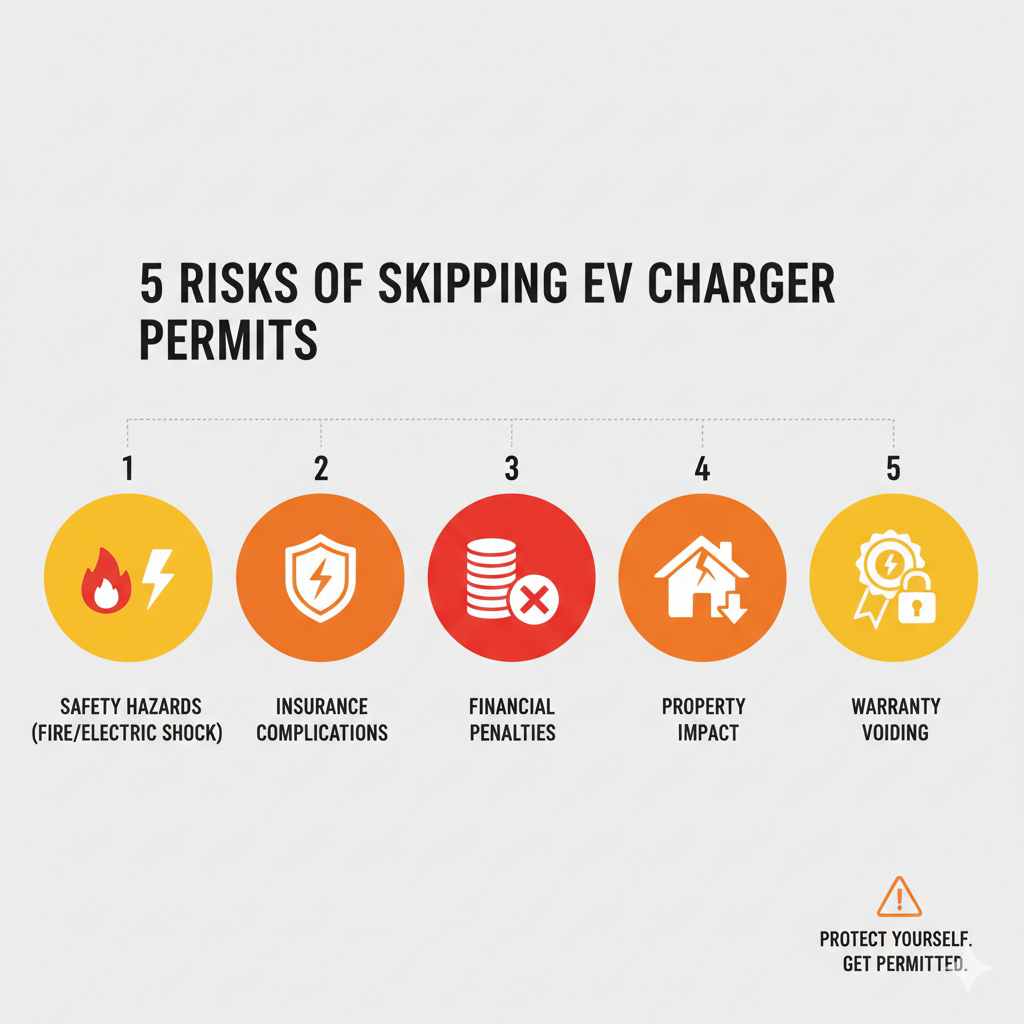
Conclusion
The permit requirements for residential EV charger installation reflect a global consensus that Level 2 charging infrastructure requires professional oversight to ensure safety, grid stability, and code compliance. While specific processes vary dramatically across regions—from streamlined online permitting in California to comprehensive DNO approvals in the UK to strict professional licensing in Japan—the fundamental principle remains constant: obtaining proper permits protects homeowners from safety hazards, insurance complications, legal penalties, and property value loss.
By understanding regional regulations before installation begins and partnering with qualified, licensed professionals, homeowners can ensure their EV charging infrastructure is safe, compliant, and properly documented for years of reliable operation.