In the invisible architecture of the modern electrical grid, three sinusoidal currents flow simultaneously, each displaced 120 degrees from the next. When these currents carry equal loads, the system operates in a state of elegant equilibrium. When they do not, the consequences cascade through every device, motor, and meter connected to the supply — and increasingly, through the batteries of electric vehicles parked across Europe and beyond.
Understanding Three-Phase Power: The Foundation
Three-phase alternating current (AC) power was pioneered in the late nineteenth century by engineers including Nikola Tesla and Mikhail Dolivo-Dobrovolsky, who recognised that generating, transmitting, and consuming electricity in three symmetrical phases offered decisive advantages over single-phase systems. A three-phase system delivers power more smoothly, uses conductors more efficiently, and enables the simple, rugged induction motors that run virtually every industrial process on Earth.
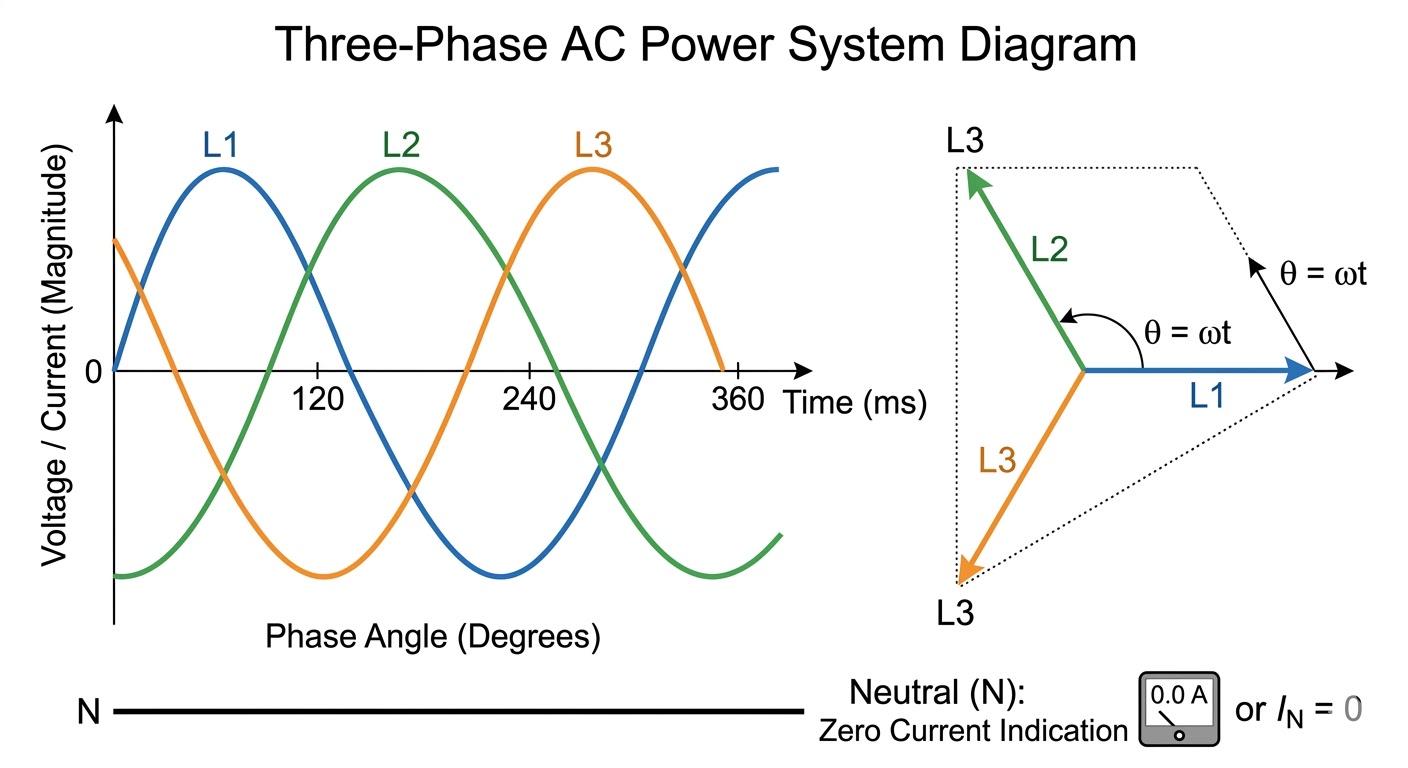
The three phases — conventionally labelled L1, L2, and L3 in Europe — are produced by a generator whose three sets of windings are spaced 120 electrical degrees apart. At any instant, the sum of the three voltages in a balanced system is zero. This geometric cancellation eliminates the need for a large return current in the neutral conductor and is the mathematical reason why balanced three-phase systems are so efficient to distribute over long distances.
Phase balancing is the practice — and the discipline — of distributing electrical loads as evenly as possible across all three phases. In an ideal installation, each phase carries the same current, operates at the same temperature, and experiences the same voltage drop from source to load. In practice, achieving and maintaining this balance is a continuous engineering challenge that spans the design of distribution boards, the commissioning of industrial equipment, and the programming of smart energy management systems.
— Industrial Power —
Phase Balancing in Industrial Electricity
Industrial facilities are the most demanding environments in the electrical supply chain. A modern automotive plant, a pharmaceutical cleanroom, or a data centre may draw tens of megawatts continuously, feeding hundreds of motors, drives, heating elements, and precision instruments simultaneously. In these environments, phase imbalance is not a theoretical concern — it is a constant operational and financial hazard.
-50.jpg?w=1408&h=768)
The Mechanics of Imbalance
Phase imbalance arises whenever single-phase loads — lighting circuits, small appliances, office equipment, single-phase welding machines — are not distributed symmetrically across L1, L2, and L3. Even a small voltage imbalance has a disproportionate effect on three-phase motors. The National Electrical Manufacturers Association (NEMA) has long documented that a voltage imbalance of just 3.5% produces a current imbalance of approximately 20%, and increases motor winding temperature by as much as 25%. This accelerated thermal ageing directly shortens insulation life and increases the probability of motor failure.
| 3.5%Voltage imbalance causing ~20% current imbalance | 25%Rise in motor winding temperature at 3.5% imbalance | 50%Potential reduction in motor service life |
|---|---|---|
Beyond motors, phase imbalance creates a substantial neutral current. In a perfectly balanced system, the neutral carries no current at all; the three phase currents cancel mathematically. With imbalance, the neutral must carry the residual current, generating heat, increasing resistive losses, and — in severe cases — creating a fire risk in undersized neutral conductors. Transformers supplying unbalanced loads experience uneven core saturation, increased magnetising losses, and harmonic distortion, all of which erode both efficiency and equipment life.
The economic consequences compound over time. Elevated neutral currents mean paying for electricity that does no useful mechanical or thermal work — it simply heats cables. Premature motor failures trigger unplanned downtime, replacement costs, and production losses that typically far exceed the cost of the original motor. Insurance premiums for facilities with poor power quality records tend to reflect these elevated risks.
Monitoring and Correction Strategies
Industrial facilities address phase imbalance through a layered approach. At the design stage, electrical engineers use load scheduling studies to distribute anticipated single-phase loads evenly across the three phases. At the installation stage, main distribution boards (MDBs) are wired to balance large loads, and sub-distribution boards are carefully designated by phase. During operation, power quality analysers monitor voltage and current on each phase continuously, triggering alerts when imbalance exceeds defined thresholds — typically 2% for voltage and 10% for current in sensitive installations.
Active correction technologies have matured significantly. Static var compensators (SVCs) and distribution static compensators (DSTATCOMs) can inject reactive current on individual phases to correct both imbalance and power factor simultaneously in real time. For smaller facilities, electronic load balancers that dynamically reassign single-phase loads between phases offer a more cost-effective solution. The growth of building energy management systems (BEMS) has made it possible to schedule high-power single-phase processes — such as electric arc furnaces, induction heaters, and electric boilers — in time-shifted patterns that maintain near-constant balance across all three phases throughout the production day.
— European Residential Context —
European Households and the Three-Phase Parallel
The situation in European residential electricity is more nuanced than is commonly understood. While most household appliances in Europe operate on single-phase 230 V supply, the distribution network that feeds those homes is fundamentally a three-phase system — and the phase balancing challenge is simply expressed at a different scale.
How European Distribution Works
European low-voltage distribution networks typically operate at 400 V phase-to-phase (230 V phase-to-neutral), and a standard residential street is served by a 400 V, three-phase, four-wire cable running from a local transformer substation. Individual dwellings are connected to one of the three phases — ideally in rotation so that roughly one-third of the homes on any given street draw from L1, one-third from L2, and one-third from L3. The street's aggregate load is thus intended to be balanced at the transformer, even though each individual home sees only single-phase supply.
| EUROPEAN VS NORTH AMERICAN DISTRIBUTIONUnlike North America, where residential supply is typically a split-phase 120/240 V system served by a single-phase transformer on each street pole, Europe's residential grid is genuinely three-phase at the distribution level. This architectural difference is consequential: European distribution networks are inherently better suited to accommodating large, unbalanced loads such as EV chargers, because the three-phase infrastructure already extends to the street level and often to the meter.In Germany, Austria, Switzerland, and the Netherlands, it is common for newer single-family homes and virtually all apartment buildings to receive a full three-phase connection at the meter, enabling the installation of three-phase wallboxes rated up to 11 kW or 22 kW without additional grid reinforcement — a capability that is simply unavailable in most North American residential installations. |
|---|
This architecture creates a residential-scale phase balancing problem that mirrors the industrial one. When EV chargers, heat pumps, and electric cookers are heavily concentrated on one phase of a residential street — because, for instance, a developer connected all units in a new block to L1 — the street transformer sees a severe imbalance. Neutral current rises, transformer losses increase, and voltage on the overloaded phase drops, leading to dimmer lights, slower motor starts, and reduced charging rates for devices at the end of the feeder.
Similarities with Industrial Practice
The parallels between residential and industrial phase management are striking. Both environments share the same physics and the same failure modes — elevated neutral current, voltage drop on the loaded phase, transformer overloading — differing only in scale and the identity of the actors responsible for correction. In industry, a qualified electrical engineer manages the distribution board; in a residential street, the responsibility falls to the distribution network operator (DNO). Both are increasingly turning to the same suite of solutions: real-time monitoring via smart meters, dynamic load shifting, and active power electronics at the point of supply.
The rollout of smart meters across the European Union — mandated progressively since the Third Energy Package — has transformed DNOs' ability to detect residential phase imbalance. Where previously a transformer fault or a burning neutral joint was the first sign of a problem, smart meters now report phase voltage and current data at intervals as short as fifteen minutes, enabling operators to detect and correct imbalance proactively. Several DNOs in Scandinavia have implemented automated phase-switching systems that can reassign individual meters to a different phase without a physical visit to the meter cabinet.
— Electric Vehicle Charging —
Phase Balancing and EV Chargers: A Critical Intersection
The electrification of transport has made phase balancing one of the most practically urgent topics in power distribution. An electric vehicle charger is not merely a large load — it is a large, intermittent, potentially unbalanced load whose behaviour depends on the vehicle's on-board charger, the available supply, the state of the battery, and increasingly, the instructions of an energy management system trying to optimise across an entire building or street.
Single-Phase vs Three-Phase Charging
Most passenger EVs sold in Europe can accept both single-phase and three-phase AC charging. A single-phase Type 2 connection at 230 V and 32 A delivers 7.4 kW — sufficient to add roughly 40–50 km of range per hour. A three-phase Type 2 connection at 400 V and 16 A delivers 11 kW, while 32 A across three phases delivers 22 kW. The advantage of three-phase charging from a grid perspective is substantial: the load is distributed across all three phases and the current drawn per phase is a third of what a single-phase charger would draw for the same total power.
| Charging Type | Voltage | Max Current/Phase | Power | Phase Impact |
|---|---|---|---|---|
|
Single-phase AC (Mode 2) |
230 V L-N |
16 A |
3.7 kW |
Full load on one phase |
|
Single-phase AC (Mode 3) |
230 V L-N |
32 A |
7.4 kW |
Full load on one phase |
|
Three-phase AC (Mode 3) |
400 V L-L |
16 A |
11 kW |
Balanced across L1, L2, L3 |
|
Three-phase AC (Mode 3) |
400 V L-L |
32 A |
22 kW |
Balanced across L1, L2, L3 |
|
DC Fast Charging (CCS) |
400–920 V DC |
200–500 A DC |
50–350 kW |
Managed by rectifier; depends on site design |
Smart Charging and Dynamic Phase Balancing
The most advanced EV charging installations now incorporate dynamic phase balancing as a core feature. An energy management system (EMS) monitors the current on each phase of the building's supply in real time and assigns incoming EV sessions to whichever phase or phases minimise the overall imbalance. In a multi-charger car park with a mix of single-phase and three-phase capable vehicles, the EMS can rotate single-phase connections between L1, L2, and L3 as vehicles arrive and depart, keeping the aggregate draw balanced to within a few amperes per phase at all times.
"In a smart charging installation, phase balancing is not a one-time engineering decision made at commissioning — it is a continuous optimisation problem solved hundreds of times per day by the energy management system."
Standards such as ISO 15118 and the Open Charge Point Protocol (OCPP 2.0.1) now include provisions for communicating phase assignment and per-phase current limits between the charge point management system (CPMS) and individual charge points, enabling the kind of coordinated, real-time balancing described above. Several European countries — Germany, the Netherlands, and Belgium among them — have incorporated phase balancing requirements into their grid connection standards for EV charging installations above a certain rated power.
Consequences of Ignoring Phase Balance in EV Infrastructure
The consequences of neglecting phase balance in EV charging infrastructure are well-documented in early high-density installations. Residential apartment blocks in the Netherlands and Norway, where EV penetration exceeds 30% of the vehicle fleet, have experienced transformer overloads, voltage drop complaints from tenants not even charging vehicles, and — in several documented cases — neutral conductor overheating requiring emergency replacement of entire cable runs. The cost of retrofitting proper phase-balanced infrastructure after the fact is typically four to seven times the cost of designing it correctly from the outset.
Commercial and workplace charging installations face the additional complication of coincident peaks. When a large proportion of employees arrive and plug in at the same time — typically between 8:00 and 9:00 in the morning — the simultaneous demand on the building's supply can exceed the contracted capacity if phase balance is not actively managed. Dynamic load management, which reduces individual charger power in proportion to the available headroom on each phase, is increasingly a regulatory requirement for installations above 50 kW of total charging capacity in several EU member states.
Vehicle-to-Grid and Phase Considerations
The emerging technology of vehicle-to-grid (V2G) charging, in which EVs export power back to the grid during periods of high demand, adds a further dimension to the phase balancing challenge. A V2G charger that injects current back into the grid on a single phase can correct an existing phase imbalance — acting, in effect, as a distributed static compensator — or can worsen imbalance if deployed without coordination. V2G-capable systems certified to IEC 61851-23 and compatible with ISO 15118-20 are being designed with per-phase power flow control specifically to enable their use as active phase balancing assets, turning the EV fleet from a source of grid stress into a resource for grid stabilisation.
Conclusion: Balance as Infrastructure
Phase balancing has always been a fundamental discipline of electrical engineering, but it was for decades a concern confined to the design offices of utilities and the maintenance departments of large industrial facilities. The electrification of heat and transport has democratised both the problem and its consequences. A distribution network designed for passive residential loads — lights, televisions, refrigerators — is being asked to absorb heat pumps drawing 8 kW, EV chargers drawing 22 kW, and induction cookers drawing 7 kW, sometimes simultaneously in a single dwelling and certainly simultaneously across entire streets and districts.
Meeting this challenge requires phase balancing to be understood not as an afterthought — a correction applied when something fails — but as a primary design principle embedded in the planning of charging infrastructure, the specification of smart meters, the programming of energy management systems, and the training of the electricians and grid operators who install and maintain the hardware. The physics have not changed since Nikola Tesla's time. The stakes have simply become considerably higher.