
Europe stands at the forefront of the global electric mobility revolution. With the European Union's commitment to ban new petrol and diesel car sales by 2035 and ambitious targets under the European Green Deal, the continent is experiencing unprecedented growth in electric vehicle adoption. However, this transformation hinges critically on one factor: the deployment of intelligent, grid-integrated charging infrastructure.
Smart EV chargers represent far more than simple power delivery points. They are sophisticated digital nodes that connect vehicles, users, and the electricity grid in an intelligent ecosystem. As Europe races to install millions of charging points across the continent—the EU aims for at least 3.5 million public chargers by 2030—the intelligence embedded in these devices will determine not only the success of e-mobility but also the stability and sustainability of Europe's entire energy system.
This article examines how smart charging technology addresses Europe's unique challenges, from integrating renewable energy sources to managing grid constraints in historic city centres, and why intelligent charging infrastructure is essential for achieving the continent's climate ambitions.
Understanding Smart Charging Technology
Smart EV chargers differ fundamentally from conventional charging points through their connectivity, controllability, and intelligence. These devices are equipped with advanced communication modules enabling real-time data exchange with the electricity grid, vehicles, and cloud-based management platforms. This connectivity allows chargers to respond dynamically to grid conditions, electricity prices, and user preferences.
European smart chargers typically comply with key standards such as OCPP (Open Charge Point Protocol), ISO 15118, and OCPI (Open Charge Point Interface), ensuring interoperability across the continent's diverse charging networks. This standardisation is particularly crucial in Europe, where cross-border travel is common and users expect seamless charging experiences from Amsterdam to Athens.
Modern smart chargers incorporate features such as load balancing, which distributes available power among multiple vehicles; remote diagnostics for predictive maintenance; integrated payment systems supporting various methods from RFID cards to contactless payments; and over-the-air firmware updates ensuring compliance with evolving regulations and standards.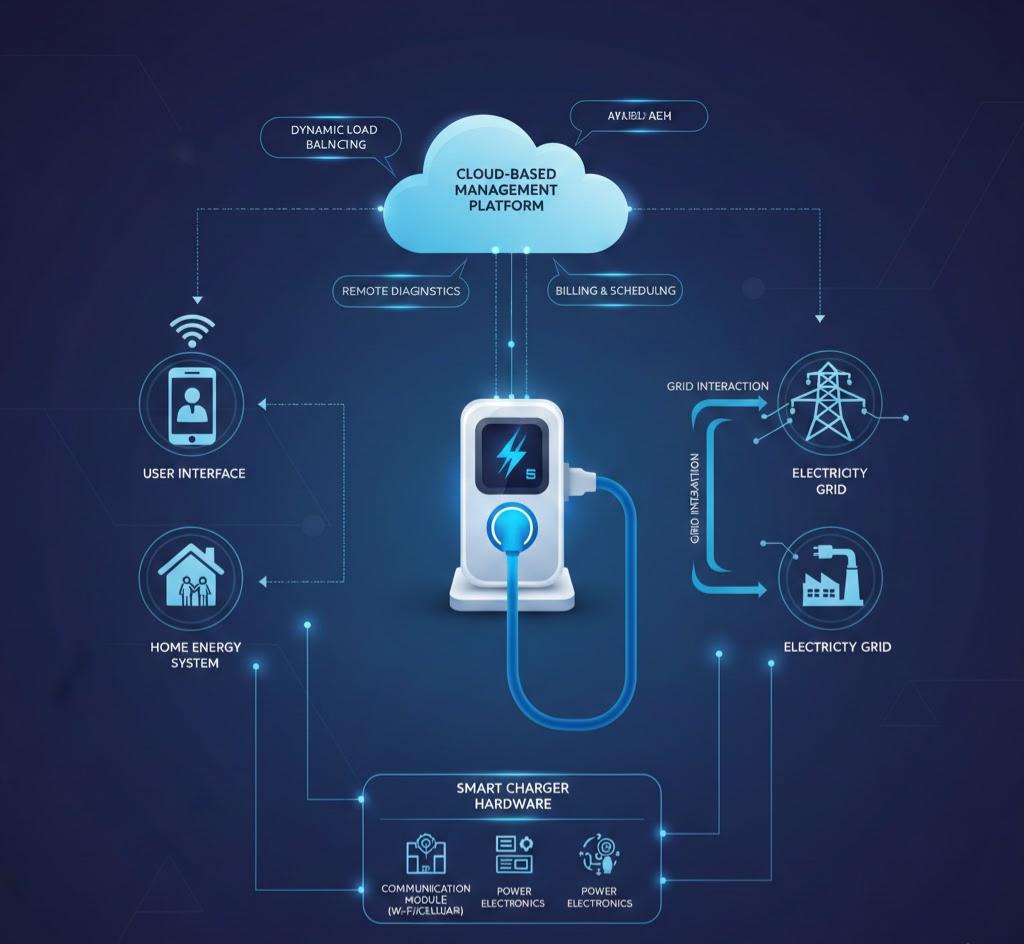
Deployment Advantages in the European Context
Addressing Grid Constraints in Historic Infrastructure
Europe's electricity infrastructure varies significantly, from cutting-edge smart grids in Nordic countries to century-old networks in historic city centres. Smart charging technology offers elegant solutions to these constraints. Rather than expensive grid reinforcement, intelligent load management allows multiple charging points to share existing electrical capacity.
This is particularly valuable in densely populated urban areas where grid upgrades are costly and logistically complex. A smart charging system can dynamically allocate power based on real-time demand, ensuring no individual connection is overloaded whilst maximising the number of vehicles that can charge simultaneously. In cities like Paris, London, and Rome, this capability is proving essential for scaling EV infrastructure without prohibitive grid investments.
Optimising Charging for European Driving Patterns
European driving patterns differ from those in North America or Asia. Shorter daily commutes, higher urban density, and extensive public transport networks mean that many European EV drivers can rely primarily on overnight charging at home or extended charging at workplaces. Smart chargers excel in these scenarios, optimising charging times to align with off-peak electricity rates and renewable energy availability.
For the growing number of apartment dwellers without private parking—a significant demographic in European cities—smart charging solutions enable efficient shared charging facilities in residential buildings. Building energy management systems can integrate EV charging with other electrical loads, preventing circuit overloads whilst ensuring all residents can charge their vehicles.
Scalability and Future-Proofing
The modular nature of smart charging systems allows operators to start small and expand systematically. A car park operator might install basic smart chargers initially, then add features like dynamic load management, renewable energy integration, or vehicle-to-grid capabilities as demand grows. This scalability is economically attractive and reduces the risk of technology obsolescence.
European regulations increasingly mandate smart charging capabilities. The EU's Energy Performance of Buildings Directive requires pre-cabling and smart charging readiness in new buildings, whilst the Alternative Fuels Infrastructure Regulation sets binding targets for charging point deployment. Investing in smart infrastructure from the outset ensures compliance with current and anticipated regulations.
Grid Integration: The European Energy Challenge
Balancing Renewable Energy Integration
Europe leads the world in renewable energy deployment, with wind and solar accounting for an increasing share of electricity generation. However, this creates challenges: renewable output fluctuates with weather conditions, creating mismatches between supply and demand. Smart EV charging offers a powerful tool to address this variability.
Intelligent charging systems can shift demand to periods of high renewable generation. On windy nights in the North Sea, when offshore wind farms produce abundant electricity, smart chargers across Northern Europe can ramp up charging rates, absorbing surplus clean energy. Conversely, during calm periods or after sunset, charging can be reduced or shifted to times when other low-carbon sources are available.
Several European countries have implemented dynamic electricity pricing that reflects real-time grid conditions. In markets like Denmark, the Netherlands, and Finland, smart chargers automatically respond to these price signals, charging when electricity is cheapest and cleanest. This creates a direct financial incentive for users whilst supporting grid stability.
-33.jpg?w=1020&h=946)
Demand Response and Grid Services
European transmission system operators face increasing challenges balancing supply and demand as coal and nuclear plants retire and variable renewables expand. Smart EV charging aggregated across thousands or millions of vehicles represents a substantial flexible load that can support grid balancing.
Through demand response programmes, charging infrastructure operators can adjust charging rates in response to grid signals. If the grid experiences stress, charging can be temporarily reduced; when there's surplus capacity, it can increase. Vehicle owners typically don't notice these adjustments—their cars still charge to the required level by their specified time—but the aggregated effect provides valuable grid services.
The UK's electric vehicle smart charging regulations, which came into force in 2022, require all new home and workplace chargers to have smart functionality including randomised delay functions to prevent simultaneous charging spikes. Similar regulations are being adopted across Europe, recognising that uncontrolled charging could destabilise local distribution networks.
Vehicle-to-Grid: The Next Frontier
Vehicle-to-Grid (V2G) technology represents the most advanced form of smart charging, enabling bidirectional power flow between vehicles and the grid. European countries are global leaders in V2G trials and deployment. The Netherlands, Denmark, Germany, and the UK are running extensive pilots demonstrating how parked EVs can provide grid services whilst earning revenue for owners.
V2G is particularly compelling in the European context. With average cars parked 95% of the time, Europe's growing EV fleet represents a massive distributed battery resource. By 2030, European EVs could provide storage capacity exceeding 1 TWh—equivalent to hundreds of grid-scale battery installations.
Real-world projects demonstrate V2G's potential. Utrecht's "living lab" shows how school bus fleets can support the grid when not in use. Renault's initiatives in France and Portugal enable EV owners to earn income by providing frequency regulation services. As V2G technology matures and regulatory frameworks develop, it could fundamentally change how we think about energy storage and grid flexibility.
Economic Considerations and Business Models
Total Cost of Ownership
While smart chargers have higher upfront costs than basic equipment, their total cost of ownership is typically lower. Remote monitoring reduces site visits for maintenance. Predictive diagnostics identify issues before they cause failures. Over-the-air updates extend equipment lifespan without hardware replacement.
For charge point operators, smart functionality enables revenue optimisation through dynamic pricing, idle fees, and participation in grid services markets. Several European operators have demonstrated that intelligent pricing strategies—charging premiums during peak hours whilst offering discounts during off-peak periods—can increase revenue whilst encouraging beneficial charging patterns.
Enabling New Revenue Streams
Europe's evolving energy markets create opportunities for smart charging operators. Balancing mechanism participation, capacity market revenues, and frequency response services all represent potential income streams. In Great Britain, aggregated smart chargers can participate in National Grid ESO's frequency response services. Similar opportunities exist across Europe as markets open to distributed energy resources.
Renewable energy integration creates another opportunity. Charging operators who install solar canopies or wind turbines can directly supply green electricity to EVs, appealing to environmentally conscious consumers. Some operators offer "100% renewable charging" guarantees, commanding premium prices.
Supporting the Circular Economy
Smart chargers support Europe's circular economy objectives through extended product lifespans, remote diagnostics reducing unnecessary maintenance visits, software updates providing new features without hardware replacement, and data-driven optimisation maximising infrastructure utilisation.-31.jpg?w=1024&h=942)
User Experience in the European Market
Cross-Border Interoperability
European EV drivers frequently cross national borders. A German driver might charge in France, Italy, and Austria during a single holiday. Smart charging networks using open standards like OCPI enable seamless roaming agreements, allowing users to charge across multiple networks with a single account or app.
The eRoaming initiatives—Hubject's intercharge network connects over 400,000 charging points across Europe—demonstrate how smart technology enables this pan-European charging experience. Users benefit from transparent pricing, real-time availability information, and unified payment systems regardless of location.
Enhancing the Charging Experience
Smartphone apps connected to smart chargers provide users with comprehensive functionality: finding available chargers with real-time status updates, reserving charging points in advance, remote monitoring of charging sessions, push notifications when charging completes, detailed energy consumption and cost breakdowns, and integration with vehicle apps for seamless experiences.
Advanced features include pre-conditioning (heating or cooling) the vehicle whilst still connected to mains power, optimising battery health through controlled charging curves, and personalised charging schedules based on user preferences and patterns.
Addressing Range Anxiety
Range anxiety remains a barrier to EV adoption, particularly in markets with developing charging infrastructure. Smart charging infrastructure addresses this through improved reliability—predictive maintenance reduces charger downtime; better information—real-time availability prevents wasted journeys; strategic deployment—data analytics identify optimal locations for new chargers; and faster charging—intelligent power management enables higher charging rates where grid capacity allows.
Environmental Impact and Sustainability
Maximising Renewable Energy Utilisation
Smart charging directly supports Europe's decarbonisation goals by aligning EV charging with renewable energy generation. Analysis shows that uncontrolled charging typically occurs during evening peaks when renewable output is lower and carbon-intensive generation increases. Smart charging shifts demand to align with renewable availability, significantly reducing charging emissions.
In Denmark, where wind power provides over 50% of electricity, smart charging algorithms prioritise windy periods. Studies indicate this can reduce charging-related emissions by 30-40% compared to uncontrolled charging. Similar benefits are observed in Germany, Spain, and other countries with substantial renewable capacity.
Reducing Grid Infrastructure Impact
By managing demand intelligently, smart charging reduces the need for grid reinforcement—infrastructure that itself has significant environmental impact through material extraction, manufacturing, and construction. Avoiding or deferring grid upgrades represents substantial embodied carbon savings.
Supporting the Transition Away from Fossil Fuels
As Europe phases out internal combustion engines, smart charging ensures the electricity system can accommodate millions of EVs without requiring excessive infrastructure investment or increased fossil fuel generation. This is essential for ensuring the transport sector's electrification genuinely reduces emissions rather than simply shifting them from tailpipes to power plants.
Policy and Regulatory Framework
European Union Initiatives
The EU has established a comprehensive regulatory framework supporting smart charging:
The Alternative Fuels Infrastructure Regulation (AFIR) sets binding targets for charging infrastructure deployment and requires newly installed chargers to have smart charging capabilities and bidirectional functionality where appropriate.
The Energy Performance of Buildings Directive mandates ducting and smart charging readiness in new buildings with parking facilities, ensuring future-proofing for EV adoption.
The Electricity Market Design Reform enables demand response and aggregation, creating market mechanisms for smart charging services to participate in electricity markets.
National Implementations
Individual European countries have adopted diverse approaches reflecting their specific circumstances:
The Netherlands offers subsidies for smart chargers and has implemented regulations requiring grid-friendly charging behaviour, particularly in areas with grid constraints.
Germany provides generous subsidies for home wallbox installations, prioritising smart-enabled devices, and has developed sophisticated bidirectional charging pilots.
France requires new buildings to include charging infrastructure, with smart capabilities increasingly mandated, and offers tax incentives for smart charging equipment.
The United Kingdom has made smart charging mandatory for all new home and workplace chargers since June 2022, requiring randomised delay functions and remote management capabilities.
Norway, despite not being an EU member, leads globally in EV adoption (over 80% of new car sales) and has extensive smart charging deployment supporting its renewable-heavy grid.-13.jpg?w=1022&h=941)
Technical Challenges and Solutions
Cybersecurity
As critical infrastructure connected to both vehicles and the electricity grid, smart chargers present cybersecurity challenges. European standards like IEC 62443 provide frameworks for securing industrial control systems, including charging infrastructure.
Manufacturers implement multiple security layers: encrypted communications between chargers and management systems, secure boot processes preventing unauthorised firmware, regular security updates addressing emerging threats, and authentication protocols ensuring only authorised access.
The European Union Agency for Cybersecurity (ENISA) has published guidelines specifically for EV charging infrastructure security, recognising its critical role in energy systems.
Data Privacy
Smart chargers collect substantial data about user behaviour, locations, and energy consumption. European GDPR requirements impose strict obligations on data collection, storage, and use. Charging operators must implement privacy-by-design principles: collecting only necessary data, anonymising personal information where possible, providing transparent privacy policies, enabling user control over data sharing, and ensuring secure data storage.
Some operators are exploring blockchain-based solutions for privacy-preserving charging data management, allowing necessary data sharing for grid services whilst protecting individual privacy.
Standardisation and Interoperability
Europe's charging landscape includes numerous competing standards and proprietary systems. Whilst progress has been made—CCS (Combined Charging System) is now the European standard for fast charging connectors—challenges remain in communication protocols and backend systems.
Industry initiatives like CharIN (Charging Interface Initiative) and organisations like ACEA (European Automobile Manufacturers' Association) work to promote standardisation. The EU's push for open protocols helps ensure new infrastructure is interoperable, but legacy equipment and proprietary systems continue to create friction.
Future Developments and Innovations
Ultra-Fast Charging
The next generation of charging infrastructure will deliver even higher power levels. Already, 350 kW chargers are being deployed along major European motorways under the IONITY network and other initiatives. Future systems may reach 500 kW or beyond, reducing charging times to near-parity with refuelling.
Smart technology becomes even more critical at these power levels. Grid impact, power quality management, and cooling requirements all demand sophisticated control systems. Dynamic power allocation ensures available grid capacity is used optimally across multiple ultra-fast chargers.
Wireless Charging
Inductive charging technology, allowing vehicles to charge without physical connections, is progressing toward commercial deployment. While challenges remain around efficiency and cost, smart wireless charging systems could enable charging during parking without user intervention—particularly valuable for shared vehicles, taxis, and autonomous vehicles.
Integration with Smart Buildings and Microgrids
As buildings become more intelligent and distributed energy resources proliferate, EV charging is increasingly integrated into broader energy management systems. A smart building might coordinate EV charging with solar generation, battery storage, and building loads to minimise grid imports and maximise self-consumption of renewable energy.
Microgrids incorporating solar, wind, batteries, and EV charging are being deployed across Europe, demonstrating how local energy systems can operate semi-independently whilst providing grid services. These showcase the future of integrated smart energy infrastructure.
Artificial Intelligence and Machine Learning
AI and machine learning are being applied to optimise charging networks through demand forecasting, predictive maintenance, dynamic pricing optimisation, and energy arbitrage strategies.
Advanced algorithms can predict when and where charging demand will occur, enabling proactive capacity management and suggesting optimal locations for network expansion. They can also optimise charging schedules considering grid conditions, electricity prices, renewable availability, and user requirements simultaneously.
Conclusion
Smart EV charging infrastructure is not merely a convenience—it is a necessity for Europe's energy transition. As the continent electrifies transport whilst increasing renewable energy penetration, the intelligence embedded in charging infrastructure becomes critical for system stability, economic efficiency, and environmental effectiveness.
Europe's combination of ambitious climate targets, renewable energy leadership, regulatory sophistication, and dense urban populations creates the ideal context for smart charging deployment. The technology addresses multiple challenges simultaneously: managing grid constraints without massive infrastructure investment, integrating variable renewable energy, providing flexibility services to electricity systems, offering superior user experiences, and supporting the economic viability of EV adoption.
For policymakers, continued support for smart charging through regulations, incentives, and market design is essential. For industry, ongoing innovation in technology, business models, and user interfaces will determine competitive success. For consumers, smart charging promises lower costs, greater convenience, and the satisfaction of supporting a sustainable energy system.
The transition to electric mobility is inevitable; the question is how smoothly and efficiently it occurs. Smart charging infrastructure—connecting vehicles, users, and grids in an intelligent ecosystem—is the key to ensuring this transition succeeds, benefiting Europe's economy, environment, and energy security.