How Your EV and Charger Communicate: The Technology Behind Every Charging Session
Most people think plugging in an electric vehicle is a bit like plugging in a phone — you connect the cable and power just flows. But behind that simple click of the connector, a surprisingly rich conversation is already underway.
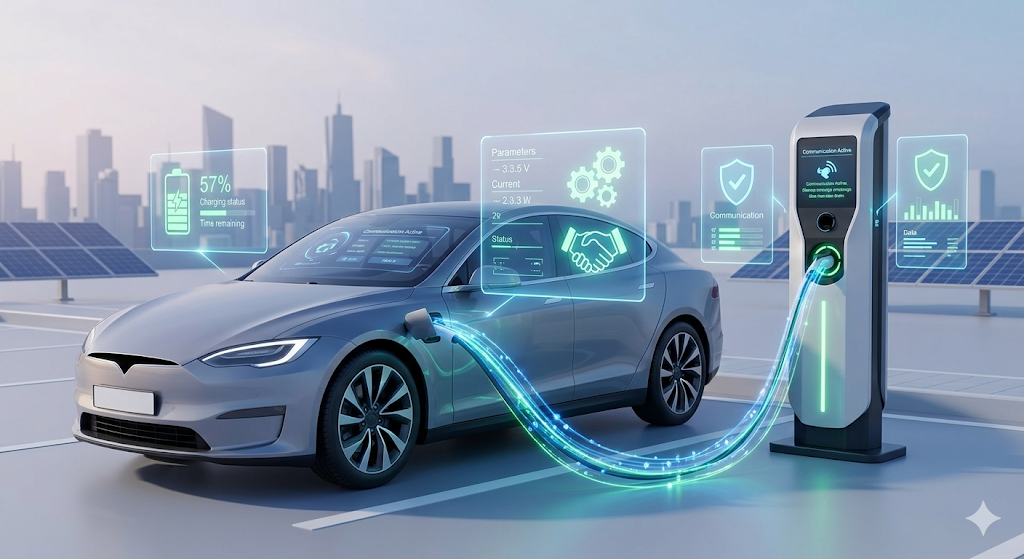
Your car and the charger are trading information back and forth before a single electron reaches the battery. They’re negotiating power levels, checking safety conditions, verifying identities, and — in some cases — agreeing on how to bill you, all in the background and all within seconds.
Understanding how that conversation works doesn’t just satisfy curiosity. It helps you make sense of why some chargers are faster, why charging sometimes fails, and where the technology is headed next.
Why Your Car and Charger Need to “Talk” at All
Think about what’s actually happening when you charge an EV. You’re not just topping up a tank — you’re managing a complex electrochemical system that has very specific preferences. Charge it too fast and you risk heat buildup or long-term battery degradation. Charge it too slow and you’re leaving range on the table unnecessarily.
The charger, on its own, has no idea what kind of battery is connected, how full it already is, or how much current it can safely handle. Without some form of communication, it would essentially be guessing — and guessing wrong with a high-voltage battery pack is not an option.
The Pilot Signal: A Simple but Clever Starting Point
For everyday home charging and public AC stations — Level 1 (120 V) and Level 2 (240 V) — the primary communication method is beautifully straightforward. It’s called the Control Pilot (CP) signal, and it’s been the backbone of EV charging communication since the SAE J1772 standard was published in North America and IEC 61851 internationally.
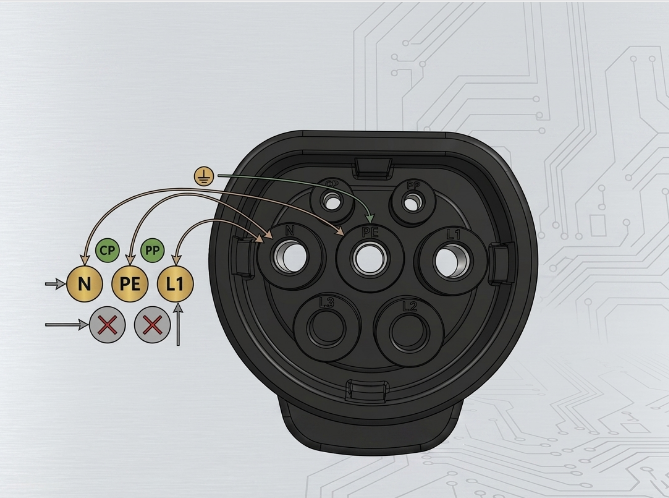
The charger — more correctly called an EVSE, or Electric Vehicle Supply Equipment — sends a low-voltage square-wave signal down a single wire in the cable. When you plug in, your car detects this signal and responds by slightly changing the voltage on that same wire. That voltage drop is the car saying, “I’m here and I’m ready.”
The clever part is how the charger communicates how much current is available. It does this not by sending complex data, but by varying the duty cycle of its signal — the proportion of time the signal is in its “high” state versus its “low” state. The car reads this, configures its onboard charger accordingly, and draws no more than the advertised amount.
There’s also a second wire called the Proximity Pilot (PP), which signals to the car that a plug is physically inserted and tells it the current rating of the cable itself. This whole exchange is analog, requires no microprocessor, and works with virtually every EV on the road today.
Power Line Communication (PLC): Talking Through the Same Wires That Carry Power
The pilot signal is great for basic safety and current negotiation, but it hits a ceiling quickly. It can’t carry billing information, can’t support two-way energy flow, and can’t handle the complex data exchange that modern smart charging requires. That’s where Power Line Communication (PLC) comes in — and it’s one of the most elegant solutions in the whole EV ecosystem.
PLC works by superimposing a high-frequency digital signal on top of the existing power conductors in the charging cable. The power itself flows at 50 or 60 Hz, but the communication signal rides on top at a much higher frequency — far above what the power electronics even notice. The technology used is called HomePlug Green PHY, a low-power variant of the same standard once used for home networking over household wiring.
What this means in practice is that the car and charger can exchange structured digital data at speeds up to 10 Mbps — all without any additional wires or wireless radio links. The cable you already have is doing double duty: carrying electricity in one direction and carrying data in both directions simultaneously.
PLC is the foundation of ISO 15118, the standard that enables what’s called Plug & Charge. Under Plug & Charge, when a compatible car connects to a compatible charger, the vehicle presents a digital certificate stored in its secure hardware. The charger’s network verifies this certificate, identifies the vehicle, and starts billing the registered owner automatically — no tap, no card, no app needed.
PLC also makes Vehicle-to-Grid (V2G) communication possible. With V2G, your car doesn’t just consume power — it can push electricity back into the grid during peak demand periods. The utility signals through the charger, the car’s battery management system responds with its available capacity, and the two sides negotiate a discharge session, all over PLC without any separate communication hardware.
DC Fast Charging: Millisecond-by-Millisecond Negotiation
Once you move into DC fast charging — the kind that can add 100+ miles of range in 20 minutes — the game changes considerably. At these power levels, bypassing the car’s onboard charger and feeding DC directly to the battery pack, the communication needs to be fast, precise, and fault-tolerant.
The dominant standard in North America and Europe for non-Tesla vehicles is CCS (Combined Charging System). CCS uses ISO 15118 and PLC for its upper communication layer, layered on top of a faster control protocol (DIN 70121) that governs the actual charging loop. Once the initial handshake is done, the car and charger exchange messages every 250 milliseconds.
The car continuously sends its target voltage, its maximum current request, its current state of charge, and its battery temperature. The charger responds by adjusting its output in near real-time. This tight loop is what enables the smooth power taper you see on fast chargers — and if a sensor detects an abnormal temperature spike, the car sends a stop command and the charger cuts power within milliseconds.
CHAdeMO, the standard used by Nissan and some other Japanese manufacturers, takes a different approach: it uses a dedicated CAN bus (Controller Area Network) running over separate signal pins in the connector. NACS, originally Tesla’s proprietary connector and now being standardized across North America, combines AC and DC charging in a single compact plug and supports ISO 15118 on newer Superchargers.
The Battery Management System: The Car’s Internal Decision-Maker
All of this external communication ultimately serves one master inside the vehicle: the Battery Management System (BMS). The BMS monitors every cell in the battery pack — voltage, temperature, state of charge, internal resistance — and is the final authority on how fast charging can proceed.
During the early phase of a fast-charging session, when cells are relatively cool and far from full, the BMS requests maximum current. As the pack fills up, it implements what engineers call a CC-CV profile — constant current first, then a gradual tapering to constant voltage as the pack approaches its ceiling. This is why the last 20% of a charge always takes longer than the first 20%.
The BMS also acts as a safety shutdown valve. If any cell behaves unexpectedly — a sudden voltage drop, an unusual temperature reading, signs of an internal short — the BMS sends an immediate stop command through the communication link, closes the high-voltage contactors, and terminates the session before any damage can spread.
Wireless Charging: When There’s No Cable to Talk Through
Inductive (wireless) charging for EVs — standardized under SAE J2954 — removes the physical connector entirely, which raises an obvious question: how do the car and charger negotiate without a wire to communicate over?
The answer is a short-range wireless link using Bluetooth Low Energy (BLE) combined with a dedicated vehicle communication channel. When you park over a ground-mounted charging pad, the car and pad first exchange positioning data. The car reports how well-aligned it is with the coil below, and this is displayed as guidance on your dashboard.
Once aligned, the two sides agree on a power class: from 3.7 kW for basic residential pads up to 22 kW for higher-power public installations. If a metallic object ends up between the coils, the system detects the drop in coupling efficiency and shuts down within seconds to prevent dangerous heating.
OCPP: How Chargers Talk to the Network
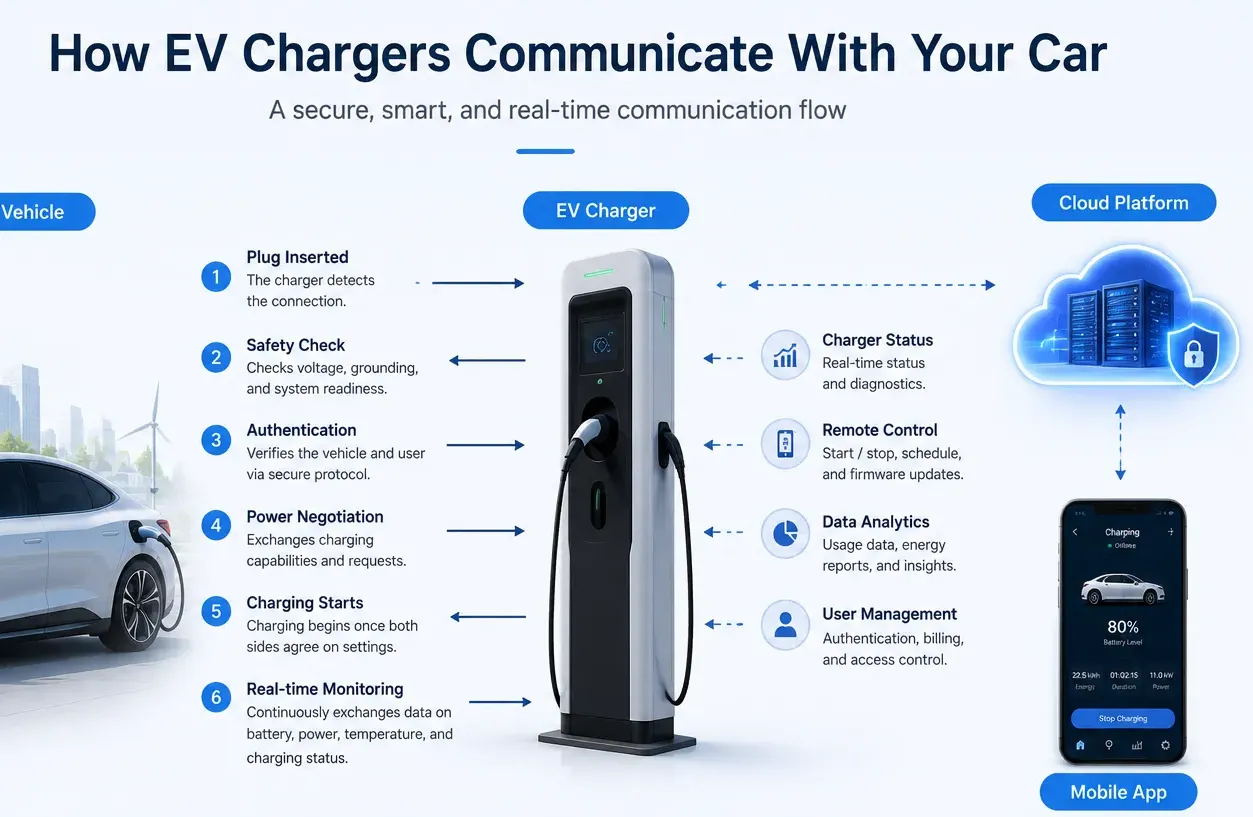
Beyond the conversation between car and charger, there’s a second layer of communication: between the charger and the wider world. This is handled by OCPP (Open Charge Point Protocol), the standard that lets charge point operators manage their networks remotely.
Through OCPP, a charger constantly reports its status — whether it’s available, in use, or faulted — to a central management system. Operators can push firmware updates, adjust pricing, monitor energy usage, and implement demand response: automatically slowing charging across their network during grid stress events, then ramping back up when demand eases.
For drivers, this is mostly invisible. What it means in practice is that your charging session can be logged, billed, and receipted without you ever interacting with the charger directly — and that the infrastructure behind the scenes is getting smarter about when and how it delivers power.
Where It’s All Heading
The direction of travel is clear: more intelligence, less friction. Plug & Charge is gradually rolling out, meaning authentication and billing will increasingly require nothing more than the act of plugging in. V2G is moving from pilot projects toward commercial deployment, with several automakers and utilities already running real-world programs. Wireless charging is creeping into public infrastructure and is already available as an optional feature on some production vehicles.
What’s easy to forget is how much of this is already working, quietly, every time you charge. The next time you plug in, the handshake has already begun.