
The transition to electric vehicles (EVs) represents one of the most significant technological shifts in modern transportation. At the heart of every electric vehicle lies its battery pack, typically composed of lithium-ion cells that store and deliver the energy needed for propulsion. Understanding battery health and longevity is crucial for both consumers and manufacturers, as the battery often represents the most expensive component of an EV, sometimes accounting for 30-40% of the total vehicle cost.
One critical factor affecting battery lifespan is the State of Charge (SOC), which represents the current charge level as a percentage of the battery's total capacity. While it might seem intuitive to keep batteries fully charged for maximum convenience, maintaining a high SOC actually accelerates battery degradation through several electrochemical and mechanical mechanisms. This article explores the fundamental reasons why high SOC increases battery stress and provides practical insights for EV owners seeking to maximize their battery's longevity.
Understanding State of Charge (SOC)
State of Charge is a fundamental metric in battery management, expressed as a percentage that indicates how much energy remains in the battery relative to its fully charged capacity. An SOC of 100% means the battery is fully charged, while 0% indicates complete discharge. Modern EVs use sophisticated Battery Management Systems (BMS) to continuously monitor and calculate SOC based on voltage, current, temperature, and historical charge-discharge patterns.
In lithium-ion batteries, SOC directly correlates with the cell voltage. A typical lithium-ion cell has a nominal voltage around 3.6-3.7V, but when fully charged to 100% SOC, the voltage rises to approximately 4.2V. At low SOC levels near 0%, the voltage drops to around 2.5-3.0V. This voltage variation is not merely a measurement convenience; it reflects fundamental changes in the battery's internal chemistry and structure that have profound implications for battery longevity.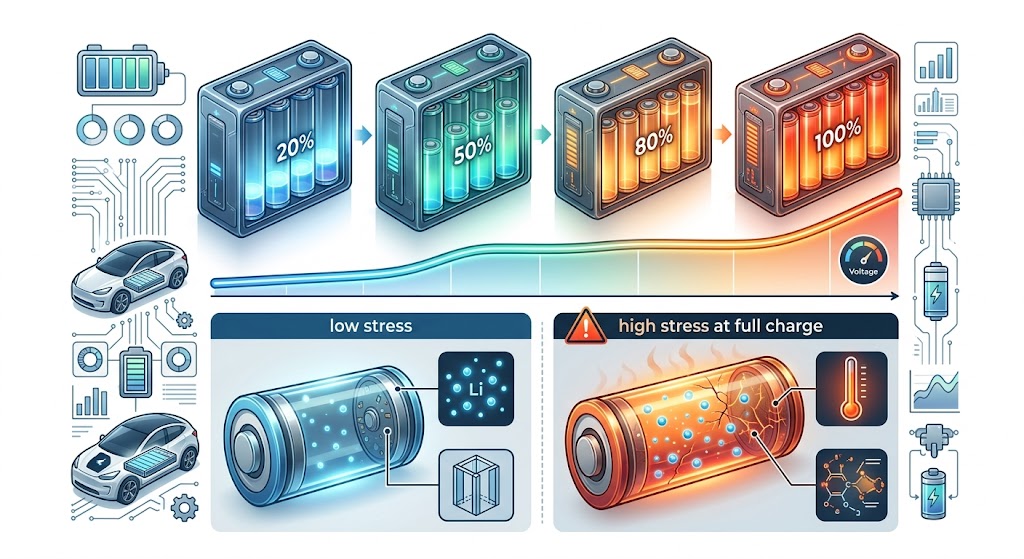
Electrochemical Stress Mechanisms at High SOC
Electrolyte Decomposition and SEI Layer Growth
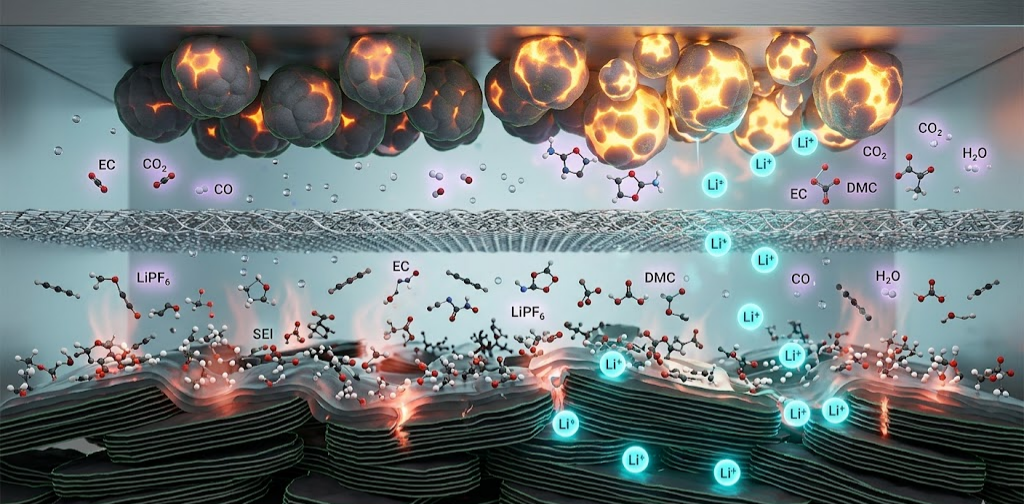
At high SOC levels, the elevated cell voltage creates a highly oxidizing environment that accelerates the decomposition of the electrolyte at the cathode interface. The electrolyte, typically a lithium salt dissolved in organic carbonate solvents, becomes thermodynamically unstable at voltages above approximately 4.0V. This instability triggers oxidative decomposition reactions that consume electrolyte material and generate gaseous byproducts, leading to gradual capacity loss over time.
Simultaneously, at the anode-electrolyte interface, high SOC conditions promote the growth of the Solid Electrolyte Interphase (SEI) layer. The SEI is a passivation layer that forms naturally on the anode surface during the first few charging cycles, and while a stable SEI is beneficial for battery operation, its continuous growth at high voltages is detrimental. Each molecule of electrolyte that decomposes to form additional SEI consumes lithium ions that would otherwise be available for charge storage, resulting in irreversible capacity fade. The process is particularly aggressive when batteries are stored at high SOC for extended periods, as the decomposition reactions proceed continuously even without active charge-discharge cycling.
Cathode Material Degradation
Most modern EV batteries use lithium nickel manganese cobalt oxide (NMC) or lithium nickel cobalt aluminum oxide (NCA) cathode materials. At high SOC, these materials experience significant structural stress because the cathode lattice must accommodate very few lithium ions. When fully charged, lithium ions migrate from the cathode to the anode, leaving the cathode structure in a delithiated state. This delithiation causes the cathode crystal structure to contract and become mechanically unstable.
The mechanical instability manifests as microcracking and particle fracture within the cathode material. These microcracks increase the surface area exposed to the electrolyte, accelerating parasitic reactions and leading to transition metal dissolution, where cobalt, nickel, and manganese ions leach from the cathode structure into the electrolyte. Once dissolved, these metal ions can migrate to the anode and become incorporated into the SEI layer, further degrading battery performance. Additionally, the high oxidation state of transition metals at high SOC makes them more susceptible to chemical reactions with electrolyte components, compounding the degradation effects.
Lithium Plating Risk
While lithium plating is primarily associated with fast charging and low-temperature operation, high SOC conditions can exacerbate this phenomenon under certain circumstances. When a battery is charged to high SOC levels, particularly during rapid charging or in cold conditions, lithium ions may not have sufficient time to intercalate properly into the anode's graphite structure. Instead, metallic lithium can deposit on the anode surface, a process called lithium plating.
Lithium plating is particularly dangerous because it creates multiple degradation pathways. First, plated lithium represents lost active material that cannot participate in future charge-discharge cycles, directly reducing capacity. Second, the plated lithium can react with the electrolyte to form additional SEI, consuming more lithium and electrolyte. Third, lithium deposits can form dendrites—needle-like structures that can grow through the separator and cause internal short circuits, creating safety hazards. The risk of plating increases significantly when batteries are maintained at high SOC while simultaneously experiencing other stressors such as high charge rates or temperature extremes.
Mechanical and Thermal Stress Factors
Volume Changes and Mechanical Strain
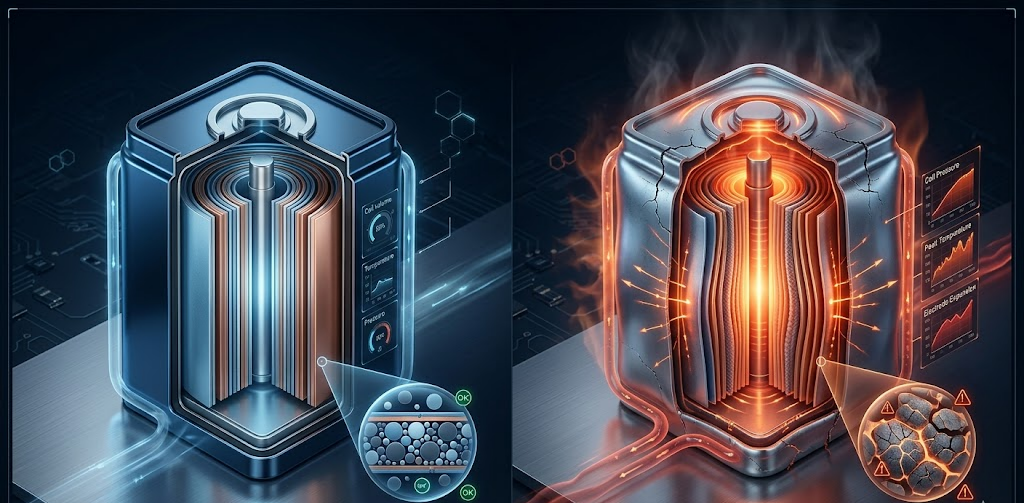
Lithium-ion batteries undergo volumetric expansion and contraction as lithium ions shuttle between the anode and cathode during charge and discharge cycles. At high SOC, the anode is saturated with lithium ions, causing it to expand, while the cathode contracts due to delithiation. These volume changes create mechanical stress throughout the cell structure, affecting not only the active materials but also the current collectors, separators, and cell packaging.
Graphite anodes, the most common anode material in EV batteries, can expand by approximately 10% in volume when fully lithiated at high SOC. This expansion generates compressive stress that can cause particle cracking, delamination of active material from current collectors, and permanent deformation of cell components. Over many cycles, the cumulative effect of this mechanical stress leads to increased internal resistance, reduced power capability, and capacity loss. The problem is particularly acute in high-energy-density cells where manufacturers pack more active material into the same volume, intensifying the mechanical constraints.
Temperature Sensitivity and Thermal Stress
Battery degradation rates are exponentially dependent on temperature, following Arrhenius kinetics. At high SOC, batteries generate more heat during operation due to increased internal resistance and higher voltage-driven parasitic reactions. This self-heating effect creates a vicious cycle: high SOC accelerates degradation reactions, which increase internal resistance, which generates more heat, which further accelerates degradation.
Studies have shown that storing a battery at 100% SOC and elevated temperatures (such as 40°C or 104°F) can result in capacity loss rates ten times higher than storage at 50% SOC and room temperature. This temperature sensitivity is particularly relevant for EVs parked in hot climates or exposed to direct sunlight, where cabin and battery temperatures can soar. The combination of high SOC and high temperature represents the worst-case scenario for battery longevity, as it maximizes the kinetic rates of all degradation mechanisms simultaneously.
Implications for Electric Vehicle Battery Management
Battery Management System Strategies
Recognizing the detrimental effects of high SOC, EV manufacturers have implemented sophisticated battery management strategies to mitigate stress. Most modern EVs do not actually charge to the absolute maximum voltage that cells can tolerate; instead, the BMS defines 100% SOC at a slightly reduced voltage, typically 4.1-4.15V per cell rather than the theoretical maximum of 4.2V or higher. This buffer provides a safety margin that significantly reduces stress while sacrificing only a small amount of usable capacity.
Additionally, many manufacturers recommend that users limit daily charging to 80% SOC, reserving the 80-100% range for long trips when the extra range is genuinely needed. This practice substantially reduces calendar aging by keeping the battery at a lower average voltage. Some EVs include features like scheduled charging departure times that delay reaching 100% SOC until just before the vehicle will be used, minimizing the time spent at peak stress conditions.
Practical Recommendations for EV Owners
For daily driving, EV owners should aim to maintain their batteries between 20-80% SOC whenever possible. This operating window represents a favorable balance between convenience and longevity. The battery spends less time at high voltage, reducing electrochemical stress, while avoiding very low SOC levels that can cause other degradation mechanisms such as copper dissolution from current collectors.
When long-term parking is anticipated, such as during extended vacations or seasonal storage, batteries should ideally be left at 40-60% SOC in a cool environment. This SOC range minimizes both high-voltage stress and the risks associated with self-discharge to very low SOC levels. Temperature control is equally important; parking in shaded or climate-controlled locations significantly reduces thermal stress. Some EVs include battery conditioning modes that slowly discharge the battery to a target SOC when the vehicle will not be used for extended periods.
It is also worth noting that occasional charging to 100% SOC for long trips does not cause significant degradation; the cumulative stress comes from consistently maintaining high SOC over time. What matters most is the time-weighted average SOC rather than the peak SOC reached during individual charging sessions. Therefore, EV owners need not be overly anxious about occasional full charges but should make lower SOC targets their default practice.
Future Developments and Emerging Technologies
Battery researchers are actively developing next-generation chemistries and technologies to mitigate high-SOC stress. Lithium iron phosphate (LFP) cathodes, which are becoming increasingly common in lower-cost EVs, exhibit superior tolerance to high SOC compared to NMC and NCA chemistries. LFP's more stable crystal structure experiences less mechanical stress during delithiation, and the absence of cobalt and nickel eliminates transition metal dissolution concerns. However, LFP batteries have lower energy density and reduced performance in cold weather, presenting different trade-offs.
Advanced electrolyte formulations incorporating additives and novel solvents are being developed to improve stability at high voltages. These electrolytes can form more stable SEI layers and resist oxidative decomposition, directly addressing two major degradation pathways. Solid-state batteries, which replace liquid electrolytes with solid ionic conductors, promise to revolutionize the field by eliminating many electrolyte-related degradation mechanisms entirely. However, these technologies are still in development and face their own technical challenges before widespread commercialization.
Silicon-based anodes, which can theoretically store much more lithium than graphite, are another area of intensive research. While silicon's high capacity could enable longer-range EVs, it also undergoes extreme volume expansion (up to 300%) during lithiation, making mechanical stress management even more critical. Researchers are exploring nanostructured silicon, silicon-graphite composites, and novel binder systems to accommodate these volume changes without catastrophic degradation.
Conclusion
Understanding why high SOC increases battery stress is essential for maximizing the lifespan and performance of electric vehicle batteries. The elevated voltage at high SOC drives multiple degradation mechanisms: electrolyte decomposition and SEI growth consume active materials; cathode structural instability leads to particle cracking and metal dissolution; mechanical stress from volume changes damages cell components; and temperature sensitivity amplifies all these effects.
For EV owners, the practical implications are clear: maintaining batteries in the 20-80% SOC range for daily use, avoiding prolonged storage at high SOC, and minimizing exposure to temperature extremes will substantially extend battery life. While occasional full charges are necessary and acceptable for long journeys, making lower SOC targets the default practice pays dividends in long-term battery health.
As battery technology continues to evolve, new chemistries and management strategies will further mitigate high-SOC stress. However, the fundamental electrochemical and mechanical principles underlying battery degradation will remain relevant. By understanding these principles and adjusting charging habits accordingly, EV owners can play an active role in preserving their most valuable vehicle component while contributing to the broader goal of sustainable transportation.
The optimal balance between convenience and longevity will vary based on individual usage patterns, climate conditions, and vehicle characteristics. However, armed with knowledge of how high SOC affects battery stress, users can make informed decisions that align with their priorities. As the EV market matures and batteries become more sophisticated, the gap between maximum possible range and optimal charging practices may narrow, but for now, moderation in SOC management remains the key to long-lasting, reliable electric vehicle batteries.