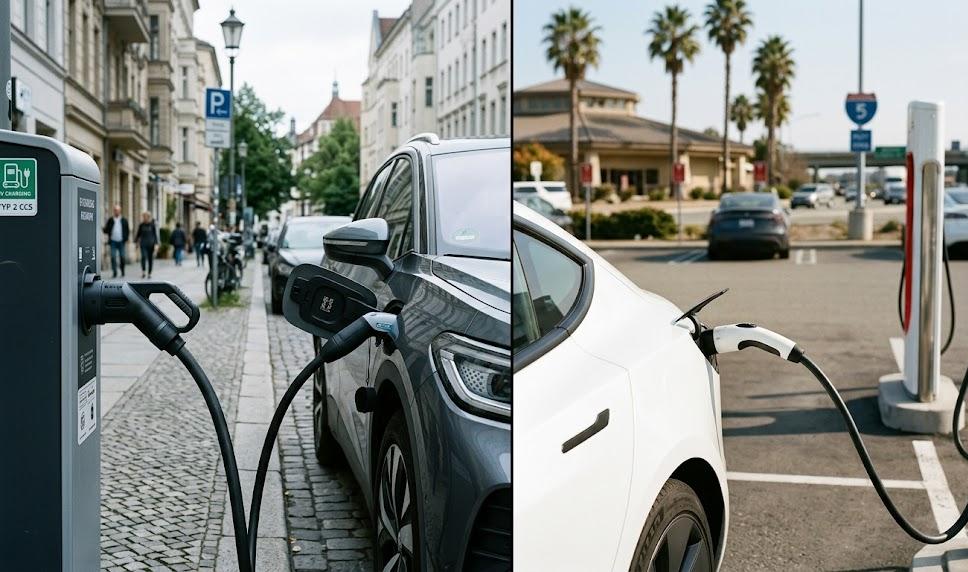
Walk up to an electric vehicle charging station in Frankfurt, and you will almost certainly encounter a CCS Type 2 connector. Cross the Atlantic to a highway rest stop in Ohio, and the dominant standard shifts to CCS Type 1 — or increasingly, Tesla's NACS (North American Charging Standard) port. Same car brand, same model year, entirely different socket. For consumers shopping across borders or simply trying to understand why their new EV came with a manual thick enough to confuse an engineer, this discrepancy is far more than a minor inconvenience. It is the visible surface of decades of divergent policy, infrastructure investment, and electrical grid philosophy.
This article explains the historical and technical reasons behind this divide, maps out the key differences between European and American standards, and offers practical guidance for buyers navigating this complex landscape.
The Root Cause: Two Different Power Grids
The single most fundamental reason Europe and America use different charger standards has nothing to do with cars at all — it has everything to do with how each continent decided to transmit electricity to homes and businesses more than a century ago.
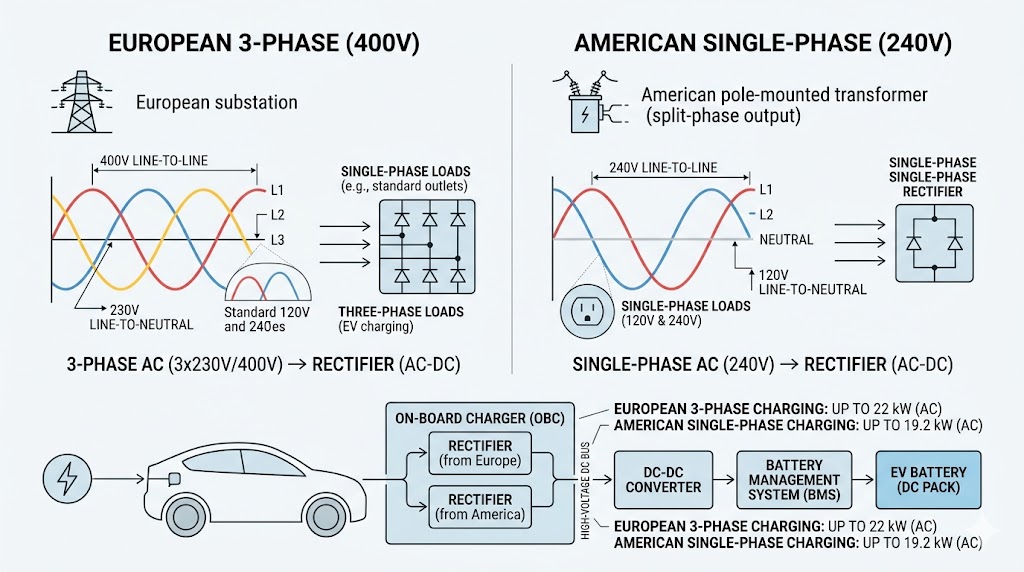
The United States standardized on a 120/240V system operating at 60 Hz, shaped largely by Edison's early DC infrastructure and later Westinghouse's AC compromise for North American conditions. Europe, rebuilt and coordinated largely after the Second World War through international regulatory bodies, converged on a 230V single-phase and 400V three-phase system running at 50 Hz. These are not minor technical footnotes — they are the bedrock upon which every wall outlet, industrial motor, and crucially, every EV on-board charger must be engineered.
Because EVs charge by converting AC power from the grid into DC stored in the battery pack, the on-board charger (OBC) hardware must be precisely tuned to local grid specifications. A vehicle designed primarily for the European 400V three-phase network can exploit the much higher power delivery available at public AC stations in Europe — often 11 kW to 22 kW at a standard Type 2 socket. The same vehicle in the US, connected to a single-phase 240V Level 2 outlet, would see a fundamentally different supply profile. Manufacturers building truly global vehicles must therefore engineer distinct OBC configurations, which in turn drives the choice of connector standard.
Understanding the Connector Standards
At present, the EV charging landscape on both continents revolves around a handful of connector types, each reflecting the priorities and grid realities of their home market.
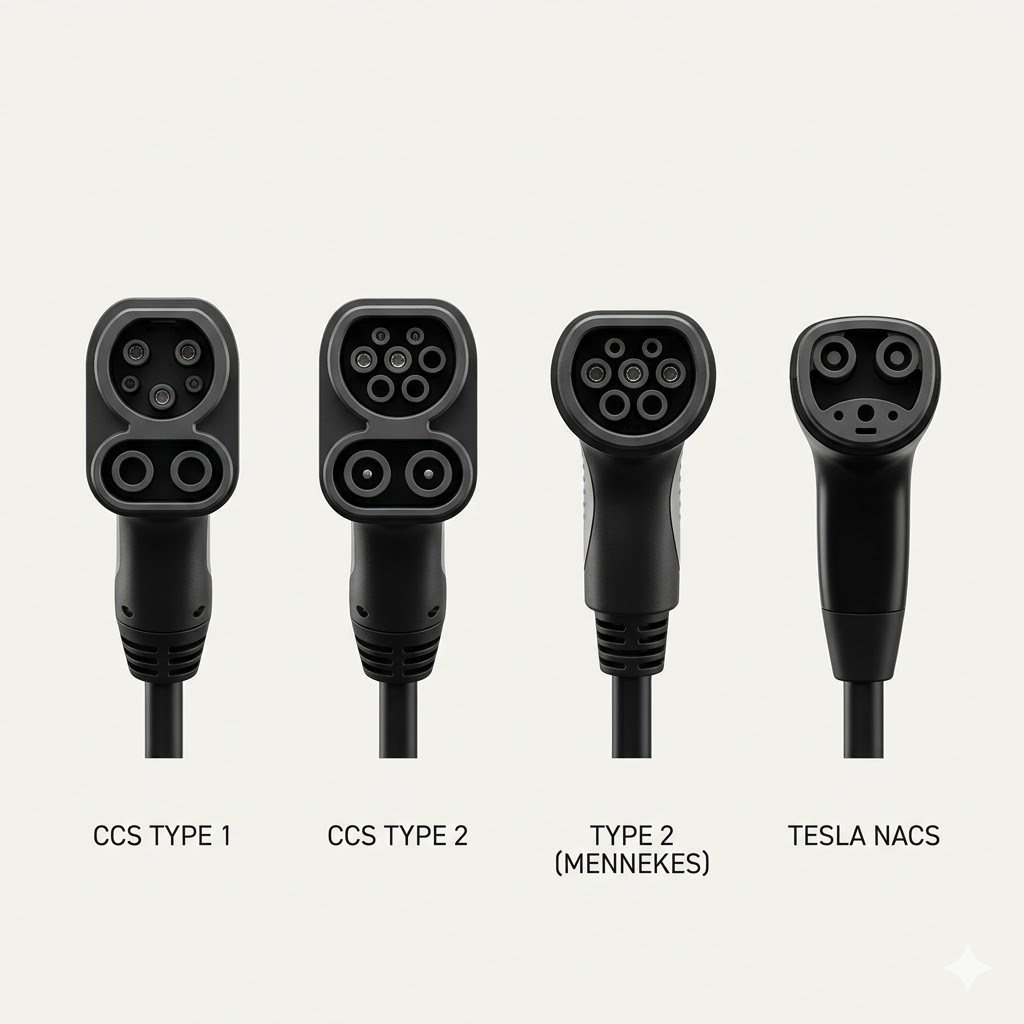
In Europe, the IEC 62196 Type 2 connector — informally called the Mennekes plug after the German company that pioneered it — serves as the universal standard for AC charging. It is a seven-pin design capable of handling both single-phase and three-phase AC power, making it well suited to Europe's robust three-phase residential and commercial infrastructure. For DC fast charging, the Combined Charging System Type 2 (CCS2) extends the Type 2 AC plug with two additional DC pins, allowing a single inlet on the car to accept both AC and fast DC power. The European Union formally mandated CCS2 as the standard for public fast-charging networks, which has significantly streamlined the public charging experience across member states.
In the United States, the SAE J1772 Type 1 connector has been the long-standing standard for Level 2 AC charging. It is a five-pin design handling only single-phase AC — adequate for the North American grid but incapable of exploiting three-phase supply. Its DC fast-charging companion is CCS1, which appends two DC pins to the J1772 body in the same conceptual approach as its European counterpart. Separately, Tesla developed its proprietary connector for its Supercharger network, which in 2022 was renamed NACS (North American Charging Standard) and subsequently adopted by major automakers including Ford, General Motors, Rivian, and others. In 2023, SAE International formally standardized NACS as SAE J3400, accelerating its industry-wide adoption.
Europe vs. America: A Direct Comparison
The table below summarises the key technical and regulatory differences between the two markets:
| Category | Europe | United States |
|---|---|---|
|
Grid voltage |
230V (single-phase) / 400V (three-phase) |
120V / 240V (single-phase dominant) |
|
Grid frequency |
50 Hz |
60 Hz |
|
AC connector standard |
IEC 62196 Type 2 (Mennekes) |
SAE J1772 Type 1 |
|
DC fast charge standard |
CCS Type 2 (CCS2) |
CCS Type 1 (CCS1) / SAE J3400 (NACS) |
|
Max AC charge rate (public) |
Up to 22 kW (three-phase) |
Up to 11.5 kW (single-phase) |
|
Max DC fast charge (CCS) |
Up to 350 kW |
Up to 350 kW |
|
Regulatory mandate |
EU mandated CCS2 for public networks |
No federal mandate; market-driven adoption |
|
Tesla network connector |
CCS2 (retrofitted from proprietary) |
NACS (SAE J3400) — original design |
Why Automakers Produce Region-Specific Variants
Given these differences, it is rarely economically or technically feasible for automakers to produce a single global EV model with one universal charging system. Several factors compound the challenge.
First, the on-board charger itself must be matched to local grid frequencies and voltages. An OBC optimised for 50 Hz three-phase European supply will not simply 'work' on a 60 Hz single-phase American circuit — the power electronics must be actively re-engineered. This means printed circuit boards, transformers, and power management firmware all differ between regional variants.
Second, physical connectors are standardised by regional bodies with legal force. In Europe, EU regulations require that any EV sold with a DC fast-charge capability expose a CCS2 inlet. In the US, while no equivalent federal law yet exists, the market has converged first on CCS1 and now rapidly on NACS/SAE J3400. An automaker shipping a CCS2-equipped vehicle to the US would find its customers unable to use the vast majority of public fast chargers without an adapter.
Third, safety and homologation requirements differ. European vehicles must comply with UN ECE regulations and CE marking directives; American vehicles face FMVSS standards administered by NHTSA. Even if the underlying battery and motor hardware were identical, the charging system must pass distinct certification test protocols in each jurisdiction.
The result is that vehicles such as the Volkswagen ID.4, Hyundai IONIQ 5, and BMW iX are all produced in meaningfully distinct regional variants, even when sharing the same body, battery chemistry, and powertrain architecture. The charging port — and often the entire OBC module — is among the most visible differences.
The Role of Policy and Industry Coordination
Policy decisions have accelerated divergence in some respects and driven convergence in others. In Europe, the European Parliament's Alternative Fuels Infrastructure Regulation (AFIR), which came into force in 2023, requires member states to ensure CCS2-capable fast chargers are deployed at minimum intervals along major road networks. This has locked in CCS2 as the de facto European standard for the foreseeable future, providing automakers with the regulatory certainty needed to invest in long-term platform design.
In the US, the federal government's National Electric Vehicle Infrastructure (NEVI) program — funded under the Infrastructure Investment and Jobs Act — initially required CCS1 compatibility at NEVI-funded stations. However, a rule amendment in 2024 also required stations to include NACS/SAE J3400 connectors, reflecting the rapid industry shift toward that standard. This dual-standard transitional phase means American drivers may encounter both CCS1 and NACS ports at public fast chargers, adding temporary complexity but ultimately pointing toward NACS consolidation.
Tesla's influence on the American market deserves particular note. For years the company operated a proprietary Supercharger network open only to its vehicles. Its decision in 2022 to open the network to other brands — and in 2023 to release the NACS connector design to the industry — effectively shifted the competitive landscape. With Ford, GM, Rivian, Volvo, Polestar, Mercedes-Benz, Honda, and others announcing NACS adoption, the US market is now coalescing around a single plug in a way that has no direct parallel in the European transition.
Practical Buying Advice for Consumers
Navigating the charger standard landscape can feel daunting, but a few clear principles can guide your purchasing decision.
- Buy for the market where you will primarily drive. A vehicle purchased in Germany and used in Germany will be fully compatible with European AC and DC public infrastructure via its CCS2 inlet. Do not assume that a 'global' model means a single universal charging inlet — always confirm the regional variant's specifications before purchase.
- In the US, prioritise NACS-equipped vehicles where possible. As of 2025, virtually all major automakers selling in the US have committed to NACS adoption. If purchasing a new vehicle, a NACS inlet gives you access to Tesla's extensive Supercharger network in addition to third-party CCS1 stations via the included CCS1 adapter most manufacturers supply.
- If you still have a CCS1 vehicle in the US, invest in a CCS1-to-NACS adapter. Several manufacturers and third parties now offer these, allowing CCS1 vehicles to access Tesla Superchargers. Verify adapter compatibility with your specific vehicle model and firmware version before relying on it for long trips.
- Check the on-board charger's maximum AC rate. European buyers should confirm whether their vehicle supports three-phase 11 kW or 22 kW AC charging. Some budget-segment vehicles include only a single-phase OBC (3.7 kW or 7.4 kW), which dramatically increases home and destination charging time. In the US, confirm whether your vehicle accepts 11.5 kW single-phase Level 2 or only 7.2 kW, particularly if you plan to install a home charger.
- Plan home charging infrastructure around your region's standard. European homeowners installing a wallbox should select a Type 2 unit rated for at least 11 kW. American homeowners should install a SAE J1772 Level 2 EVSE or a NACS-compatible unit, depending on their vehicle's inlet. Avoid cheaply-imported chargers that may not comply with local safety standards (CE marking in Europe; UL/ETL listing in the US).
- Consider long-term serviceability and software support. Charging standards are still evolving. When evaluating models, check the manufacturer's track record on over-the-air firmware updates that can unlock higher charging speeds or improve compatibility with new station protocols. A vehicle that is software-updatable is better insulated from infrastructure changes than one with a fixed firmware.
- For frequent cross-border travel, verify adapter availability. Within Europe, CCS2 coverage is extensive and growing. For travellers driving between the UK and continental Europe, note that UK chargers use the same CCS2 and Type 2 standards, making cross-border compatibility smooth. For travellers between North America and Mexico, note that Mexico largely mirrors US standards.
Conclusion
The divergence of EV charger standards between Europe and America is not the result of carelessness or corporate rivalry alone. It is rooted in genuine physical differences — distinct power grids, distinct regulatory philosophies, distinct infrastructure investment timelines — that were established long before the first modern electric car rolled off an assembly line. The connector you see on your vehicle is, in miniature, a history of two continents' relationships with electricity and industrial standardisation.
The encouraging news is that both regions are converging, even if slowly. Europe has achieved a high degree of standardisation around CCS2 backed by EU law. The United States is rapidly consolidating around NACS, a process driven by market forces and increasingly supported by federal infrastructure funding. For consumers today, the practical advice is straightforward: buy the vehicle designed for your market, understand the charging network your inlet unlocks, and equip yourself with any adapters that extend your access. The infrastructure is still maturing, but with the right knowledge, the transition to electric driving need not be complicated by the plug at the end of the cable.