
As electric vehicles continue to transform our roads, the data generated from every charging session tells a story far beyond simple energy transfer. These charging records serve as the backbone of the EV ecosystem, enabling everything from billing accuracy to grid stability. But what exactly should these records contain, and how do requirements differ across the globe?
The Core Purpose of Charging Records
At their heart, charging records serve multiple critical functions. They're the foundation for accurate billing, ensuring drivers pay for exactly what they use. They provide invaluable data for network operators managing thousands of charging stations. They help utilities understand and manage grid demand. And increasingly, they're becoming essential for regulatory compliance and carbon accounting.
Think of a charging record as a digital receipt with superpowers—it's not just about the transaction, but about creating a comprehensive picture of EV charging behavior, infrastructure performance, and energy flow.
Essential Data Elements
Transaction Fundamentals
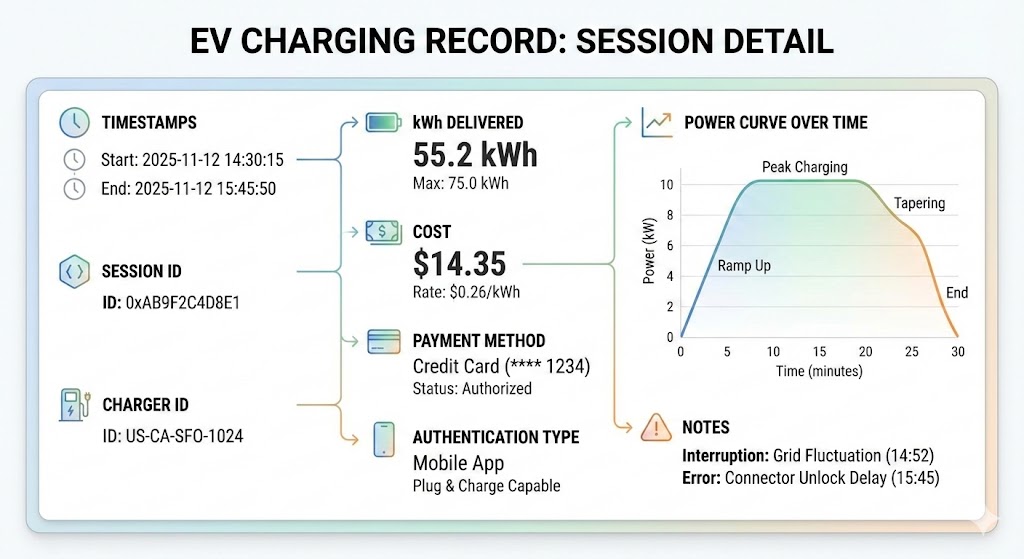
Every charging record must capture the basics: when did the session start and end? How much energy was delivered? What was the cost? These seem obvious, but the devil is in the details. Timestamps need to be precise, often down to the second, and must account for time zones. Energy measurements should be accurate to at least two decimal places, as even small discrepancies can add up across thousands of sessions.
The unique identifiers are equally crucial. Each session needs a distinct ID, the charging station must be identifiable, and the user or vehicle needs proper authentication records. These IDs create the audit trail that makes the entire system accountable.
Technical Performance Data
Beyond the transaction basics, charging records should capture technical performance metrics. What was the peak power delivered? How did the charging rate vary over time? Were there any interruptions or errors? This data helps operators identify underperforming stations, predict maintenance needs, and optimize charging speeds.
Battery state-of-charge information at the start and end of charging provides insights into user behavior and helps validate the energy delivery. Temperature readings from the charging equipment can flag safety issues before they become problems.
Payment and Authentication Details
The financial side requires careful documentation. What payment method was used? Was there a membership discount applied? Were there time-of-use pricing variations? For commercial operations, this granular pricing data ensures transparency and enables sophisticated billing strategies.
Authentication records show how the user initiated the charging session—whether through an app, RFID card, or credit card tap. This information is vital for security and troubleshooting access issues.
Why This Data Matters
Operational Excellence
For charging network operators, these records are gold. They reveal usage patterns—when are stations busiest? How long do people typically charge? Which locations are underutilized? This intelligence drives decisions about where to build new stations, when to schedule maintenance, and how to price services competitively.
Real-time monitoring of charging sessions helps operators respond quickly to problems. If a station repeatedly shows error codes or unusual power delivery patterns, maintenance teams can investigate before users experience significant issues.
Grid Integration
As EVs proliferate, their impact on electrical grids becomes more significant. Charging records help utilities understand when and where EV charging demand occurs. This data is essential for grid planning, managing peak loads, and integrating renewable energy sources.
Smart charging programs use this historical data to predict future demand and incentivize charging during off-peak hours or when renewable energy is abundant. The records prove whether these programs are working and help quantify their grid benefits.
User Experience
From the driver's perspective, detailed charging records provide transparency and control. Users can track their charging costs, compare prices across networks, and identify their charging patterns. This empowers them to make smarter decisions about when and where to charge.-19.jpg?w=1024&h=1024)
Regional Requirements: One Size Doesn't Fit All
European Union: Calibration and Transparency
Europe has led with stringent requirements for charging records. The Measuring Instruments Directive (MID) requires that energy measurements be made with calibrated, certified meters. Every charging record must include detailed metering data that can be cryptographically verified.
German regulations go even further, requiring the "Eichrecht" (calibration law) compliance, where charging records must be digitally signed and tamper-proof. Users must be able to verify that the energy they were billed for matches what was actually delivered. This means including hash values, digital signatures, and meter readings in machine-readable formats.
Additionally, EU roaming requirements mean charging records must include standardized data elements that enable seamless billing across different networks and countries. The Open Charge Point Protocol (OCPP) and similar standards help ensure interoperability.
North America: Grid Services and Demand Response
In the United States and Canada, charging records increasingly need to capture data for grid services programs. Many utilities offer incentives for flexible charging, so records must document whether charging occurred during incentivized periods and at what power levels.
California's regulations require detailed reporting of charging session data for rebate programs and grid planning. Records must include geographic coordinates to help utilities identify distribution system impacts and plan infrastructure upgrades.
Time-of-use rates are common, so North American records often need to show how charges are calculated across different rate periods, making billing transparency particularly important.
China: Subsidy Tracking and Battery Monitoring
Chinese charging records face unique requirements driven by government EV incentives and safety concerns. Records must capture data needed to verify eligibility for various subsidy programs, which may include vehicle identification numbers, battery capacities, and certification information.
Battery safety is a particular concern, so Chinese systems often require more detailed battery monitoring data in charging records—including temperature readings, voltage curves, and state-of-health indicators. This data helps identify potentially dangerous battery conditions.
The integration with payment platforms like WeChat Pay and Alipay means records must accommodate these mobile payment ecosystems and their specific data requirements.
Japan: Earthquake Preparedness and V2X
Japan's unique context includes both disaster preparedness and advanced vehicle-to-grid (V2X) capabilities. Charging records may need to capture bidirectional energy flow—both charging and discharging events—as EVs can serve as backup power during emergencies.
Records must support the CHAdeMO protocol's specific data formats and may need to document emergency charging events differently from routine charging, given the country's experience with natural disasters.
Emerging Markets: Offline Capability and Alternative Payment
In regions with less reliable internet connectivity, charging records need robust offline capabilities. Systems must be able to store records locally and sync later, while still maintaining data integrity and preventing fraud.
Alternative payment methods are common in many emerging markets, so records must accommodate cash transactions, mobile money platforms like M-Pesa, and even prepaid tokens. This requires different data structures than credit card-centric systems.
The Future of Charging Records
As the EV ecosystem matures, charging records will likely need to capture even more information. Carbon intensity of the electricity used, participation in demand response events, and integration with smart home energy management systems will all require new data fields.
The key is building systems that are flexible enough to accommodate regional requirements while maintaining core data integrity and security. The charging record of today is just the beginning—it's evolving into a comprehensive data layer that will help optimize not just individual charging sessions, but the entire energy transition.
For anyone building EV charging systems, the lesson is clear: invest in robust, flexible data infrastructure from the start. The data you collect today will become increasingly valuable tomorrow, as long as it's accurate, secure, and adaptable to changing needs across different markets and use cases.