
The rapid global proliferation of electric vehicles has elevated EV chargers from niche accessories into essential infrastructure. Behind every reliable charging session lies a carefully engineered assembly of metals, polymers, and advanced composite materials — each chosen to satisfy demanding requirements for electrical efficiency, mechanical resilience, thermal stability, and long-term safety. As the EV charging market accelerates toward an estimated $8.1 billion by 2031, material quality has become one of the most decisive differentiators between premium charging products and commodity alternatives. Understanding which metals are critical to EV charger design — and why their specifications matter — provides a clear framework for evaluating product quality and real-world performance.
This analysis examines the key metals and materials that define EV charger performance, explores the principal characteristics by which chargers should be evaluated, and illustrates how deliberate premium material choices — as exemplified by brands like Feyree — translate directly into measurable advantages for end users.
1. Critical Metals and Materials in EV Chargers
A modern EV charger comprises several distinct functional systems — the power transmission path, the connector interface, the protective housing, and the cable insulation layer. Each system demands specific materials optimized for its particular role and operating conditions.
1.1 Copper: The Backbone of Electrical Performance
Copper is the single most critical metal in any EV charging system. With an electrical conductivity of approximately 59.6 × 10⁶ S/m, copper is the standard material for charging cables, internal bus bars, transformer windings, and interconnect wiring. In EV chargers, the copper cable carries the full rated current from the power source to the vehicle's onboard charger — a role that demands both minimal resistive losses and reliable thermal performance across sustained high-current loads.
The purity of copper directly governs its conductivity. Standard commercial copper typically reaches 99.0–99.5% purity, which is adequate for general electrical applications. However, at higher purity levels — approaching 99.9% and above — resistive losses decrease, heat generation under sustained load is reduced, and the cable's operational lifespan is extended. Impurities in copper, even at trace concentrations, can reduce conductivity, increase resistive heating under load, and accelerate material degradation through thermal cycling over years of operation.
Beyond conductivity, copper's mechanical properties are equally relevant in portable and flexible charging cables. The cable must withstand thousands of bending, coiling, and thermal expansion cycles without fatigue cracking of the conductor. Achieving this requires a precise balance between purity and the granular microstructure of the copper, which only carefully controlled manufacturing processes can deliver.
1.2 Silver: Elevating Connector Contact Reliability
At the physical interface between the charger and the vehicle — the connector pins — contact resistance becomes a critical engineering parameter. Elevated contact resistance at this point generates localized heat, increases voltage drop, reduces effective charging efficiency, and over time can lead to oxidation and progressive connector degradation. Silver addresses this challenge more effectively than any other commercially viable metal: it offers the highest electrical conductivity of all pure metals (approximately 63 × 10⁶ S/m) and exhibits excellent intrinsic resistance to oxidative corrosion.
Silver-plated contact pins are therefore widely used in premium EV charger connectors. The silver layer ensures minimal voltage drop at the connection interface, smoother current flow during charging sessions, and greater resilience to the micro-arcing that can occur with repeated plug-and-unplug cycles. The thickness of the silver plating is a meaningful quality indicator: thicker plating extends connector service life while maintaining consistent low-resistance contact throughout the product's operational lifetime.
1.3 Structural Materials: Aluminum, Steel, and Engineering Polymers
The housing and structural frame of EV chargers must provide robust physical protection for sensitive internal electronics while resisting environmental degradation over years of deployment. Traditional industrial chargers have historically used aluminum enclosures for their excellent strength-to-weight ratio and natural corrosion resistance. However, modern portable and wall-mounted chargers increasingly employ advanced engineering polymers — particularly PC (Polycarbonate) and ASA (Acrylonitrile Styrene Acrylate) composites — which offer comparable or superior impact resistance at lower weight, while avoiding the electromagnetic compatibility complications of fully metallic enclosures.
ASA is specifically prized for its outstanding UV stability relative to ABS or standard PC, making it a natural material choice for outdoor charging station housings exposed to prolonged sunlight. PC contributes exceptional impact resistance and thermal dimensional stability. Together, a PC+ASA composite provides a housing material profile that addresses the full spectrum of mechanical, thermal, and weathering challenges inherent to outdoor electrical equipment deployment.
1.4 TPU: The Premier Cable Insulation Material
Thermoplastic Polyurethane (TPU) has become the industry-preferred insulation material for EV charging cables, displacing legacy PVC in quality product lines. TPU maintains flexibility across a wide operational temperature range — remaining pliable at temperatures well below freezing, where PVC insulation becomes brittle and prone to cracking under bending stress. This cold-weather flexibility is particularly important for portable chargers used in winter climates, where a stiff cable not only creates usability difficulties but also risks cracking the insulation jacket if forcibly bent.
In addition to thermal flexibility, TPU provides excellent resistance to oils, UV radiation, and abrasion — properties that extend the useful life of cables routinely stored in vehicle trunks or routed along garage walls. TPU also maintains superior dielectric properties under mechanical stress, ensuring that electrical insulation integrity is preserved even when the cable is compressed, bent, or subjected to physical loads in everyday use.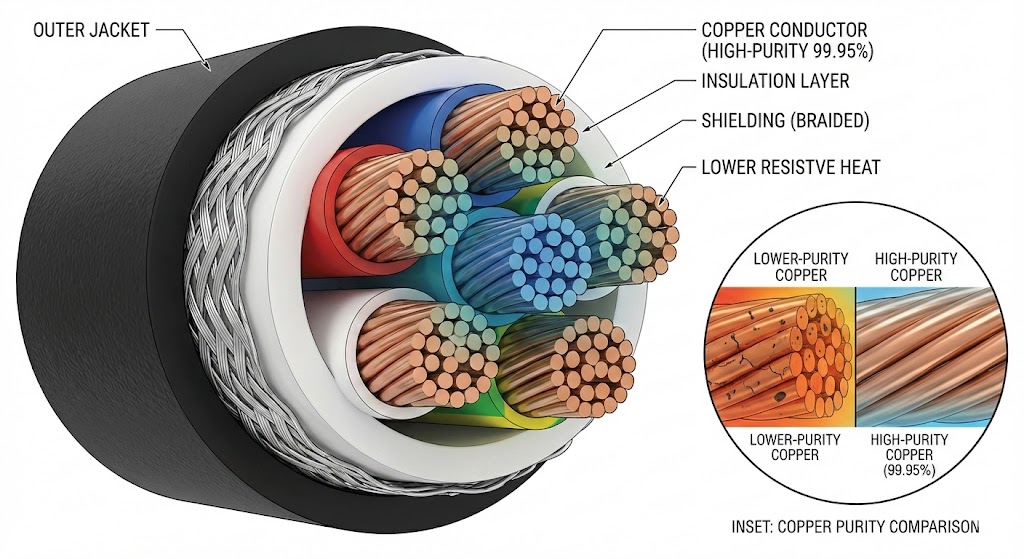
2. Key Performance Characteristics of EV Chargers
Evaluating EV charger quality requires examining performance across five principal dimensions, each of which is directly influenced by the materials used in construction.
2.1 Electrical Efficiency and Power Delivery
An EV charger must deliver its rated power output with minimal transmission losses from the grid connection point to the vehicle battery. Every watt of resistive loss in the cable manifests as heat — reducing effective charging efficiency and accelerating thermal aging of insulation materials. Chargers span from Level 1 (1.4–1.9 kW residential), through Level 2 (3.5–22 kW), to DC fast chargers (50–350+ kW). At higher power ratings, cable conductor quality and connector contact resistance become increasingly critical to system efficiency and safe operation.
2.2 Environmental Durability
EV chargers — particularly portable units and outdoor wallboxes — must perform reliably across challenging environmental conditions. IP (Ingress Protection) ratings quantify resistance to water and particulate ingress. IP65 certification provides protection against low-pressure water jets; IP66 offers protection against powerful directional water jets and heavy rain. Temperature operating range is equally critical: chargers deployed across diverse global markets must function without performance degradation or safety compromise from sub-zero winter conditions to intense summer heat.
2.3 Mechanical Robustness
Portable EV chargers are subjected to significant physical stresses in everyday use — being dropped on hard surfaces, stored under luggage in vehicle trunks, accidentally driven over in parking environments, and exposed to compressive loads from equipment stored on top of them. The mechanical resilience of the housing material and its wall thickness determine whether the charger survives these real-world stresses intact. Housing materials must be both impact-resistant and thermally stable to maintain their protective geometry across the full operational temperature range.
2.4 Safety System Comprehensiveness
Modern EV chargers incorporate multiple layers of protective circuitry to safeguard both the vehicle's battery system and the building's electrical installation. Comprehensive protection typically includes overvoltage and undervoltage protection, overcurrent protection, overtemperature protection, residual current (ground fault) detection, and lightning surge protection. The quality and certification standard of the components implementing these protections — particularly residual current devices and thermal monitoring sensors — directly determines how reliably the charger detects and responds to abnormal operating conditions.
2.5 Connectivity and Smart Load Management
Next-generation EV chargers increasingly integrate Wi-Fi connectivity and companion app functionality to enable remote monitoring, scheduled charging, energy consumption tracking, and dynamic load balancing. Dynamic load balancing is particularly important in residential settings where the charger shares available grid capacity with household appliances. By continuously monitoring circuit load and adjusting the charging current in real time, smart chargers prevent circuit breaker trips and optimize energy use without requiring manual intervention.
3. How Premium Material Choices Deliver Product Advantages
The relationship between material specification and product performance in EV chargers is direct and measurable. Examining how specific material choices map to performance outcomes clarifies why premium specifications matter across the full operational life of the product.
3.1 High-Purity Copper: Efficiency and Longevity Through Purity
Using 99.95% pure copper in charging cables — a specification adopted by quality-focused manufacturers including Feyree — delivers conductivity that minimizes resistive losses to near-theoretical limits for copper conductors. At this purity level, more of the electrical energy drawn from the grid actually reaches the vehicle battery rather than being dissipated as heat within the cable. This translates into measurably faster effective charging, reduced cable operating temperatures that extend insulation lifespan, and safer operation under sustained high-current sessions. The 99.95% purity specification represents a deliberate investment in performance over cost — a difference that compounds across the thousands of charging cycles the cable will experience over its operational life.
3.2 Silver-Plated Connector Pins: Sustained Contact Performance
Specifying 5-micron silver plating on charging connector pins directly addresses the contact resistance challenge at the vehicle interface. A 5μm silver layer provides sufficient thickness to resist wear across thousands of connection cycles while maintaining the superior conductivity and oxidation resistance that defines silver as a contact material. In practice, properly silver-plated pins sustain lower voltage drop at the connector interface, maintain cooler pin temperatures during charging, and resist the contact oxidation that can develop over years of regular use — keeping connector performance close to its original specification throughout the product's operational lifetime.
3.3 Certified TPU Insulation: Cold Weather Performance and Safety Credentials
Specifying cable insulation that carries independent certification — such as TUV Rheinland approval — from a recognized testing body validates that the insulation meets defined standards for electrical integrity, flame resistance, temperature cycling performance, and chemical resistance. Beyond certification, TPU's inherent material properties deliver real-world flexibility at temperatures as low as -30°C, enabling safe cable handling in winter charging conditions where PVC alternatives would stiffen and risk cracking. This is not a marginal improvement but a functional difference that affects both safety and usability in cold-climate markets.
3.4 PC+ASA Housing at Adequate Wall Thickness: Physical and Environmental Protection
Constructing charger housings from PC+ASA composite at a wall thickness of 3.5mm delivers a combination of impact resistance, UV stability, and thermal dimensional stability that justifies deployment in demanding outdoor environments. Polycarbonate's impact toughness and ASA's UV weathering resistance together produce a housing that maintains its structural integrity over years of outdoor exposure without yellowing, embrittling, or deforming. The real-world implications of this specification are validated through testing: housings built to this standard can withstand being run over by vehicles weighing up to 2 tons and survive 1-meter drop tests without functional damage. A UL 94 V-0 flame rating further certifies that the housing material resists flame propagation — an important safety credential for electrical enclosures.-40.jpg?w=1024&h=559)
3.5 IP66 Sealing: Genuine All-Weather Reliability
Achieving IP66 waterproof certification requires a sealed, professionally engineered enclosure design that goes meaningfully beyond the IP65 rating found in many competing products. IP66 specifically certifies protection against powerful water jets from any direction — providing a real-world safety margin for outdoor installations subject to heavy rain, pressure washing of surrounding surfaces, or pooling water. When combined with a wide operational temperature range, an IP66-rated charger is a genuinely all-weather solution capable of reliable deployment across the full diversity of climates in which EVs are operated globally.
4. Conclusion
The analysis of critical metals and materials in EV chargers reveals that product quality in this category is fundamentally a materials science question. The performance gap between an adequate charger and a genuinely premium one typically comes down to the purity of the copper, the specification of the connector plating, the certification standard of the cable insulation, and the engineering precision of the housing material and wall thickness.
Premium material choices across every layer of charger construction — high-purity copper cables, thick silver-plated pins, certified TPU insulation, and robust PC+ASA housings — collectively deliver measurably superior electrical efficiency, mechanical durability, environmental resilience, and safety compared to products built with commodity-grade alternatives. These are not incremental improvements but compounding advantages that manifest more clearly as the product ages and accumulates real-world operating hours.
As the EV charging market continues its rapid global expansion and consumer expectations for charging infrastructure rise accordingly, the quality of materials embedded in a charger at the point of manufacture determines how well it serves users not just on day one, but across years of daily operation. In a product category where material choices have direct and measurable consequences for safety and performance, specification decisions are ultimately the most honest indicator of product quality.