Over the past decade, the European automotive market has undergone a profound transformation. The industry is rapidly shifting from the era of internal combustion engines to one defined by electrification, intelligent mobility, and digital ecosystems. Consumer expectations, government regulations, and competitive dynamics are all evolving at an unprecedented pace.
For decades, Europe’s automotive sector was dominated by traditional manufacturers, with consumers placing strong emphasis on engine performance, driving dynamics, and brand heritage. Today, however, priorities are changing. Range capability, charging efficiency, software integration, and intelligent cockpit systems have become key factors influencing purchasing decisions. Modern vehicles are no longer viewed solely as transportation tools; they are increasingly becoming connected digital platforms that integrate energy management, smart technology, and mobility services.
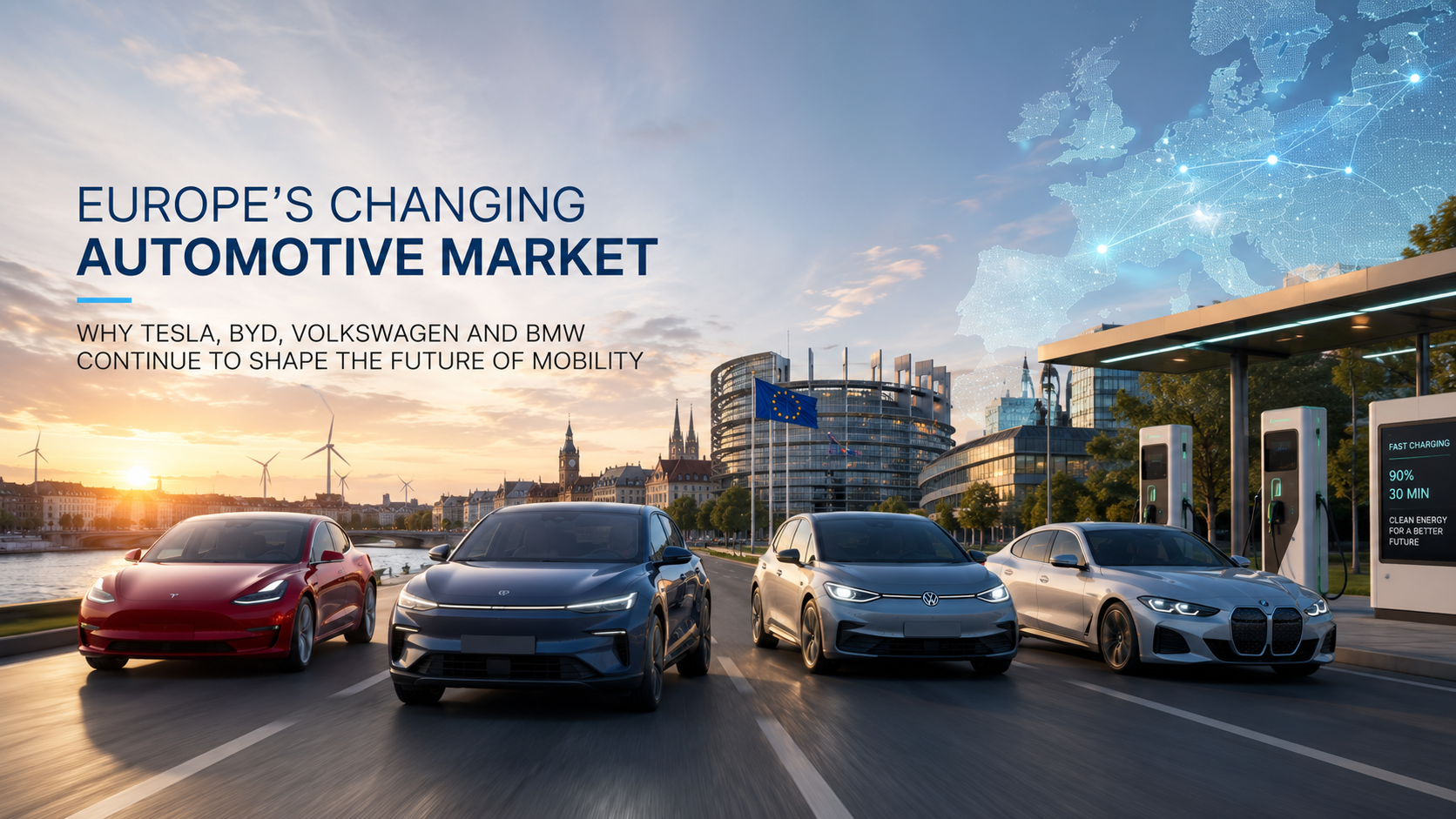
At the center of this transition are four influential automotive brands — Tesla, BYD, Volkswagen, and BMW. Each represents a different strategic pathway toward the future of mobility. Tesla continues to accelerate the adoption of intelligent electric vehicles, BYD is expanding globally through advanced EV technology and vertical integration, Volkswagen is leading the electrification transition among legacy automakers, while BMW is redefining premium mobility through the fusion of luxury and electrification.
Together, these companies are not only influencing European consumer behavior but also reshaping the future structure of the continent’s automotive industry.
Why Europe Is Accelerating Toward Electrification
The rapid growth of Europe’s electric vehicle market is the result of multiple converging factors, including regulatory pressure, energy concerns, technological advancement, and changing consumer preferences.
In recent years, the European Union has introduced increasingly strict carbon emission targets, while several European countries have announced timelines to phase out the sale of new combustion-engine vehicles. Under these conditions, traditional automakers have been forced to accelerate their electrification strategies.
At the same time, rising energy costs across Europe have pushed consumers to reconsider long-term vehicle ownership expenses. Compared with conventional fuel-powered vehicles, electric vehicles offer significantly lower operating and maintenance costs, making them increasingly attractive to both urban and family consumers.
The shift has been dramatic. In 2020, electric vehicles accounted for only around 10% of Europe’s automotive market. Within just a few years, EV market share in several European countries has exceeded 30%. In Norway, electric vehicles now represent nearly 90% of new vehicle sales.
This trend demonstrates that EV adoption in Europe is no longer in its early experimental stage. The market is rapidly moving toward large-scale mainstream acceptance.
How Tesla Redefined European Consumer Expectations for Electric Vehicles
Among all EV manufacturers, Tesla remains one of the most influential players in Europe’s transition toward sustainable mobility.
For many years, European consumers associated electric vehicles with limited driving range, inadequate charging infrastructure, and compromised driving performance. Tesla fundamentally changed this perception by introducing vehicles that combined long-range capability, high performance, advanced software integration, and intelligent user experiences.
One of Tesla’s strongest competitive advantages in Europe has been its Supercharger network. Given the importance of long-distance and cross-border driving within Europe, charging accessibility plays a critical role in EV adoption. Tesla’s early investment in fast-charging infrastructure significantly reduced range anxiety for consumers and strengthened confidence in electric mobility.
Equally important is Tesla’s software-first approach. Features such as over-the-air updates, advanced driver-assistance systems, and highly integrated infotainment platforms have shifted the automotive industry closer to the consumer electronics model.
In recent years, the Tesla Model Y has become one of the best-selling EVs across multiple European markets. Consumers are increasingly attracted by its balance of practicality, efficiency, intelligent features, and low operating costs.
Tesla’s success has also forced the broader automotive industry to recognize a new reality: future competition will not be defined solely by manufacturing capabilities, but by software ecosystems, energy integration, and digital innovation.
How BYD Is Reshaping Europe’s EV Competitive Landscape
While Tesla helped accelerate EV adoption in Europe, BYD represents the rapid rise of Chinese electric vehicle manufacturers on the global stage.
Over the past several years, Chinese EV brands have significantly expanded their presence across Europe, and BYD has emerged as one of the fastest-growing players in the region.
One of BYD’s core strengths lies in its vertically integrated supply chain, particularly in battery technology. Its Blade Battery platform has gained recognition for its safety, durability, and cost-efficiency, helping the company establish a strong technological foundation in the EV market.
At the same time, European consumer priorities are evolving. While brand heritage once dominated purchasing decisions, buyers are now increasingly focused on real-world EV performance metrics, including driving range, charging speed, intelligent features, and overall value.
In these areas, Chinese automakers have rapidly narrowed the gap with traditional European manufacturers.
The rising cost of energy across Europe has also made affordability and operational efficiency more important than ever. Compared with many premium European brands, BYD often offers higher equipment levels and competitive pricing, making its vehicles increasingly appealing to middle-class and family consumers.
BYD’s expansion into Europe is therefore more than just the growth of a single company. It reflects the emergence of a more globally competitive EV industry where Chinese manufacturers are becoming major players in international markets.
Volkswagen and BMW: The Electrification Challenge for Legacy Automakers
For Europe’s traditional automotive giants, electrification represents both a major opportunity and a structural challenge.
Volkswagen, one of Europe’s most iconic automotive brands, plays a critical role in the region’s transition toward electric mobility. In recent years, the company has invested heavily in its ID series lineup as part of its strategy to evolve from a combustion-engine leader into a dominant EV manufacturer.
Although Volkswagen has faced challenges related to software integration and digital platform development, its manufacturing scale, supply chain capabilities, and brand recognition remain extremely powerful.
For many European consumers, Volkswagen continues to symbolize reliability, familiarity, and long-term ownership confidence. Family-oriented buyers often prioritize service infrastructure, maintenance accessibility, and overall dependability over experimental innovation.
BMW, meanwhile, represents a different approach to electrification — one centered on preserving premium driving dynamics while embracing sustainable mobility.
Historically, high-performance driving and electrification were often viewed as incompatible. BMW’s i4 and iX models attempt to bridge this gap by combining luxury design, advanced EV technology, and the brand’s traditional focus on driving engagement.
Within Europe’s premium automotive segment, brand identity remains highly influential. For many consumers, luxury vehicles are not simply transportation products but reflections of lifestyle and personal values.
The Data Clearly Indicates Europe’s EV Future
Current market trends suggest that Europe’s electric vehicle sector is still in a high-growth phase, with even stronger expansion expected over the next decade.
Industry forecasts indicate that electric vehicles could account for more than 50% of Europe’s total vehicle sales by 2030. At the same time, governments and private companies continue to invest heavily in charging infrastructure development.
Public charging networks across Europe are expanding rapidly, while demand for home charging systems, portable EV chargers, and ultra-fast charging solutions is expected to increase significantly.
The following data illustrates the projected development trajectory of Europe’s EV market:
| Year | Estimated EV Market Share in Europe | Charging Infrastructure Development |
|---|---|---|
| 2020 | Approximately 10% | Early-stage infrastructure expansion |
| 2023 | Approximately 25%–30% | Rapid public charging growth |
| 2025 | Approximately 35%–40% | Major urban network expansion |
| 2030 | Expected to exceed 50% | Mature fast-charging highway networks |
The data clearly shows that Europe’s EV market is transitioning from an adoption phase into a large-scale mainstream mobility ecosystem.
At the same time, the nature of competition within the automotive industry is evolving. In the past, automakers competed primarily through engine technology and mechanical engineering. In the future, competitive advantages will increasingly depend on:
- Battery innovation
- Software ecosystems
- Intelligent driving systems
- Charging efficiency
- Energy management integration
This shift explains why technology companies, EV startups, and Chinese manufacturers are all accelerating their expansion into Europe.
The future European automotive market is likely to evolve into a three-way competitive structure involving:
- Traditional European automakers
- American technology-driven EV companies
- Chinese new-energy vehicle manufacturers
Europe’s Automotive Future Is Being Redefined
The European automotive market is no longer simply experiencing a transition between fuel-powered and electric vehicles. It is undergoing a fundamental restructuring of the entire industry.
Tesla has accelerated the rise of intelligent electric mobility. BYD has demonstrated the growing global competitiveness of China’s EV supply chain. Volkswagen is attempting to transform a traditional industrial giant into a modern electric mobility leader, while BMW is redefining what premium electrification can represent.
Although each brand follows a different strategic path, all are contributing to the same outcome: a more connected, sustainable, software-driven, and intelligent future for mobility in Europe.
For consumers, this transformation means greater choice, more advanced technologies, and increasingly convenient electric mobility solutions. For the automotive industry, however, the real competition may only be beginning.