To compare the Blade Battery with "Lithium" batteries, it is essential first to clarify the terminology. The Blade Battery is a type of lithium battery.
The user's question reflects a common market distinction between BYD's Blade Battery (based on Lithium Iron Phosphate, or LFP chemistry) and Ternary Lithium Batteries (NCM/NCA), which are widely used in high-performance EVs like many Teslas (Long Range/Performance models) and other luxury cars.
The following report provides a McKinsey-style analysis comparing these two technologies, covering their definitions, performance differences (especially charging), and a FAQ section.
Executive Summary: Is Blade Better?
The short answer: The Blade Battery is "better" for safety, longevity, and cost, making it the superior choice for daily commuting and economy-to-mid-range vehicles. Traditional Ternary Lithium (NCM) batteries are "better" for maximum range, cold-weather performance, and peak charging speeds, making them the preferred choice for performance and luxury vehicles.
Overview of Technologies
BYD Blade Battery (LFP)
-
Chemistry: Lithium Iron Phosphate (LiFePO₄). It contains no cobalt or nickel.
-
Innovation: The "Blade" refers to the structural form factor, not just chemistry. BYD arranges long, thin, blade-like cells directly into the battery pack (Cell-to-Pack or CTP technology), eliminating the intermediate "modules."
-
Key Feature: This structure increases space utilization by over 50% compared to traditional LFP packs, allowing BYD to fit enough energy into the car to rival the range of NCM batteries, despite LFP chemically having lower energy density.
Ternary Lithium Battery (NCM/NCA)
-
Chemistry: Lithium Nickel Manganese Cobalt (NCM) or Nickel Cobalt Aluminum (NCA).
-
Structure: Typically uses cylindrical (e.g., Tesla 4680/2170) or prismatic cells organized into modules, which are then assembled into a pack.
-
Key Feature: High energy density. Chemically, these batteries store more energy per kilogram than LFP, enabling the longest driving ranges (e.g., 400+ miles/650+ km) and highest acceleration performance.
-11.jpg?w=1024&h=559)
Detailed Comparison: Blade vs. Ternary Lithium
| Feature | Blade Battery (LFP) | Ternary Lithium (NCM/NCA) | Winner |
|---|---|---|---|
|
Safety |
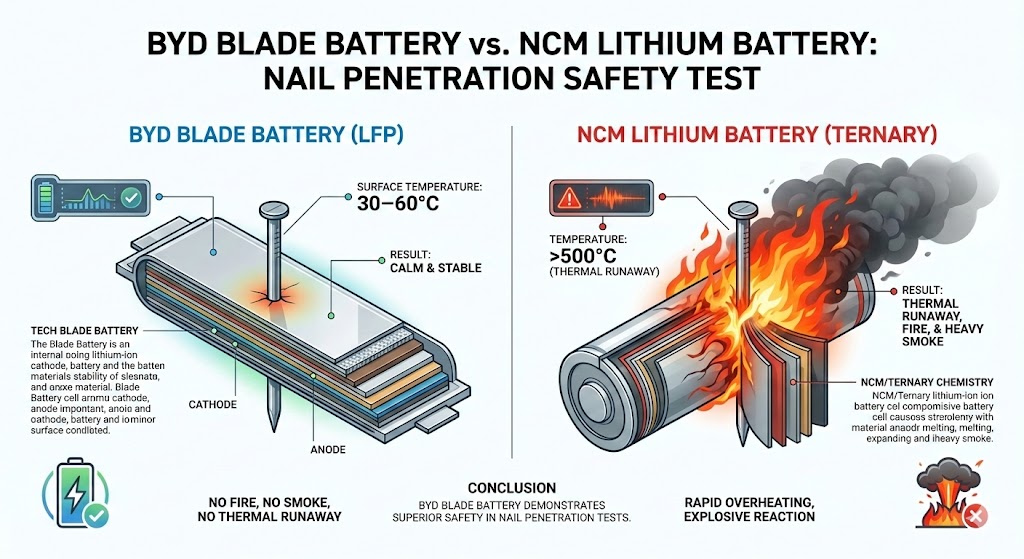
Ultra-High. Passes "Nail Penetration Test" without fire/smoke. Surface temp reaches only 30–60°C. |
Moderate. Prone to thermal runaway if punctured. Surface temp can exceed 500°C rapidly. |
Blade |
|
Lifespan |
3,000+ cycles. Can last 1.2 million km. Often outlasts the vehicle itself. |
1,500–2,500 cycles. Degrades faster; typically lasts 500k–800k km. |
Blade |
|
Charging Speed |
Standard Fast. 10–80% in ~26–33 mins. Peak rates usually 1–2C. |
Ultra Fast. 10–80% in ~15–25 mins (on 800V systems). Peak rates up to 3–4C. |
Ternary |
|
Energy Density |
Lower (~150 Wh/kg). Heavier battery for the same range. |
Higher (~250+ Wh/kg). Lighter battery; better for sports cars. |
Ternary |
|
Cold Weather |
Weaker. LFP chemistry loses more range in freezing temps (-20°C). Requires aggressive heating. |
Stronger. Retains better conductivity and range in deep winter conditions (-30°C). |
Ternary |
|
Cost |
Low. No expensive cobalt/nickel. Cheaper to replace. |
High. Volatile prices due to cobalt and nickel content. |
Blade |
Deep Dive: Charging Differences
-
Ternary Lithium (NCM): The chemical structure of NCM allows lithium ions to move more freely, enabling extremely high current acceptance. High-end NCM packs (like in the Porsche Taycan or Hyundai Ioniq 5) can charge from 10% to 80% in roughly 18 minutes under ideal conditions.
-
Blade Battery (LFP): While BYD has improved charging speeds significantly, LFP chemistry is naturally more resistant to high-current charging, especially as the battery fills up. A typical BYD Seal or Atto 3 (Blade Battery) charges from 10% to 80% in 26 to 35 minutes.
-
Constraint: You must be more careful charging LFP in freezing temperatures; the Battery Management System (BMS) will significantly restrict speed to prevent permanent damage until the battery warms up.
-
 Deep Dive: Safety (The "Nail Test")
The most famous differentiator is the Nail Penetration Test, considered the "Mount Everest" of battery safety.
- Scenario: A metal nail punctures the battery, simulating a severe internal short circuit (like in a major crash).
-
Ternary Result: The cell often explodes or catches fire within seconds due to oxygen release from the cathode.
- Blade Result: The cell does not emit smoke or fire. The surface temperature remains cool enough to touch (30-60°C). This makes Blade batteries arguably the safest option on the market today.
FAQ: Common Questions
Q1: Is the Blade Battery worse in winter?
A: Chemically, yes; practically, it depends.
LFP batteries (Blade) naturally lose more range (approx. 20–30% loss) in freezing temps compared to NCM (10–15% loss) because the internal chemical reaction slows down more drastically. However, modern EVs with Blade batteries use heat pumps and thermal management systems to keep the battery warm, mitigating this issue. If you live in extreme cold (e.g., Canada, Northern Europe), NCM is still technically superior, but Blade is sufficient for most users.
Q2: Can I charge a Blade Battery to 100%?
A: Yes, and you should.
Unlike Ternary Lithium batteries, which should generally be kept between 20–80% for daily use to avoid degradation, Blade (LFP) batteries represent a chemistry that is highly stable. Manufacturers actually recommend charging to 100% at least once a week to help the BMS calibrate the range accurately. This effectively gives you "more" usable daily range compared to an NCM battery you only charge to 80%.
Q3: Which cars use Blade Batteries?
A: Originally exclusive to BYD (e.g., BYD Han, Seal, Atto 3), the technology is now being supplied to other manufacturers. Notably, the Tesla Model Y (RWD versions produced in Berlin/Shanghai) and some Toyota EVs (bZ3) now use BYD Blade batteries due to their cost and safety advantages.
Q4: Is the Blade Battery heavy?
A: Yes. Because LFP chemistry is less energy-dense, a Blade Battery pack is heavier than an NCM pack of the same capacity. This can slightly affect vehicle handling and efficiency (tire wear), but for most daily drivers, the difference is negligible.
Q5: Will I ever need to replace a Blade Battery?
A: Unlikely.
With a cycle life of 3,000 to 5,000 cycles, a Blade Battery can theoretically cover 1.2 million kilometers before its capacity drops below 80%. The car's body, suspension, and interior will likely wear out long before the battery does.