
The global transition to electric vehicles represents one of the most significant technological shifts in transportation history. With over 20% of new car sales worldwide comprising electric vehicles in 2024, and projections suggesting exponential growth in the coming decades, the infrastructure supporting this revolution has become critical to its success. At the heart of this infrastructure evolution lies artificial intelligence—a transformative force that is fundamentally reshaping how electric vehicles are charged, managed, and integrated into our energy systems.
The convergence of AI and EV charging infrastructure addresses a multifaceted challenge: how to efficiently charge millions of vehicles while maintaining grid stability, minimizing costs, reducing environmental impact, and ensuring a seamless user experience. Traditional charging approaches, based on fixed schedules and manual management, are increasingly inadequate for the complex, dynamic requirements of modern electric mobility. AI-powered solutions offer the intelligence, adaptability, and scale necessary to meet these evolving demands.
The Strategic Importance of AI in EV Charging Infrastructure
Electric vehicle charging infrastructure faces unique challenges that distinguish it from traditional refueling systems. Unlike gas stations, which operate independently of the broader energy system, EV charging stations are intrinsically connected to the electrical grid. This connection creates both opportunities and challenges. On one hand, it enables sophisticated energy management and integration with renewable sources; on the other, it introduces complexities related to grid stability, peak demand management, and infrastructure capacity.
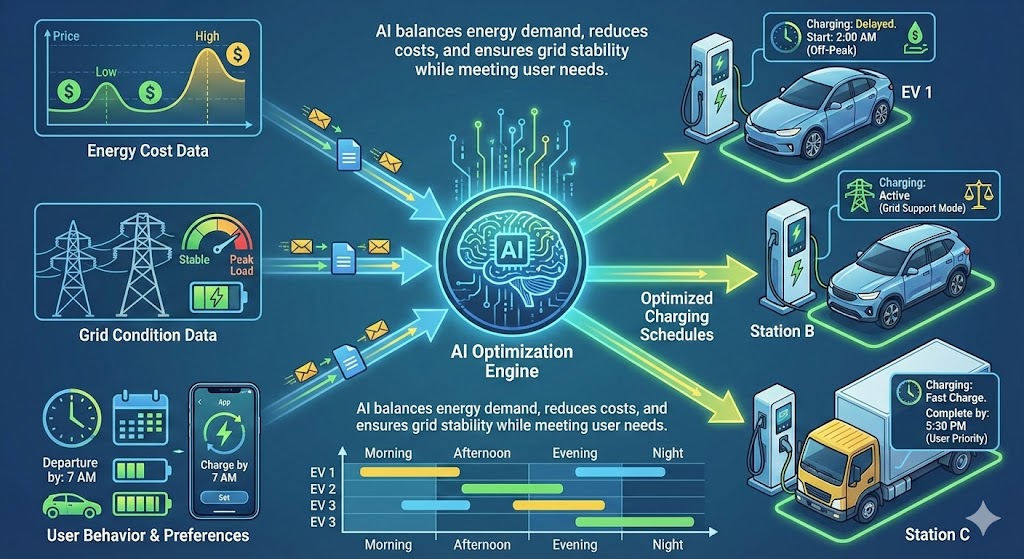
Artificial intelligence addresses these challenges through data-driven optimization, predictive analytics, and real-time decision-making. By processing vast amounts of information—from user behavior patterns and energy prices to weather conditions and grid capacity—AI systems can orchestrate charging activities in ways that benefit individual users, charging station operators, utility companies, and the environment simultaneously.
-37.jpg?w=971&h=559)
Key Applications of AI in EV Charging
1. Intelligent Charging Schedule Optimization
One of the most impactful applications of AI in EV charging is the optimization of charging schedules. Research from institutions like the Royal Military College of Canada has demonstrated that AI algorithms using particle swarm optimization and GPU-accelerated processing can dramatically improve charging efficiency in large parking facilities. These systems analyze multiple variables including vehicle arrival and departure times, energy demand, electricity costs, and grid conditions to determine optimal charging schedules.
Studies show that AI-driven charging strategies can achieve remarkable results. By scheduling charging during off-peak hours, these systems reduce strain on the electrical grid while cutting reliance on fossil-fuel power plants. Research indicates that AI-based scheduling can boost station efficiency by 30% and reduce operating costs by 20%. Moreover, large-scale experimental evidence suggests that managed charging using AI automation can reduce peak household electricity use by 42%, with all EV demand successfully shifted to off-peak hours, resulting in annual electricity bill reductions averaging £343 per consumer.
2. Strategic Charging Station Placement
AI and machine learning are revolutionizing how companies decide where to install new charging infrastructure. General Motors, for instance, employs AI to identify ideal locations for EV charging stations across America. These algorithms process diverse datasets including traffic patterns, demographic information, existing infrastructure, and EV adoption trends to pinpoint strategic locations that maximize accessibility while ensuring economic viability.
This data-driven approach to infrastructure planning addresses a critical challenge in EV adoption: range anxiety and charging station availability. By ensuring charging stations are positioned where they are most needed, AI helps create a more reliable and comprehensive charging network that encourages more drivers to transition to electric vehicles.
3. Predictive Maintenance and Reliability Enhancement
Charging station reliability is paramount to user trust and widespread EV adoption. Harvard research has revealed that public EV charging ports are less reliable than traditional gas pumps, contributing to "charge anxiety" among drivers. AI-powered predictive maintenance addresses this issue by identifying potential failures before they result in downtime.
Through continuous monitoring of hardware components—power electronics, cooling systems, connectors, and payment terminals—machine learning models detect subtle anomalies that precede failures. These might include slight temperature variations, minor voltage fluctuations, or changes in charging speed. By flagging these early warning signs, AI enables proactive intervention, preventing costly breakdowns and ensuring charging infrastructure remains operational when users need it most.
4. Load Management and Grid Stability
The integration of millions of electric vehicles into the power grid presents significant challenges for grid operators. Unmanaged charging, particularly during peak demand periods, could strain infrastructure and potentially cause blackouts. AI provides sophisticated load management capabilities that balance charging demand with grid capacity.
Advanced AI systems employ machine learning algorithms including Random Forest, Recurrent Neural Networks, Gaussian Process Regression, and Reinforcement Learning to forecast energy consumption patterns and optimize load distribution. These models analyze historical data alongside real-time information to make informed decisions that enhance charging efficiency while reducing operational costs. In California, where officials project 5 million EVs on the road by 2030, AI-driven charging strategies have demonstrated the ability to smooth the infamous "duck curve"—the graph showing net power demand throughout the day—reducing grid fluctuations even as millions of vehicles are integrated into the system.
5. Dynamic Pricing and Demand Response
AI enables sophisticated dynamic pricing models that respond to real-time grid conditions, energy availability, and market variables. These systems adjust charging rates based on factors such as time-of-use electricity rates, renewable energy availability, and current grid stress. By incentivizing charging during periods when electricity is abundant and cheap, AI-driven pricing helps flatten demand curves and maximize the use of renewable energy sources.
Implementation of AI-based demand response systems allows charging infrastructure to become an active participant in grid management rather than merely a passive consumer. During periods of high renewable energy generation, AI systems can increase charging rates or offer discounted prices to encourage energy consumption. Conversely, during peak demand or grid stress, the systems can reduce charging rates or shift demand to later periods.
6. Enhanced User Experience and Interaction
The latest innovations in AI-powered EV charging extend beyond operational efficiency to user experience enhancement. Companies like Electric Era have introduced charging systems featuring bilingual AI technology that can interact with drivers conversationally. These systems provide information on charging status, suggest power requirements for reaching destinations, offer loyalty program updates, and even engage in casual conversation or tell jokes.
Such AI-enhanced interfaces represent a shift from purely functional charging stations to interactive service points that engage users and potentially increase dwell time at associated retail locations. This integration of conversational AI makes the charging experience more intuitive and user-friendly, reducing friction for new EV owners and enhancing overall satisfaction.
Core Technologies and Algorithms Powering AI-Driven Charging
The AI revolution in EV charging leverages several sophisticated technologies and algorithmic approaches:
Machine Learning Models: Various ML techniques are employed depending on specific applications. XGBoost has demonstrated superior performance in demand prediction, achieving significantly lower error rates than alternative models. Long Short-Term Memory (LSTM) networks excel at processing temporal sequences, making them ideal for predicting charging patterns based on historical data. Support Vector Machines and Random Forest algorithms contribute to classification tasks and pattern recognition.
Deep Learning Architectures: Neural networks, particularly deep learning models, enable the processing of complex, high-dimensional data. These architectures can identify subtle patterns in user behavior, energy consumption, and grid dynamics that might elude simpler analytical approaches.
Optimization Algorithms: Particle swarm optimization, genetic algorithms, and other metaheuristic approaches help solve complex scheduling and resource allocation problems. These algorithms can navigate large solution spaces to identify optimal or near-optimal charging strategies.
Cloud Computing and Edge Processing: The scalability required for managing extensive charging networks demands cloud-based infrastructure capable of processing massive data volumes in real-time. Platforms like the Scalable Cloud-Based Continuous Monitoring Platform (SC-CMP) combine cloud computing with edge processing, enabling both centralized coordination and local decision-making. This architecture reduces latency while providing the computational power necessary for sophisticated AI operations.
Internet of Things (IoT) Integration: IoT sensors deployed throughout charging infrastructure collect real-time data on equipment status, energy flow, environmental conditions, and usage patterns. This continuous data stream feeds AI systems, enabling adaptive responses to changing conditions.
Real-World Applications and Case Studies
Tesla's AI-Optimized Supercharger Network
Tesla employs AI to optimize its Supercharger network, analyzing vehicle data, traffic patterns, and charging demand to direct drivers to available chargers and balance load across locations. This system reduces wait times while ensuring efficient utilization of charging infrastructure.
Malaysian Smart Charging Initiative
Malaysia's implementation of AI-based smart charging systems represents an emerging market approach to EV infrastructure development. With plans for 10,000 EV charging stations by 2025, Malaysian authorities are leveraging AI technologies for demand forecasting and energy management. Research has demonstrated that AI-based systems can achieve 30% energy savings and 20.38% cost reduction compared to traditional charging methods in Malaysian contexts.
Large-Scale UK Managed Charging Trial
One of the world's largest AI-managed EV charging trials, conducted in the UK with over 13,000 consumers, provided empirical evidence of AI's transformative potential. The trial demonstrated that AI-managed charging could reduce peak household electricity use by 42%, generate consumer savings averaging £343 annually, and maintain high user satisfaction with minimal manual overrides of automated schedules.
Integration with Renewable Energy and V2G Technology
AI plays a crucial role in integrating EV charging infrastructure with renewable energy sources and enabling Vehicle-to-Grid (V2G) technology. Machine learning algorithms forecast renewable energy availability—particularly solar and wind generation—and optimize charging schedules to coincide with periods of high renewable output. This alignment reduces carbon emissions associated with EV charging and maximizes the utilization of clean energy.
V2G technology, which allows electric vehicles to supply power back to the grid, requires sophisticated AI coordination. Machine learning models optimize bidirectional power flow, managing battery health, grid stability, and energy trading simultaneously. AI-powered V2G systems enable EVs to function as distributed energy resources, supporting grid resilience during peak demand periods while generating revenue for vehicle owners.
Challenges and Limitations
Despite its transformative potential, AI implementation in EV charging infrastructure faces several challenges:
Computational Complexity: Advanced AI models require substantial computational resources, particularly for real-time optimization across large networks. Balancing model sophistication with processing speed remains an ongoing challenge.
Data Privacy and Security: AI systems depend on extensive data collection, including user behavior patterns and location information. Ensuring data privacy while maintaining system functionality requires careful design and robust cybersecurity measures. The interconnected nature of smart grids and charging infrastructure makes these systems vulnerable to cyberattacks.
Infrastructure Integration: Retrofitting existing charging stations with AI capabilities or integrating AI systems with legacy grid infrastructure can be technically challenging and expensive. Achieving seamless interoperability across diverse systems and standards requires coordinated industry efforts.
Algorithm Bias and Fairness: AI algorithms must be designed to ensure equitable access to charging infrastructure across different geographic areas and demographic groups. Bias in training data or algorithm design could inadvertently create disparities in service availability or pricing.
Regulatory and Standardization Issues: The rapid pace of AI development often outstrips regulatory frameworks. Establishing standards for AI-powered charging systems while maintaining innovation flexibility represents a delicate balance.
Future Directions and Emerging Trends
The future of AI in EV charging points toward several exciting developments:
Blockchain Integration: Combining AI with blockchain technology promises enhanced security for energy trading transactions and greater transparency in charging operations. Decentralized AI architectures leveraging blockchain could enable peer-to-peer energy trading and more resilient charging networks.
Federated Learning: This approach allows AI models to learn from distributed data sources without centralizing sensitive information, addressing privacy concerns while maintaining model effectiveness.
Hybrid AI Models: Future systems will likely combine multiple AI approaches—deep learning for pattern recognition, reinforcement learning for adaptive optimization, and traditional algorithms for specific computational tasks—to achieve superior performance across diverse operational scenarios.
Autonomous Vehicle Integration: As autonomous vehicles become prevalent, AI charging systems will need to coordinate not just charging schedules but also vehicle routing to charging stations and autonomous navigation within charging facilities.
Ultra-Fast Charging Optimization: As charging technology advances toward ultra-fast charging capabilities (350 kW and beyond), AI systems will need to manage the thermal, electrical, and grid integration challenges associated with these high-power systems.
Conclusion: Toward a Sustainable Electric Mobility Future
Artificial intelligence has emerged as an indispensable enabler of the electric vehicle revolution. By optimizing charging schedules, enhancing grid stability, reducing costs, improving reliability, and creating better user experiences, AI addresses the multifaceted challenges inherent in large-scale EV adoption. As demonstrated by research and real-world implementations, AI-driven charging systems can deliver substantial benefits—reducing energy costs by 20-30%, cutting peak demand by over 40%, and improving infrastructure utilization while maintaining grid stability.
The continued evolution of AI technologies, combined with advances in charging hardware, renewable energy integration, and smart grid infrastructure, promises increasingly sophisticated and efficient EV charging ecosystems. These systems will not merely support the transition to electric mobility; they will help create a more sustainable, resilient, and intelligent energy infrastructure that benefits society as a whole.
As electric vehicle adoption accelerates globally—with projections suggesting hundreds of millions of EVs on the road within the next decade—the role of AI in managing this transformation will only grow more critical. The intelligent charging networks being developed today lay the foundation for a transportation future that is cleaner, more efficient, and more accessible than ever before. Through continued innovation, collaboration, and investment in AI technologies, the vision of seamless, sustainable electric mobility is becoming an achievable reality.