
In today’s digital age, batteries have become an indispensable energy source in our daily lives. From smartphones to electric vehicles, from laptops to portable electronic devices, battery performance directly affects the user experience and lifespan of these devices. However, many people overlook a critical factor—the profound impact of charging methods on battery performance. Different charging strategies not only affect charging speed but also significantly influence battery health, service life, and overall performance. This article will explore various battery charging methods in depth, analyze how they impact battery performance, and provide practical charging recommendations for users.
Common Battery Charging Methods
1. Constant Current Charging (CC)
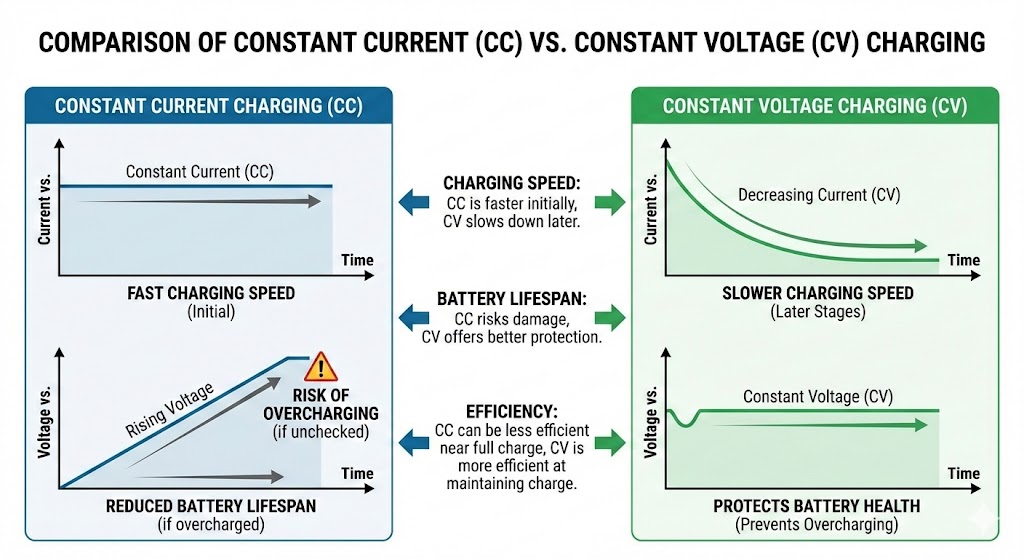
Constant current charging is one of the most traditional charging methods, characterized by maintaining a constant current input throughout the charging process. This method is simple and reliable, but it also has obvious limitations.
Working Principle:
In constant current charging mode, the charger provides a fixed current to the battery until the battery voltage reaches the set upper limit. This method is quite efficient in the early stages of charging, but continuing to use constant current charging as the battery voltage increases may lead to overcharging, thereby damaging the battery.
Impact on Performance:
- Charging Speed: Stable charging speed initially, but needs to switch to other modes later to avoid overcharging
- Battery Lifespan: Without proper control, may cause battery overheating and overcharging, shortening service life
- Safety: Requires precise voltage monitoring, otherwise poses safety hazards
2. Constant Voltage Charging (CV)
Constant voltage charging maintains a constant charging voltage while allowing the charging current to vary naturally with battery state. This method is commonly used for lead-acid battery charging.
Working Principle:
The charger outputs a fixed voltage, and as the battery charge increases, the charging current gradually decreases. When the battery approaches full charge, the current drops to a very small trickle level.
Impact on Performance:
- Charging Efficiency: Slower charging speed in later stages, longer overall charging time
- Battery Protection: Effectively prevents overcharging, relatively gentle on the battery
- Application Range: More suitable for specific types like lead-acid batteries, limited effectiveness for lithium batteries
3. Constant Current-Constant Voltage Charging (CC-CV)
CC-CV charging is currently the most commonly used charging method for lithium-ion batteries, combining the advantages of both constant current and constant voltage modes.
Working Principle:
The charging process is divided into two stages:
- Constant Current Stage (CC): Rapid charging at constant current until battery voltage reaches the set upper limit
- Constant Voltage Stage (CV): Maintains constant voltage while current gradually decreases until it drops to the cutoff current
Impact on Performance:
- Charging Efficiency: Fast charging initially, fine-tuning later, high overall efficiency
- Battery Health: Effectively balances charging speed and battery protection, extending battery life
- Temperature Control: Two-stage design helps control charging temperature, improving safety
- Practical Application: Almost all modern smartphones and laptops use this method
4. Pulse Charging
Pulse charging charges the battery through intermittent current pulses, allowing the battery to “rest” during pulse intervals.
Working Principle:
The charger provides current in pulse form, with a brief pause or discharge period after each pulse. This method can reduce battery polarization and promote uniform electrolyte distribution.
Impact on Performance:
- Depolarization Effect: Effectively reduces internal battery polarization, improving charging efficiency
- Temperature Management: Pulse intervals help with heat dissipation, lowering charging temperature
- Battery Activation: May help restore some performance to aging batteries
- Complexity: Requires more complex charging control circuits
5. Fast/Rapid Charging
Fast charging technology dramatically reduces charging time by increasing charging power and has been a popular technology in recent years.
Working Principle:
Fast charging technology increases charging power by raising voltage, current, or both. Modern fast charging protocols (such as USB-PD, QC, VOOC, etc.) use intelligent communication, allowing the charger and device to negotiate optimal charging parameters.
Impact on Performance:
- Charging Speed: Significantly reduces charging time, some technologies can charge to 80% in 30 minutes
- Heat Generation: High-power charging generates more heat, requiring good thermal management
- Battery Aging: Long-term use of fast charging may accelerate battery aging, but modern BMS systems have greatly improved this issue
- Convenience: Greatly enhances user experience, especially in emergency situations
-34.jpg?w=1024&h=559)
6. Trickle Charging
Trickle charging continuously replenishes the battery with a very small current, primarily used to maintain the battery in a fully charged state.
Working Principle:
When the battery approaches or reaches full charge, the charger switches to extremely low current mode, compensating for the battery’s self-discharge losses.
Impact on Performance:
- Battery Maintenance: Effectively maintains battery full charge state, suitable for devices in long-term storage
- Overcharging Risk: May cause overcharging damage to certain battery types (especially lithium batteries)
- Energy Efficiency: Long-term trickle charging may waste electrical energy
Performance Comparison of Different Charging Methods
Charging Speed
In terms of charging speed, fast charging is undoubtedly the fastest, followed by constant current-constant voltage charging. Pulse charging and trickle charging are slower, focusing more on battery health than charging speed.
Battery Lifespan Impact
Research shows that charging methods have a significant impact on battery lifespan:
- Optimal Choice: CC-CV charging with appropriate parameters best balances speed and lifespan
- Higher Risk: Improper fast charging and continuous trickle charging may shorten battery life
- Protective Measures: Modern Battery Management Systems (BMS) greatly reduce the negative impact of fast charging on lifespan through temperature monitoring, voltage control, and other means
Temperature Management
Temperature control during charging is crucial:
- Fast charging generates the most heat, requiring active cooling
- The intermittent nature of pulse charging aids temperature control
- The two-stage design of CC-CV charging facilitates thermal management
- High temperature is one of the main factors in battery aging, so temperature control directly affects battery performance
Safety Considerations
The safety of different charging methods also varies:
- Fast charging requires stricter protection mechanisms
- Constant current charging without proper control may lead to overcharging
- Modern intelligent charging systems integrate multiple protections, significantly enhancing safety
Practical Charging Recommendations
Based on the above analysis, here are recommendations for extending battery life and maintaining optimal performance:
-
Choose the Right Charger: Use original or certified chargers to ensure charging parameters match device requirements
-
Avoid Extreme Temperatures: Charge at suitable temperatures (20-25°C), avoid charging in high or low temperature environments
-
Use Fast Charging Intelligently: Fast charging can be used daily, but you don’t need to pursue maximum speed every time; occasional slow charging benefits battery health
-
Avoid Complete Discharge: Modern lithium batteries don’t need complete discharge; keeping charge levels between 20%-80% is most beneficial for lifespan
-
Don’t Keep at 100% Long-term: Disconnect the charger promptly after full charge, avoid maintaining full charge state for extended periods
-
Regular Calibration: Perform complete charge-discharge cycles 1-2 times per month to help maintain accuracy of battery level indicators
Conclusion
The impact of battery charging methods on performance is multifaceted, involving charging speed, battery lifespan, safety, and user experience. The development of modern battery technology, particularly the application of intelligent Battery Management Systems, has significantly reduced the negative impacts of improper charging methods. CC-CV charging has become the standard charging method for lithium-ion batteries due to its excellent balance; fast charging technology has greatly enhanced user experience without significantly sacrificing battery lifespan.
For ordinary users, understanding these charging principles helps make more informed charging decisions. In practical use, choosing reliable chargers, avoiding extreme usage habits, and flexibly selecting charging methods according to actual needs will maximize battery performance and lifespan. As technology continues to advance, future charging methods will become more intelligent, automatically adapting to battery status and usage scenarios to provide users with the optimal charging experience.