
This analysis combines scientific data, in-depth studies, and real-world market insights to provide a richly detailed comparison of hybrid, gasoline, and electric vehicles (EVs) from multiple angles. It captures market dynamics, technology, performance, costs, environmental impacts, infrastructure, consumer behavior, and practical considerations for users in 2025.
Market Overview and Adoption Trends
Despite strong growth in hybrid and electric vehicles globally, gasoline-powered cars remain dominant in many markets, especially in regions like Mexico, where 98% of light vehicle sales in 2022 were gasoline cars compared to only about 2% for hybrid and electric combined. Awareness and acceptance remain hurdles, especially in areas with limited charging infrastructure and established consumer habits.
Hybrid vehicles are gaining market traction, offering a viable alternative with fuel savings and reduced emissions, notably in urban driving. Pure electric cars are rapidly evolving but still face challenges like range limitations and longer charging times on long trips, making them ideal mainly for city and moderate-distance use.
Technical Performance and Energy Efficiency
Gasoline Vehicles
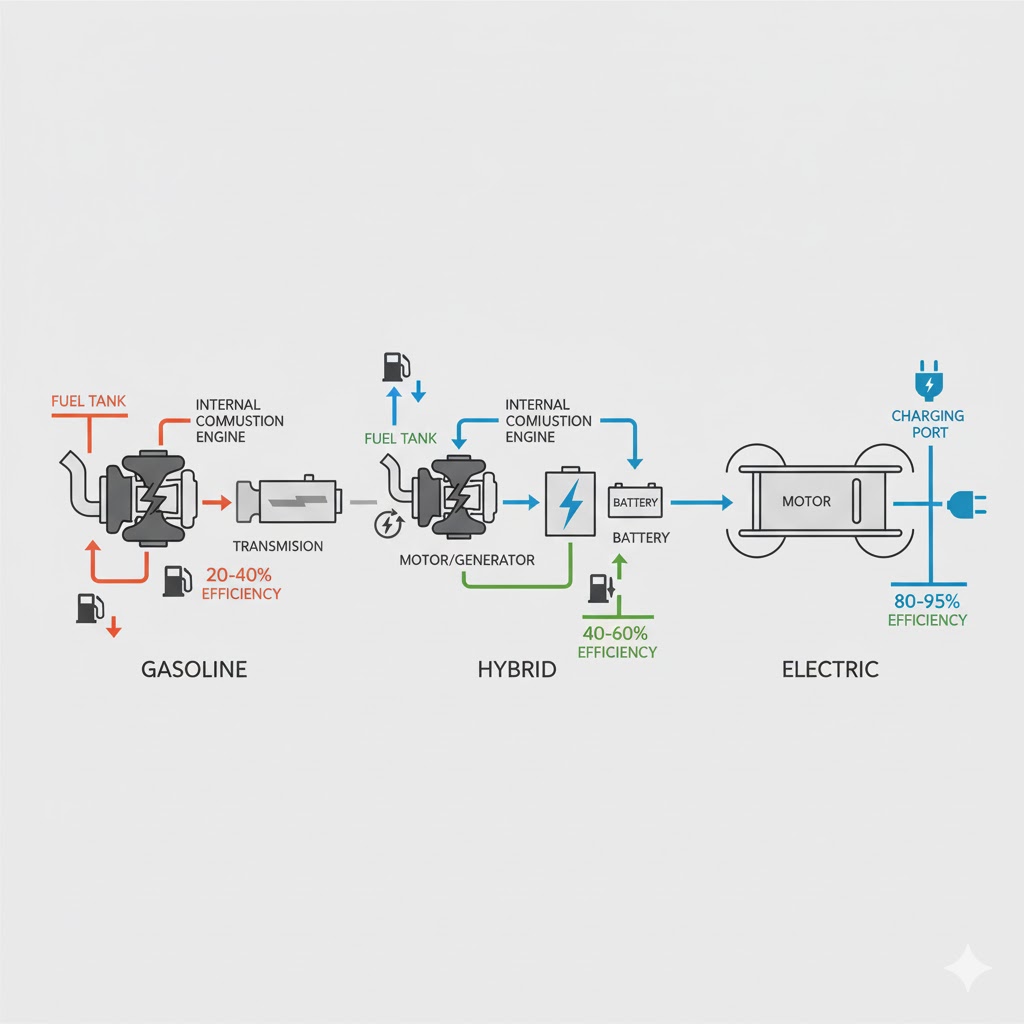
Gasoline cars use traditional internal combustion engines (ICE) operating on the Otto cycle, characterized by four stages: intake, compression, combustion, and exhaust. The average efficiency of gasoline engines is about 25%, with notable energy loss mainly as heat and friction.
Energy Required for Motion: The total energy consists of kinetic, potential (altitude-related), drag (air resistance), and friction (tire-road) energies. The combined energy requirement for typical journeys depends on vehicle mass, speed, and route topography.
Hybrid Vehicles
Hybrids integrate an ICE with one or more electric motors and a battery. They operate predominantly on electric power during low speeds and use the ICE for higher speeds or when battery charge is low. Regenerative braking recovers energy during deceleration, significantly boosting overall efficiency (fuel savings up to ~50% compared to gasoline vehicles). Unlike pure EVs, hybrids do not need external electric charging (except plug-in hybrids), as the engine and regenerative systems recharge the battery.
Strong hybridization technologies with extra downsized gasoline engines acting as range extenders optimize fuel efficiency and emissions, especially in urban stop-and-go traffic. Powertrain management optimizes engine operation to always work near peak efficiency, while electric motors handle varying load conditions. This leads to improved fuel economy and lower CO₂ emissions by about 3-5% in typical urban cycles.
Electric Vehicles (EVs)
EVs use electric motors powered by large lithium-ion batteries. Electric motors have an energy conversion efficiency around 75% or higher, much superior to ICEs. EVs use regenerative braking extensively and produce zero tailpipe emissions.
Major challenges include battery weight that increases total vehicle mass (over 1,500 kg vs. 1,100 kg for gasoline cars), limited driving range per charge (typically 200-400 km), and the need for charging infrastructure. Charging times vary widely: Level 1 (standard outlet) may require 6-8 hours; Level 2 chargers (240V) take 3-4 hours; DC fast chargers can replenish 80% battery in 20-40 minutes but may accelerate battery degradation if frequently used.
Innovations in thermal management systems and battery chemistry aim to reduce charging time impact and improve battery life. For long trips, charge planning is critical, with frequent stops potentially doubling travel time compared to gasoline or hybrid vehicles.
Practical Trip Analysis: Case Study
An applied study compared three popular vehicles (Nissan Versa — gasoline, Toyota Prius — hybrid, JAC e10X — electric) on a 1,116 km route with variable topography in Mexico.
- Energy Consumption: EV required about 29-30% more energy on this route because of battery weight.
- Refueling/Charging Stops: Gasoline and hybrid cars needed 2 each with refueling times around 20 min per stop; EV required 31 fast charging stops (around 42 min each), totaling over 2 days of travel with charging included.
- Travel Time: Gasoline car took ~12.6 hours; hybrid ~13.1 hours; EV took 56-68 hours depending on charging strategy.
- Cost: Gasoline ~$1,350 MXN for fuel; hybrid ~$1,550 MXN; EV ~$840 MXN using fast chargers, but with significantly higher accommodation and downtime costs if overnight stays for slow charging included. Purchase price was lowest for gasoline, followed by electric, then hybrid.
Economic Considerations: Purchase and Operating Costs
- Purchase Price: Gasoline cars have the lowest upfront cost. Hybrids are pricier due to dual drivetrain complexity and batteries; EVs generally cost the most due to battery technology, although prices are gradually decreasing.
- Fuel & Energy Costs: EVs have the lowest "fuel" cost per km, often half or less than gasoline vehicles. Hybrids reduce gasoline consumption considerably, lowering running costs.
- Maintenance: Simple EV electric drivetrains require less maintenance than complex ICE and hybrid powertrains, reducing lifetime costs.
- Depreciation & Resale: EV values depend on battery health; hybrids generally depreciate slower than gasoline cars but depend on regional factors.
Environmental Impact
- Gasoline cars emit the highest CO₂ and pollutant levels.
- Hybrids can reduce emissions by 40-80%, especially in urban stop/start driving.
- EVs produce zero tailpipe emissions; lifecycle emissions depend on electricity generation but tend to be significantly lower.
Charging Infrastructure and User Experience
- Gasoline fueling is fast and ubiquitous.
- Hybrids mostly avoid charging needs; plug-in hybrids require moderate charging infrastructure.
- EVs require home chargers (Level 2 recommended) and access to public fast-charging networks. Smart charging technologies optimize electricity cost by charging during off-peak hours. Rapid charging stations continue expanding along highways and urban areas.
- Frequent fast charging can impact battery health; thermal management solutions mitigate this.
User Experience and Practical Use Considerations
Choosing a vehicle is not merely a technical decision. User experience and lifestyle factors weigh heavily. Gasoline vehicles offer quick refueling and wide availability, favored for long trips and unpredictably timed travel. Electric vehicle owners prioritize access to charging: home Level 2 chargers and comprehensive public fast charger networks significantly enhance convenience.
Hybrids appeal largely due to convenience without charging infrastructure dependency in non-plug-in versions, while plug-in hybrids allow zero-emission urban driving with gasoline backup for longer trips. Quietness and smooth acceleration enhance enjoyment.
Battery Technology and Innovation Trends
Battery advancements are crucial drivers of electric and hybrid vehicle evolution. While lithium-ion batteries dominate, solid-state batteries promise higher density, faster charging, and improved safety, with commercial scaling expected in the next 5-10 years. Battery recycling and second-life applications mitigate raw material concerns and environmental impacts.
Charging system innovations—including vehicle-to-grid (V2G) capabilities, smart energy management, and thermal controls—improve efficiency, reduce grid stress, and prolong battery health..jpg?w=1024&h=1024)
Policy Support and Market Incentives
Government incentives remain strong factors in shaping vehicle choices. Purchase subsidies, tax breaks, and non-monetary benefits (free parking, road priority) lower barriers. Emission regulations push automakers to innovate and phase out high-emission models. Urban low-emission zones are accelerating adoption of cleaner vehicles, especially EVs and hybrids.
Future Outlook
In the coming decade, automotive markets will witness a diversified ecosystem. Electric vehicles will increasingly dominate urban mobility as battery improvements and charging infrastructure progress. Hybrids serve as a necessary bridge technology, balancing efficiency and convenience. Traditional gasoline vehicles face gradual phase-out, replaced increasingly by alternative fuels.
Integration of autonomous driving, connectivity, and shared mobility will further transform car use and ownership patterns. The industry’s trajectory aligns with global sustainability goals, embracing cleaner technologies and smarter mobility solutions.
Summary Table of Key Comparisons
| Feature | Gasoline Cars | Hybrid Cars | Electric Cars (EVs) |
|---|---|---|---|
| Purchase Cost | Lowest | Higher than gasoline | Highest; decreasing with scale |
| Energy Efficiency | ~25% | ~35-50%, varies by system | ~75% |
| Fuel/Charging Cost | Highest | Mid | Lowest |
| Maintenance Cost | Highest | Mid | Lowest |
| Driving Range | Longest (>600 km) | Long (~500-700 km) | Shorter (200-400 km typical) |
| Refueling/Charging Time | 3-5 minutes; widespread stations | 3-5 minutes; gasoline stations | Minutes to hours; growing stations |
| Environmental Impact | Highest CO₂ and pollutants | Moderate reduction | Zero tailpipe emissions |
| Long Trip Suitability | Best | Good | Limited; requires planning |
| Urban/Short Trip Use | Standard | Ideal | Ideal |
Conclusion
Industry experts conclude that vehicle choice depends on usage, environment, economics, and priorities. Gasoline cars offer convenience and low cost for longer distances; hybrids provide a flexible, efficient middle ground, especially in mixed driving; electric cars lead in environmental benefits and operating cost savings where charging access is assured.
Investment in home and public charging infrastructure, along with continued technological innovation and supportive policies, is key to advancing electric mobility. As battery technology and infrastructure mature, electric vehicles are expected to become mainstream, with hybrids maintaining relevancy as a transitional technology.
This comprehensive, data-driven comparison aims to empower intelligent consumer choices and reflect the evolving landscape of personal transportation in 2025 and beyond..jpg?w=1024&h=1024)