
Introduction: The Electrification Revolution is Here
The year 2025 represents a landmark chapter in the history of electric vehicles (EVs), which have transitioned from niche innovations to dominant forces reshaping the global automotive landscape. From major urban centers in Beijing, Berlin, and Boston to smaller emerging markets in Southeast Asia and Latin America, the electrification of transport is accelerating with unprecedented vigor.
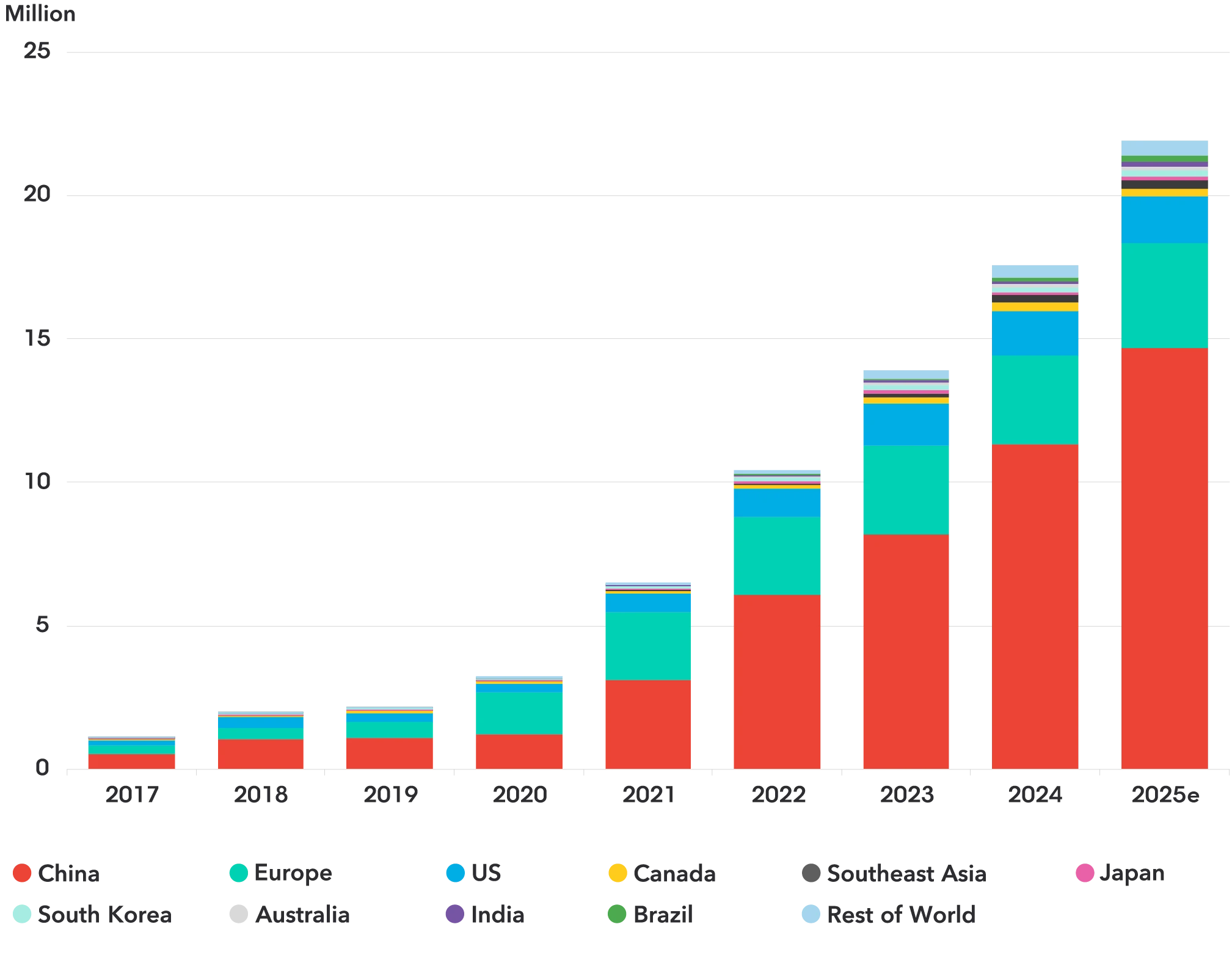
According to Virta Global and corroborated by BloombergNEF (BNEF) and the International Energy Agency (IEA), electric vehicle sales surpassed 17 million units in 2024, accounting for over 20% of all new cars sold worldwide. This figure alone more than doubles the total EV sales from 2020 and sets the stage for an estimated 22 million units to be sold worldwide in 2025, marking a robust 25% year-over-year increase.
Electric vehicles are no longer the future; they are the present, and their rapid adoption echoes the combined effects of cost reductions, regulatory incentives, consumer acceptance, and advancements in technology.
Global Market Size and Sales Trends
Explosive Sales Growth
In just five years, EV sales have gusted from virtually marginal percentages to a quarter of the global new vehicle market. In 2024 alone, an additional 3 million EVs were sold than in 2023, pushing the active global electric fleet to nearly 58 million vehicles. The growth trajectory continues sharply upward, with the first quarter of 2025 witnessing a remarkable 35% sales increase from the previous year, exceeding 4 million units sold.
Analysts at BloombergNEF project nearly 22 million battery electric vehicles (BEVs) and plug-in hybrid electric vehicles (PHEVs) sold in 2025, with projections pointing toward ever-expanding sales figures in the coming years as battery costs decline and more affordable models hit the market.
The Shifting Sales Mix: BEVs Gain Ground
The BEV share of the global sales mix is steadily rising. While plug-in hybrids (PHEVs) have been instrumental in easing the transition, BEVs increasingly dominate new registrations. Industry forecasts indicate a marked BEV preference in core markets, especially China and Europe, fueled by policy levers, improved charging infrastructure, and longer driving ranges. From 2025 onward, BEVs are expected to account for a growing majority of electric car sales.
Regional Market Breakdown: Powers of the EV Age
China: The Defiant Leader
China remains the unrivaled powerhouse of the EV world, consuming nearly two-thirds of global sales. In 2024, China sold over 11 million EVs, more than the total global sales volume just two years prior. The country’s portion of the global EV market is expected to hold firm at around 65% in 2025.
By mid-2025, over 49 million electric vehicles are estimated to be on Chinese roads - a staggering figure compared to roughly 20 million in Europe and 10 million in North America. This vast penetration is propelled by aggressive government subsidies, policies aimed at replacing conventional vehicles, and robust domestic EV automakers like BYD and NIO expanding their market share. For example, BYD reported selling more than 4 million EVs and plug-in hybrids in 2024 alone, a testament to China's electrification giant status.
China's pioneering role extends beyond sales: it dominates battery manufacturing, technological innovation, and infrastructure deployment. Companies like CATL lead the battery pack segment globally, anchoring the supply chain to China’s EV export strength.
Europe: The Green Continent’s Accelerating Journey
Europe is charging forward with intensity. The continent achieved a 25% EV sales share in 2025, with 17% of global sales coming from this region. Despite some setbacks related to subsidy reductions in countries like France and Germany, Europe’s electrification remains on an impressive upward trend. The region sold approximately 3.7 million EVs in the first half of 2025, marking solid growth despite economic challenges.
Countries such as Norway lead with market penetration rates exceeding 80%, while Germany, France, and the UK contribute robust growth through ambitious emission regulations and expanding charging infrastructure networks. Europe's car market anticipates EVs to reach an estimated 63% of new car sales by 2030, supported by tightening CO2 targets and regulatory frameworks.
North America: Challenges and Opportunities
North America had somewhat slower growth in 2025, with EV sales adding about 1.6 million units in the United States—down from earlier projections due to federal policy rollbacks and potential regulatory uncertainties. The U.S. EV market, representing approximately 7% of global sales, faces challenges including the phase-out of federal tax credits and debates over state versus federal air quality standards.
Despite this, North America's market remains a vital and fast-growing segment. The Inflation Reduction Act has provided substantial incentives, fostering increased demand. Industry experts forecast that EVs will constitute at least 22% of new car sales in the U.S. by 2030 as vehicle prices become competitive and public charging infrastructure improves, with Canada and Mexico showing similar upward trajectories.
Emerging Markets: The Next Frontier
Emerging economies in Southeast Asia, Latin America, and Africa are witnessing the most rapid EV adoption rates, albeit from smaller bases. In Southeast Asia, sales jumped nearly 50% in 2024, with countries like Thailand reaching 13% market penetration and Indonesia tripling EV sales. Latin America showed dynamic growth, with Brazil doubling sales to 125,000 units and Colombia and Costa Rica reaching approximately 15% penetration rates. Meanwhile, Africa’s EV market remains nascent but rapidly expanding, led by nations such as Egypt and Morocco.
Technology & Infrastructure: The Foundations of Growth
Battery Technology: The Heart of Electrification
Arguably the most critical driver behind EV market expansion has been advancements in battery technology. Lithium-ion battery costs have plummeted over the past decade, with prices per kWh falling more than 85% since 2010. For 2025, costs are expected to stay around $100-120 per kWh, making EVs progressively price-competitive with internal combustion vehicles.
Cutting-edge innovations such as solid-state batteries and improvements in energy density promise longer ranges and faster charging. These advancements assuage "range anxiety" and improve the practicality of EVs for consumers globally.
Charging Infrastructure: Powering the Transition
Charging infrastructure is expanding in tandem with vehicle sales. Europe and China lead with rapid public charger network growth rates exceeding 40% annually, enabling convenient, fast charging for Europe’s urban and suburban users, and for China’s immense urban population.
North America, though less dense, is rapidly deploying fast-charging networks with Tesla’s Superchargers and other companies expanding public access points. Emerging markets focus heavily on urban charging solutions adapted to their contexts, combining public and home charging options.
Model Availability and Consumer Choice
Consumer choice has grown tremendously. By the end of 2024, 785 distinct electric vehicle models were available globally, spanning luxury sedans, SUVs, compact cars, and light commercial vehicles. Analysts expect this number to surpass 1,000 by 2026, increasing affordability and accessibility.
Domestic manufacturers in China and Europe have introduced competitively priced compact EVs, while major legacy automakers have launched electrified versions of best-selling models, helping drive broader consumer adoption.
.png?w=1152&h=896)
Market Outlook & Projections
The EV market’s trajectory for the next decade is steep and promising. Industry forecasts project global EV sales to nearly double from around 21 million in 2025 to over 40 million by 2030. The market value is slated to grow from approximately $1.3 trillion in 2024 to around $6.5 trillion by the end of the decade, illustrating a compound annual growth rate (CAGR) north of 30%.
China is expected to maintain leadership, while regulatory pressures in the European Union and later in North America will further accelerate EV uptake. The proliferation in emerging markets will increasingly contribute to global demand, particularly as second- and third-tier cities gain access to affordable EV technology.
Despite occasional policy uncertainties and supply chain challenges, the EV sector's fundamentals remain robust—advancements in battery manufacturing, commitment to clean energy, and consumer preference shifts underpin continued exponential growth.
Challenges Ahead
While growth is impressive, challenges persist:
- Raw material sourcing for batteries faces sustainability and geopolitical risks.
- Infrastructure, particularly fast and ultra-fast charging availability, requires further investment to keep pace with vehicle growth.
- Policy consistency is crucial; fluctuations in incentives or environmental standards can dent adoption rates, as observed in the U.S.
- Consumer education and seasonal market adaptation in developing regions are ongoing concerns.
Conclusion
The global electric vehicle market in 2025 stands at an inflection point. Massive sales volumes, surging adoption rates, and expanding infrastructure signal an irreversible shift toward electrified transport. China leads the charge, Europe follows closely with bold policies, and North America rebounds amid complex economic realities. Emerging markets open exciting frontiers.
Technological advances and the declining cost curve have made EVs not just viable, but compelling alternatives to traditional cars. The transformation is sweeping, encompassing urban environments, rural areas, and industries.
As EVs transition from early adoption to mainstream, their role in the global effort to combat climate change and urban pollution will expand dramatically. The next 5-10 years will be crucial in determining the shape of the transportation landscape and the sustainability of mobility worldwide.