
Electric vehicles (EVs) are becoming more common globally, with millions of drivers relying on them daily. Charging infrastructure continues to grow, and most EV owners charge their cars at home, work, or public stations. But what happens if the power goes out while your EV is charging? This question is important because power interruptions can have impacts not only on your car’s battery but also on safety, vehicle electronics, and your daily schedule. Understanding the mechanics behind EV charging, the nature of power outages, and best responses is crucial for drivers everywhere.
How EV Charging Works
EV charging involves transferring electrical energy from a power source—usually the electric grid—to the car’s battery through a charging station or onboard charger. The process is managed by the vehicle’s Battery Management System (BMS) and often by the charging equipment itself, both of which monitor voltage, current, temperature, and charging progress.
Charging power levels and protocols vary widely depending on the charger type (Level 1, Level 2, DC fast charging) and regional standards. Despite these variations, EVs and chargers are designed to handle unexpected interruptions safely. This is key to understanding what happens during a power outage.-13.jpg?w=1024&h=559)
Electrical Safety and Automatic Shutdown
If the power is interrupted during charging, the power supply to the charger is instantly cut off. EV chargers and vehicles are equipped with fail-safe mechanisms to protect both the car’s battery and the electrical system. Once power goes off, the charging process immediately stops, and most EVs enter a safe standby mode.
The onboard systems detect the absence of power and isolate the battery from the charger, preventing backflow of current which could cause damage. This automated response safeguards not only the battery’s health but also prevents electrical hazards such as short circuits or electrical fires. In nearly all cases, the vehicle’s battery is not harmed by an unexpected power loss.
For home chargers connected to residential circuits, circuit breakers or ground fault interrupters may also activate during grid faults, adding another layer of protection.
Impact on Battery and Charging State
A sudden power outage interrupts charging, but it does not force a harmful state into the battery. Most modern lithium-ion EV batteries have elaborate battery management systems that monitor and control charging states meticulously.
When charging stops abruptly, the battery simply holds the charge level achieved before the interruption. There is no risk of overcharging or damage caused by an unfinished charging session. However, if the power outage lasts a long time and the battery isn’t sufficiently charged, the car won’t have the range initially planned, which could be an inconvenience.
Once power is restored, the EV and charger will typically resume charging automatically or require a slight restart by the owner. Whether this happens automatically depends on the vehicle, charger model, and local software controls.
Effects on Smart Charging and Grid Integration
More EVs and chargers are integrated into smart grids, enabling optimized charging based on grid load, renewable energy availability, and user preferences. Power outages can disrupt these smart services, creating temporary hiccups in scheduled charging, energy management, and vehicle-to-grid (V2G) functionalities.
For example, if a car is set to charge during off-peak hours but a power outage hits then, the charging schedule pauses. When power returns, the system tries to pick up as programmed, but depending on grid stability or control algorithms, manual intervention might sometimes be needed.
On a global scale, power infrastructure resilience varies. In some countries, frequent outages require EV users to be extra cautious and possibly invest in backup power solutions like home solar with batteries or uninterruptible power supplies (UPS) to ensure continuous EV charging.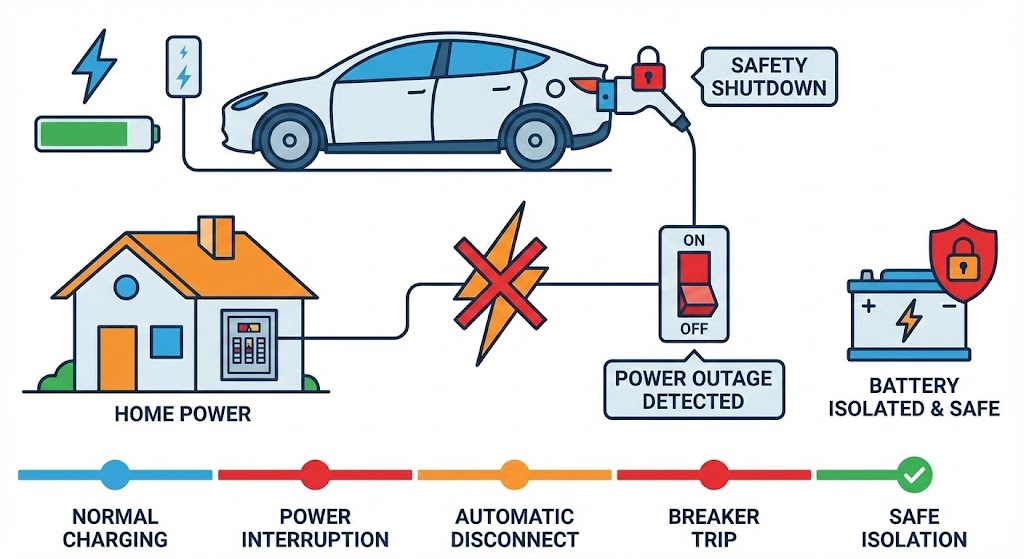
Practical Guidance for EV Owners Worldwide
- Understand Your Charging Equipment
Familiarize yourself with your charger’s behavior during power interruptions. Check if your system supports automatic restart or if you must manually reset it after outages. - Monitor Battery Levels
Always maintain a buffer in your battery charge, especially if you live in regions prone to power outages. Avoid starting long trips on nearly empty batteries if the power supply is unreliable. - Consider Backup Power Solutions
In areas with frequent blackouts, supplement your EV charging with an energy backup system such as home battery storage or solar power. These can provide uninterrupted charging during grid failures and increase your energy independence. - Safety First
Never attempt to disconnect or repair your charger or car charging port during a power outage. Wait for power restoration and verify system status before handling electrical equipment. - Use Smart Chargers and Apps
Modern chargers connected to apps can alert you about charging interruptions, allowing remote monitoring and timely actions. - Plan for Emergency Mobility
Keep alternative mobility options or public charging locations in mind when outages affect your home charging, especially during adverse weather or disaster situations.
Regional Variations and Considerations
-
In developed countries with stable grids, power outages during EV charging tend to be rare and brief. Users can expect minimal impact with robust safety mechanisms already in place.
-
In developing or remote areas, grid instability is more frequent, increasing the importance of understanding how outages affect charging and the value of backup power setups.
-
Regions with extreme weather events (storms, heat waves) may see outages coinciding with high EV usage, adding complexity to energy supply and requiring advanced preparation.
-
Government policies and incentives promoting EV adoption often include programs supporting home energy resilience upgrades, including reliable chargers and backup power systems.
Environmental and Economic Impacts
Sudden power interruptions do not harm EV batteries but can delay charging schedules and vehicle availability, potentially influencing transportation patterns. For fleet operators and businesses relying on electric vehicles, outages mean operational disruptions and economic costs.
Globally, enhancing grid resilience and integrating renewable energy with EV charging infrastructure help reduce outage frequency and duration. Such investments improve EV user experience and support broader sustainability goals.
Power outages during EV charging are an important consideration as electric vehicles become mainstream worldwide. Fortunately, modern EV technology has made the charging process safe and resilient to interruptions. Drivers everywhere can take simple yet effective precautions—such as understanding their equipment, maintaining battery charge buffers, and considering backup power—to minimize inconvenience and protect their vehicles. As the global energy landscape evolves, ongoing improvements in grid reliability and smart charging infrastructure will further ensure smooth, secure EV charging no matter where you live.