
Electric vehicles don't simply plug in and start charging the way a phone does. Before a single watt of power flows into the battery, the charging station and the vehicle must complete a carefully orchestrated electronic handshake. At the heart of this handshake are two low-voltage signals — the Control Pilot (CP) and the Proximity Contact (PP) — that together form the communication backbone of every Level 1 and Level 2 AC charging session, as defined by the SAE J1772 and IEC 61851 standards.
Why These Signals Exist
High-power AC charging introduces real risks. A 7.2 kW single-phase charger or a 22 kW three-phase unit pushes dozens of amperes through the cable. If the connector separates under load, or if the vehicle's on-board charger isn't ready, an uncontrolled arc could damage hardware or injure users. The CP and PP signals act as a safety interlock layer that sits entirely outside the power path — they run at milliampere levels and never touch the high-voltage conductors — but they govern when and how power is delivered.
The Proximity Contact (PP) Signal
The PP signal answers one simple question: is the charging connector physically and securely seated in the vehicle's inlet?
Inside the charging connector (the plug you hold in your hand), there is a small resistor tied between the PP pin and the protective earth (PE) pin. The vehicle's inlet reads the resistance across these two contacts and interprets it according to a defined table. In the SAE J1772 scheme, an open circuit (no plug inserted) presents more than 1 kΩ. When the connector is fully seated and latched, the resistance drops to 150 Ω. Some connectors incorporate a push-button release; pressing it changes the resistance to 68 Ω, signalling the vehicle's charge management system to stop current flow before the mechanical latch releases, preventing a hot-unplug event.
IEC 62196 (the European standard, used with Type 2 connectors) uses a slightly different resistor ladder — 1500 Ω, 680 Ω, 220 Ω, and 100 Ω — but the principle is identical: resistance encodes connection state. The vehicle's inlet contains a voltage divider that converts the plug's resistor value into a voltage the body control module can read with a simple analogue-to-digital converter.
In the physical charger, the PP circuit requires almost no active components. The resistor lives inside the moulded plug body itself, making it inherently reliable. The vehicle provides the pull-up voltage (typically 5 V) and reads back the divided result. No microcontroller on the EVSE side needs to participate in the PP measurement at all for basic presence detection.-49.jpg?w=1024&h=559)
The Control Pilot (CP) Signal
While PP is passive and analogue, CP is an active, bidirectional signalling channel. It carries two distinct pieces of information simultaneously: the EVSE communicates the maximum current it can supply (using pulse-width modulation), and the vehicle communicates its readiness state (by loading the line with a resistor that shifts the DC offset of the waveform).
The EVSE (Electric Vehicle Supply Equipment — the charge point) generates a ±12 V square wave on the CP pin at 1 kHz. The duty cycle of this waveform encodes the charger's current capacity. The formula is straightforward: for currents between 6 A and 51 A, the available current equals the duty cycle percentage multiplied by 0.6. So a 25% duty cycle advertises 15 A, a 50% duty cycle advertises 30 A, and so on. For higher-power stations above 51 A, a different linear mapping applies. This elegant encoding means the vehicle's on-board charger always knows exactly how hard it is allowed to draw, without needing a separate data bus.
The vehicle interprets the CP signal through a resistor network inside its inlet. Different resistor values, switched in by the vehicle's charge controller, pull the positive peak voltage of the CP waveform down from its nominal +12 V to lower levels. These modified peak voltages are what define the standard charging states.
Here is how those states map to the physical situation:
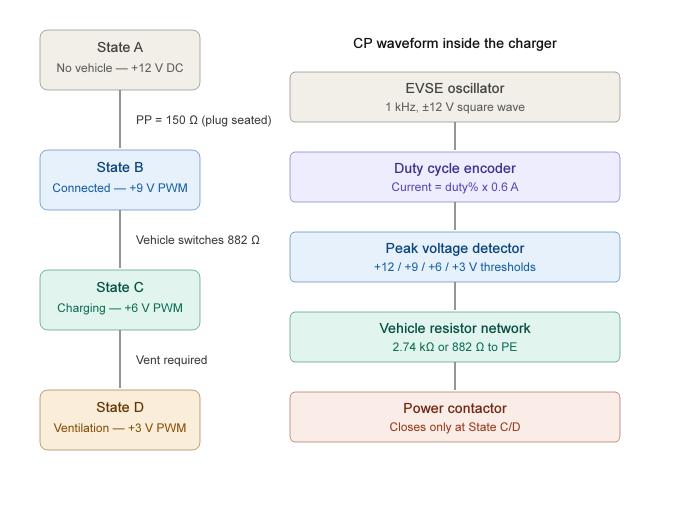
When no vehicle is connected, the CP line floats at a steady +12 V DC (no PWM yet). The EVSE is in standby, the contactor is open, and no power is available on the supply pins.
Once the connector is fully inserted — confirmed by the PP signal — the EVSE switches CP to its 1 kHz PWM waveform. The vehicle, detecting this oscillation, switches in a 2.74 kΩ resistor from CP to PE inside its inlet. This pulls the positive peak down to approximately +9 V. The EVSE measures this voltage and recognises State B: a vehicle is connected but not yet ready to accept charge.
When the vehicle's battery management system (BMS) decides it is ready to charge — it has completed its internal checks and closed its own pre-charge contactors — the vehicle switches in an additional 1.3 kΩ resistor in parallel. The combined resistance is now roughly 882 Ω, pulling the CP positive peak down to approximately +6 V. This is State C, the signal for the EVSE to close its main power contactor and energise the supply conductors. Charging begins.
A fourth state, State D (+3 V), is defined for situations where the vehicle requires forced ventilation during charging — a legacy consideration for older battery chemistries that could off-gas. Modern lithium-ion vehicles rarely invoke State D. A negative peak of −12 V on CP always indicates a fault; the EVSE immediately opens its contactor if it detects a missing or inverted negative half.
Here is a diagram of how the CP voltage states map to the full charging handshake:
Inside the Charger: The Hardware That Makes It Work
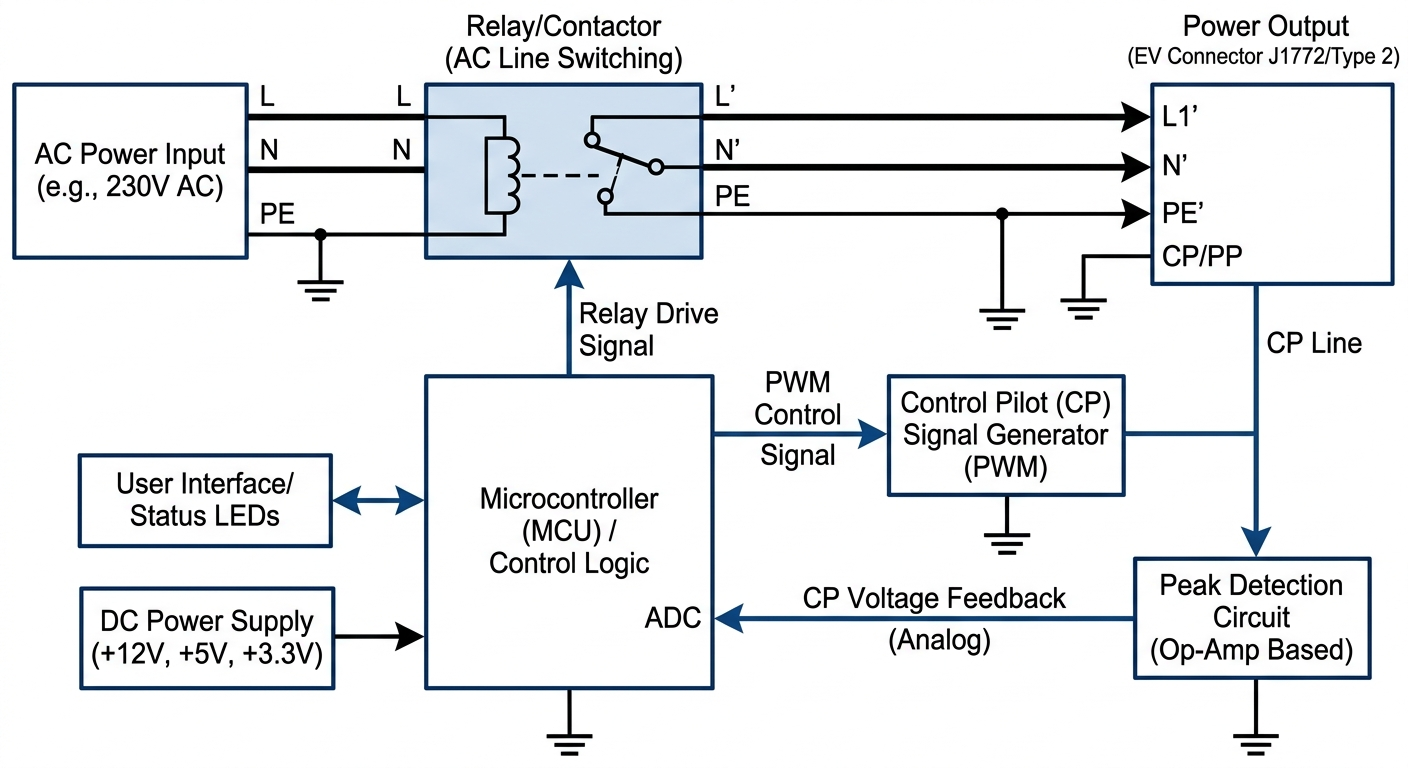
On the EVSE side, the CP signal is generated by a small dedicated circuit — in many modern charge points, a single microcontroller or a dedicated EVSE controller IC (such as the Atmel ATA6870 or similar) handles the entire CP/PP interface. The controller produces the PWM waveform, monitors the incoming peak voltage through an op-amp peak-detector circuit, and drives the main power relay or contactor through an isolated gate driver.
The 1 kΩ current-limiting resistor in series with the CP line is a mandatory safety element defined by the standard. It limits any fault current that could flow if the CP pin were shorted to the power conductors — keeping any accidental exposure to a safe level.
On the vehicle side, the inlet assembly contains the pull-down resistors, a diode to rectify the CP waveform for measurement, and the switching transistors or relays that change the resistor configuration as the BMS progresses through its readiness checks. The inlet itself is a sealed, weather-resistant module that connects directly to the vehicle's charge management ECU.
The Complete Handshake Sequence
Putting it all together, a complete charging session from plug-in to full power flows as follows. The user inserts the connector; the PP resistor immediately signals "connected" to the vehicle. The vehicle wakes its charge controller. The EVSE detects the PP closure on its own monitoring circuit and begins generating the CP PWM waveform, advertising its maximum current. The vehicle reads the positive peak (+12 V → ~+9 V as the vehicle loads the line with 2.74 kΩ) and confirms State B, meaning "I see you, and I'm running my own pre-charge checks." Once the BMS verifies cell voltage, temperature, and isolation resistance, it switches in the second resistor, pulling CP to +6 V — State C. The EVSE detects this transition and commands its power contactor to close. AC power appears on L1/L2/N, and the vehicle's on-board charger begins rectifying it to DC for the battery. Throughout charging, if the vehicle needs to pause (thermal management, balancing), it simply opens its resistor back to 2.74 kΩ, returning to State B, and the EVSE opens its contactor within 100 milliseconds.
Why This Design Has Proven Durable
The elegance of the CP/PP approach is that it achieves robust, safe coordination using almost no digital complexity. The entire system runs on a 1 kHz analogue waveform, a handful of resistors, and two voltage thresholds. It is immune to network outages, requires no pairing procedure, and degrades gracefully — if the CP line is severed, the EVSE sees no load and stays in State A with the contactor firmly open. This robustness explains why the same fundamental signalling scheme, first published in the early 1990s as part of SAE J1772, continues to underpin virtually every Level 2 AC charging session worldwide today, even as higher-level protocols like ISO 15118 and Plug & Charge add digital communication layers on top.
Understanding CP and PP is therefore not merely an academic exercise. It is the foundation upon which every safety interlock, every smart-charging negotiation, and every grid-responsive charging session ultimately rests.
1 comments