
The global transition to electric vehicles (EVs) represents one of the most significant shifts in transportation history. As EV adoption accelerates across continents, the reliability of the charging infrastructure becomes a critical concern — particularly in regions where the electrical grid is prone to instability. Selecting the right EV charger is no longer just a matter of charging speed or connector compatibility; it is increasingly about resilience, safety, and compatibility with the local power supply conditions.
This article explores how grid instability manifests differently in Europe and the Americas, the specific technical and practical impacts these conditions have on EV charging, and how consumers and fleet operators can make informed decisions when choosing a charger suited to their local electrical environment.
Understanding Grid Instability
Grid instability refers to the inability of an electrical power system to consistently maintain stable voltage, frequency, and continuous power supply to end users. It can manifest as voltage sags or surges, frequency deviations, harmonic distortions, sudden outages, or brownouts. These anomalies — whether brief or prolonged — can disrupt electronic devices, damage charging equipment, and compromise battery health in EVs.
For EV chargers, which are sophisticated power conversion systems, grid instability poses a unique set of challenges. Unlike simple household appliances, chargers must maintain precise voltage and current levels to safely transfer energy to a vehicle battery. Any significant deviation in the incoming power supply can trigger protective shutdowns, cause hardware degradation, or in severe cases, create safety hazards.
Grid Instability in Europe
3.1 Overview of the European Grid
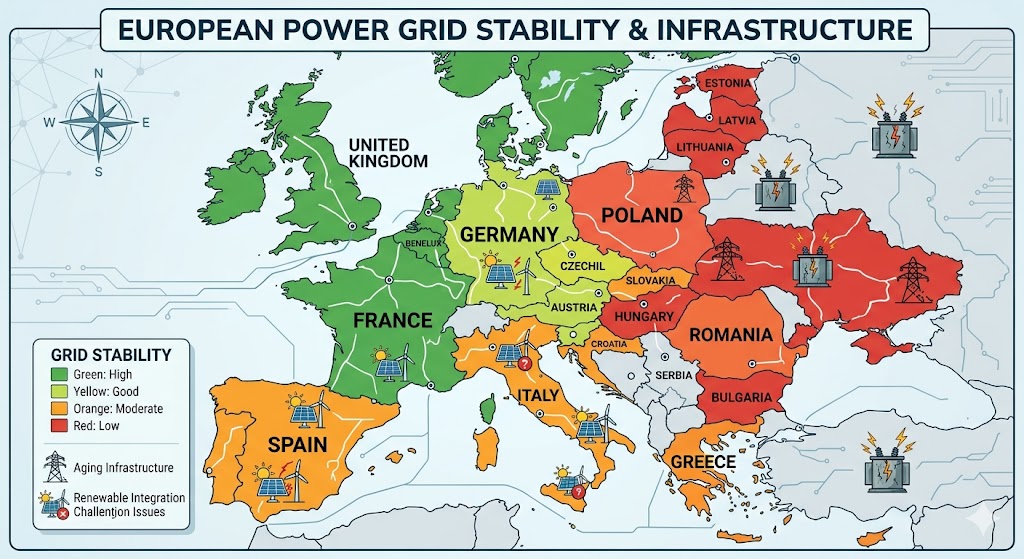
Europe operates on a highly interconnected alternating current (AC) grid, standardized at 230V / 50 Hz across most member states, managed through the European Network of Transmission System Operators for Electricity (ENTSO-E). While Western European countries such as Germany, France, and the Netherlands maintain some of the most stable and modern grids in the world, significant disparities exist across the continent — particularly in Southern, Eastern, and South-Eastern Europe.
3.2 Sources of Instability
Several structural and environmental factors contribute to grid instability in various parts of Europe:
- Aging Infrastructure: Countries in Eastern Europe, including parts of Romania, Bulgaria, and the Western Balkans, still operate on grid infrastructure built during the Soviet era. These aging systems suffer from frequent voltage fluctuations and are ill-equipped to handle the growing demands of electrification.
-
Renewable Energy Integration: The rapid expansion of solar and wind energy — particularly in Germany, Spain, and the Nordic countries — introduces intermittent power generation. While renewable energy is vital for decarbonization, its variability contributes to frequency instability and requires sophisticated grid balancing mechanisms.
-
High Demand Peaks: Tourist-heavy regions in Southern Europe, such as parts of Greece and Italy, experience extreme peak demand during summer months. Overloaded distribution networks lead to brownouts and temporary outages, especially in rural or island communities.
-
Cross-Border Transmission Challenges: The interconnected nature of the European grid means that instability in one country can cascade across borders, as seen during the 2006 European blackout that affected millions of households.
3.3 Regulatory Standards
Despite these challenges, Europe has a strong regulatory framework. The EN 61851 and IEC 62196 standards govern EV charging equipment and require chargers to handle a defined range of voltage and frequency fluctuations. The CE marking ensures that products sold in the EU have passed minimum safety and performance criteria, which includes tolerance for grid deviations.
Grid Instability in the Americas
4.1 North America: The United States and Canada
The North American grid operates at 120V / 240V, 60 Hz, and is divided into several interconnections — the Eastern, Western, and Texas (ERCOT) Interconnections in the US, plus the Canadian systems. While major metropolitan areas enjoy relatively stable power, the grid faces growing vulnerabilities from aging infrastructure, extreme weather events, and rapid load increases driven by EV adoption and data center proliferation.
The February 2021 Texas winter storm, during which the ERCOT grid failed catastrophically, highlighted the fragility of infrastructure that was not designed for extreme climate scenarios. In California, planned Public Safety Power Shutoffs (PSPS) are increasingly common during fire season, leaving EV owners without access to charging for days at a time. The northeastern United States is also prone to power disruptions from hurricanes, nor'easters, and ice storms.
4.2 Latin America: Structural and Environmental Challenges
In contrast to North America, many Latin American countries face more systemic and chronic grid instability. The sources are varied:
- Hydroelectric Dependence: Brazil generates approximately 60-70% of its electricity from hydroelectric power. During prolonged droughts — which are becoming more frequent due to climate change — reservoir levels drop, leading to energy rationing, rolling blackouts, and significant voltage instability. The 2001 energy crisis, which resulted in mandatory consumption cuts of up to 20%, demonstrated how vulnerable a hydroelectric-dependent grid can be.
-
Inadequate Infrastructure Investment: Countries such as Venezuela, Bolivia, and parts of Central America suffer from decades of underinvestment in grid infrastructure. Power outages lasting hours or even days are common in both urban and rural areas. Voltage levels can be highly erratic, and the nominal supply often deviates significantly from the standard.
-
Natural Disaster Exposure: Caribbean nations and Central American countries are regularly struck by hurricanes and earthquakes that destroy transmission and distribution infrastructure. Recovery can take weeks or months, during which grid power is either unavailable or extremely unreliable.
-
Urban-Rural Divide: In most Latin American countries, there is a stark contrast between the relatively stable grid supply in major cities like Mexico City, Bogota, or Lima, and the highly irregular supply in rural and peri-urban communities, where voltage drops are a daily reality.
4.3 Regulatory Landscape
North America's EV charging standards are governed by SAE International (SAE J1772, SAE J3068), UL certifications, and National Electrical Code (NEC) requirements. These standards include mandatory protection against overvoltage, undervoltage, and ground faults. In Latin America, however, regulatory frameworks are fragmented, and enforcement is inconsistent, meaning that consumers must take extra care when selecting charging equipment for use in these markets.
Impacts of Grid Instability on EV Charging
5.1 Hardware Damage and Reduced Lifespan
Voltage surges and spikes are among the most damaging consequences of grid instability. When a charger receives power significantly above its rated voltage — even for milliseconds — it can damage internal power electronics, burn out rectifiers, or destroy control boards. Over time, repeated exposure to these anomalies reduces the operational lifespan of the charger, leading to higher replacement and maintenance costs.
5.2 Battery Degradation
Modern EV battery management systems (BMS) are designed to regulate charging precisely. However, when the input power is unstable, the charger may deliver inconsistent current to the battery, causing uneven charge distribution across cells. Over months and years, this contributes to accelerated capacity fade and can reduce the overall range of the vehicle. This is particularly relevant in regions where daily charging occurs under poor grid conditions.
5.3 Safety Risks
Unstable power can cause chargers to fail in dangerous ways. Overvoltage conditions can lead to overheating of the charging cable and connector, potentially causing fires. Undervoltage can prevent proper ground fault detection, increasing the risk of electric shock. In extreme cases, faulty chargers in unstable grid environments have been linked to electrical fires in residential and commercial settings.
5.4 Charging Interruptions and Inconvenience
Grid instability often triggers the overvoltage or undervoltage protection circuits built into EV chargers. While this is technically the correct behavior, it results in frequent charging interruptions. For drivers who rely on overnight home charging, waking up to a partially charged vehicle because the charger shut down in the night due to a grid anomaly is a serious practical problem — particularly in regions with long commutes or limited public charging alternatives.
5.5 Economic Costs
Beyond hardware damage, grid instability carries significant economic implications. Frequent charger replacements, increased energy costs due to inefficient charging cycles, and potential warranty voidance from using equipment outside its rated conditions all add up. For fleet operators in Latin America or Eastern Europe managing dozens or hundreds of vehicles, these costs can substantially undermine the business case for electrification.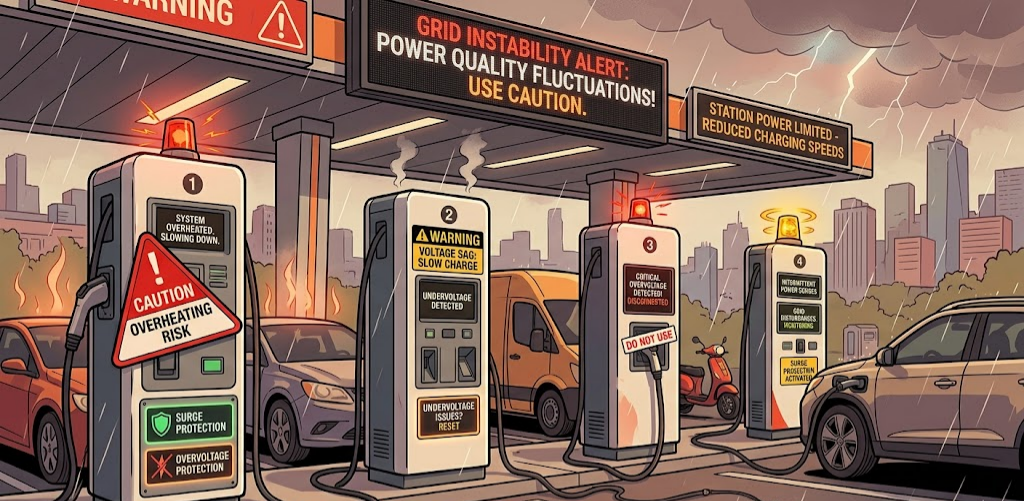
Choosing the Right EV Charger for Unstable Grids
6.1 Key Technical Features to Look For
When selecting an EV charger for use in a region with grid instability, the following technical specifications and features should be prioritized:
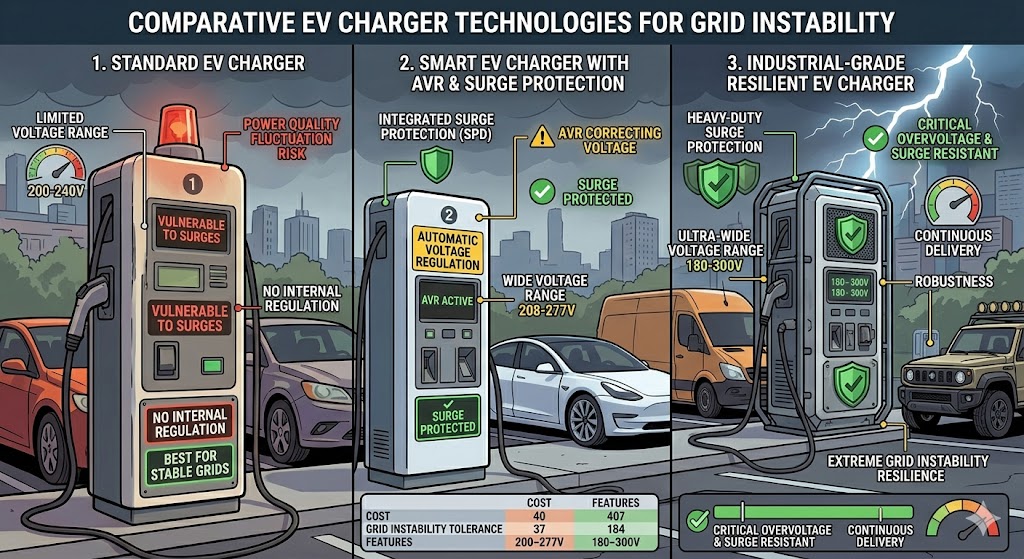
- Wide Input Voltage Range: Look for chargers that support a broad input voltage tolerance, such as 85-265V AC. This ensures the charger can function correctly even during significant voltage sags or surges, which are common in Latin America and parts of Eastern Europe.
-
Automatic Voltage Regulation (AVR): Some advanced chargers include built-in AVR technology that smooths out incoming voltage fluctuations before power reaches the charger's internal components. This is particularly valuable in areas with chronic low-voltage problems.
-
Overvoltage and Undervoltage Protection: Ensure the charger has certified protection circuits that can safely disconnect from the grid when voltage exceeds or falls below defined thresholds, and automatically reconnect once the supply stabilizes.
-
Surge Protection: Built-in or compatible external surge protection devices (SPDs) are essential in lightning-prone regions such as Brazil and the Caribbean, where transient overvoltage events are common.
-
Power Factor Correction (PFC): Active PFC improves the efficiency of the charger under varying load conditions and reduces harmonic distortion — a common issue in regions with aging grid infrastructure.
-
UPS Integration Capability: For critical applications, consider chargers that can integrate with uninterruptible power supplies (UPS) or battery energy storage systems (BESS), providing a stable and continuous power source even during outages.
6.2 Regional Recommendations
For European users in Western Europe, mainstream Level 2 AC chargers from established manufacturers such as ABB, Wallbox, or Schneider Electric, which comply with IEC 62196 standards, are generally sufficient. However, users in Eastern or Southeastern Europe should prioritize models with extended voltage tolerance and built-in surge protection.
For North American users, SAE J1772-compliant Level 2 chargers with UL certification provide adequate protection for most conditions. Users in areas prone to storms or grid events (Texas, California, Southeast) should consider smart chargers with scheduling features that allow charging during periods of greater grid stability, and should pair their charger with a whole-home surge protector.
For Latin American users, the selection criteria should be significantly stricter. Priority should be given to industrial-grade chargers with wide input voltage ranges, robust surge and spike protection, and ideally the ability to work with a UPS or generator backup. Brands such as Enel X, BTC Power, and local distributors offering ruggedized models should be evaluated carefully, with attention to local certification and after-sales support.
6.3 Installation Considerations
Even the best charger will underperform if improperly installed. In regions with grid instability, the following installation practices are strongly recommended:
- Dedicated Circuit with Appropriate Gauge Wiring: Avoid sharing a circuit with other heavy appliances. Undersized wiring increases resistance and heat buildup under load.
-
External Surge Protection Device: Install a Type 1 or Type 2 SPD at the main electrical panel, particularly in lightning-prone regions.
-
Earth Grounding: Proper grounding is critical for safety. In countries where residential wiring standards are inconsistently enforced, verify that the installation includes a verified earth ground.
-
Smart Energy Management: In regions with Time-of-Use (TOU) electricity pricing or demand-response programs, smart chargers that can delay or reduce charging during peak hours not only save money but also reduce stress on the local grid.
The Future Outlook
The challenge of matching EV charging technology to grid realities is not static. Grid modernization programs are underway in most of the countries discussed, driven by both electrification targets and climate resilience imperatives. In Europe, the REPowerEU plan is accelerating grid investment and smart grid deployment. In the Americas, US federal infrastructure funding is being directed toward grid hardening, and several Latin American countries are exploring microgrid and distributed energy solutions that could dramatically improve local supply stability.
At the same time, EV charger technology is advancing. Vehicle-to-Grid (V2G) systems, bidirectional chargers, and cloud-based load management platforms are beginning to transform EVs from passive consumers of electricity into active participants in grid stabilization. As these technologies mature and become more affordable, even users in challenging grid environments may find that their EV serves as a partial buffer against the very instability that once threatened it.
Conclusion
Choosing a suitable EV charger for an unstable power grid requires a thorough understanding of regional grid conditions, the technical risks they pose, and the specific protective features that mitigate those risks. In Europe, the diversity between well-maintained Western grids and aging Eastern infrastructure demands a context-sensitive approach. In the Americas, the contrast between a largely reliable North American grid — increasingly stressed by extreme weather — and the chronically under-resourced grids of much of Latin America calls for distinct strategies.
The key takeaway is that charger selection must go beyond charging speed and brand preference. In unstable grid environments, investing in a charger with wide voltage tolerance, comprehensive protection features, and robust construction is not a luxury — it is a necessity. By aligning charger specifications with local grid realities and following best-practice installation guidelines, EV owners and operators can protect their investment, preserve battery health, and charge with confidence regardless of what the grid delivers.