
The Ultimate Guide to Solar EV Charging: Grid-Tied vs. Off-Grid Systems

As electric vehicles (EVs) become more popular, more homeowners are exploring solar EV charging as a way to use renewable energy for everyday driving. By combining solar panels with a compatible EV charging system, homeowners can use self-generated electricity to charge their vehicles and potentially reduce their reliance on grid power.
However, not all solar EV charging systems work in the same way. Some homes use grid-tied solar systems, others rely on off-grid systems with battery storage, and many use hybrid systems that combine solar energy, batteries, and the public electricity grid. Understanding these differences is essential when planning a solar EV charging installation.
In this guide, we explain how solar EV charging works, compare grid-tied and off-grid systems, explore the role of battery storage and energy management, and explain how to choose a suitable EV charger for your solar setup.
 1. What Is Solar EV Charging?
Solar EV charging is the process of using electricity generated by solar photovoltaic (PV) panels to charge an electric vehicle. A typical residential solar EV charging system may include:
- Solar panels: Convert sunlight into direct current (DC) electricity.
- Inverter: Converts DC electricity into alternating current (AC) for compatible household electrical loads and AC EV charging.
- EV charger: Controls the electrical connection and charging current supplied to the vehicle.
- Battery storage: Stores surplus energy for later use when the system supports battery charging and discharging.
- Energy meter or energy management system: Monitors power flows and may coordinate solar charging, grid import, battery operation, or export control.
In a typical AC charging installation, solar panels generate DC electricity, which is converted into AC by the inverter. The electricity then flows through the home's electrical system to supply household appliances and the EV charger. The vehicle's onboard charger converts the incoming AC electricity into DC power to charge its battery.
The amount of solar energy available for EV charging changes throughout the day. It depends on sunlight, weather, panel capacity, inverter output, household consumption, and whether battery storage is charging or discharging.
This means that installing solar panels does not automatically guarantee that an EV will charge entirely from solar energy. The system must also be designed and configured to manage available power effectively.
2. How Does Solar EV Charging Work?
The working principle of solar EV charging is based on balancing electricity generation and consumption.
When solar panels generate electricity, the available power can supply household appliances and EV charging. Depending on the system configuration, surplus electricity may charge a battery, be exported to the grid, or be limited by an export-control system. When solar generation decreases, the system must determine whether to reduce EV charging, use stored battery energy, or draw electricity from the grid.
For example, if a home generates 4 kW of usable solar power while household appliances consume 1 kW, approximately 3 kW remains available before considering other system constraints. If the EV charger requires more power, the additional electricity may come from the grid or battery storage, depending on the installation and settings.
A solar-compatible EV charging system may adjust the charging current to make better use of available solar energy. However, the specific behavior depends on the charger, inverter, meter, and energy management system.
It is important to distinguish between a charger that operates in a solar-powered home and a charger that actively manages charging according to solar surplus. The latter requires compatible solar charging functionality and the necessary control equipment.
3. What Is Grid-Tied Solar EV Charging?
 A grid-tied solar EV charging system remains connected to the public electricity grid. It is a common choice for homeowners who already have rooftop solar panels and a grid connection. In this configuration, solar electricity can supply household appliances and EV charging. Depending on the installation and local regulations, surplus energy may be exported to the grid, stored in a battery, or limited by an export-control system.
How Does a Grid-Tied System Work?
Scenario 1: Solar generation exceeds household demand. When the solar panels generate more electricity than the home consumes, the surplus may be used to charge the EV. If there is still excess electricity, it may be exported to the grid or stored in a battery, depending on the system configuration.
Scenario 2: Solar generation is lower than EV charging demand. If the EV requires more power than the solar system can provide, the difference may be supplied by the public grid, provided grid-assisted charging is enabled. For example, if an EV charger draws 7 kW while the solar system provides 3 kW of usable power, approximately 4 kW may come from the grid. Actual power flows depend on household loads, system losses, and energy management settings.
Scenario 3: Household electricity demand increases. When appliances such as air conditioners, ovens, or heat pumps switch on, household demand increases. A compatible dynamic load balancing system can reduce the EV charging current to help keep the total electrical load within the configured limit.
What Is Zero-Export Solar Charging?
Some homeowners want to use their solar electricity without sending surplus power back to the grid. This is known as zero-export or no-feed-in operation. A compatible energy meter or export-control system monitors electricity exchanged with the grid and adjusts the system to limit exported power. The exact control method depends on the inverter, meter, and energy management configuration.
Zero-export operation does not necessarily mean that the home never imports electricity. If solar generation is insufficient, the home may still draw electricity from the grid unless it is configured and equipped to operate differently.
The main advantage of grid-tied solar EV charging is flexibility. The public grid can supplement solar generation when necessary, allowing the vehicle to continue charging even when sunlight is limited.
4. What Is Off-Grid Solar EV Charging?

An off-grid solar EV charging system operates without relying on the public electricity grid for its normal power supply. It is often used in remote properties, locations without grid access, or installations designed for greater energy independence. A typical off-grid system includes:
- Solar panels to generate electricity.
- An off-grid inverter to supply compatible AC loads.
- Battery storage to retain energy for periods with limited sunlight.
- An EV charger to control vehicle charging.
- An energy management system to coordinate generation, storage, and consumption where required.
How Does an Off-Grid System Work?
During daylight hours, solar panels generate electricity. The inverter supplies household loads and EV charging, while surplus energy may charge the battery if the system supports it. When solar generation decreases, the battery may supply electricity to the home and EV charger. However, charging must be adjusted if the available solar and battery power cannot meet the total demand.
Unlike a grid-connected home, a standalone off-grid system cannot automatically rely on the public grid to make up a power shortfall.
Why Are Inverter Power and Battery Capacity Important?
Two specifications are particularly important when designing an off-grid EV charging system: inverter output power and battery capacity.
Inverter power, measured in kW, indicates how much power the inverter can supply at a given time, subject to its continuous output rating, overload limits, and operating conditions.
Battery capacity, measured in kWh, indicates how much energy the battery can store. The energy available for EV charging depends on usable capacity, state of charge, discharge limits, conversion losses, and energy reserved for household loads.
For example, a system with 3.5 kW of solar panels and a 6 kW inverter may not be able to supply a 7.5 kW EV charging load from solar generation alone. If the system permits battery discharge, the battery may provide some of the difference, but only within the inverter's output limits and the battery's available discharge power.
Solar generation also varies with sunlight, shading, panel orientation, and weather. System sizing should therefore consider both daily energy production and the maximum power required during charging.
The main advantage of off-grid solar EV charging is independence from the public grid. However, reliable operation requires careful planning of solar generation, inverter output, battery storage, and household demand.
5. Grid-Tied vs. Off-Grid Solar EV Charging: Key Differences
Both systems can use solar electricity to charge an EV, but they differ in how they manage power shortages, surplus generation, and energy storage.
| Feature | Grid-Tied System | Off-Grid System |
|---|---|---|
| Public grid connection | Connected | Not connected for normal operation |
| Main power sources | Solar and grid; batteries may also be included | Solar and battery storage |
| When solar power is insufficient | Grid power may supply the difference | Charging relies on available solar and battery power |
| Battery required | Not always | Usually beneficial and often essential for reliable operation |
| Surplus solar energy | May be exported, stored, or curtailed | May be stored or curtailed |
| Main design priorities | Grid import, export control, and household load management | Inverter capacity, battery power, and stored energy |
| Typical applications | Grid-connected homes with rooftop solar | Remote properties or installations seeking off-grid operation |
What About Hybrid Solar Systems?
A grid-connected hybrid solar system combines solar panels, battery storage, and a public grid connection. It can store surplus solar electricity, use stored energy later, and draw electricity from the grid when needed, depending on the system configuration.
Some hybrid inverters can also provide backup power during a grid outage. However, not every system can operate in backup mode or support an EV charger during an outage. The inverter's backup output, power rating, wiring, and compatibility must be checked.
For many homeowners, a hybrid system offers a practical balance between solar self-consumption, battery storage, and access to grid electricity.
6. Can You Charge an Electric Car Using Solar Panels Only?
Yes, it is possible to charge an EV using solar energy, but the practical result depends on solar generation, the vehicle's charging requirements, and how the system manages energy.
Solar Generation Capacity
The rated capacity of a solar array is not the same as its continuous real-world output. A 5 kW solar array will not necessarily generate 5 kW throughout the day. Actual output changes with sunlight, temperature, shading, panel orientation, and system losses.
Minimum Charging Current
AC EV charging has minimum operating current requirements. For IEC-based AC charging, the commonly specified minimum continuous current is 6 A per phase, subject to the applicable standards, vehicle, and EVSE configuration.
At 230 V, 6 A corresponds to approximately 1.38 kW for single-phase charging. Three-phase charging at 230 V phase-to-neutral and 6 A per phase is approximately 4.14 kW in total. As a result, a small amount of surplus solar power may not be sufficient to start or sustain AC charging. The exact threshold depends on the charger and vehicle.
Energy Management
A solar charging system may adjust charging current as solar generation changes. Depending on its features, it may prioritize solar surplus, permit grid assistance, or coordinate charging with battery storage. Without suitable control logic, an EV charger may continue drawing electricity from the grid even when the homeowner would prefer to use solar energy first.
If your goal is to maximize solar self-consumption, check whether the charging system supports solar-priority or solar-surplus charging and whether additional metering or energy management equipment is required.
7. Solar EV Charging vs. Dynamic Load Balancing
Solar charging management and dynamic load balancing (DLB) are related to home energy management, but they solve different problems.
What Is Solar Charging Management?
Solar charging management aims to make better use of available solar energy. Depending on the system, it can prioritize solar surplus, adjust charging current as generation changes, or coordinate charging with grid power and battery storage. Its main objective is to increase the use of self-generated solar electricity.
What Is Dynamic Load Balancing?
Dynamic load balancing monitors household electrical demand and adjusts EV charging current to help keep total demand within a configured electrical limit. For example, if a home has limited electrical capacity and several high-power appliances operate simultaneously, DLB can reduce EV charging current to help avoid exceeding that limit. Its main objective is to manage total electrical load.
Can Solar Charging and DLB Work Together?
Yes, provided the EV charger and energy management equipment support the required functions and are compatible. A system can prioritize solar surplus while also monitoring household demand. Solar management determines how to use available solar energy, while DLB helps keep the combined household and EV load within the permitted limit.
However, DLB alone does not necessarily identify solar surplus or distinguish solar generation from grid electricity. The system may require a compatible energy meter, inverter integration, or other control equipment to provide solar-specific functionality.
When selecting a charger, check the exact model's supported features, metering requirements, communication protocols, and operating modes.
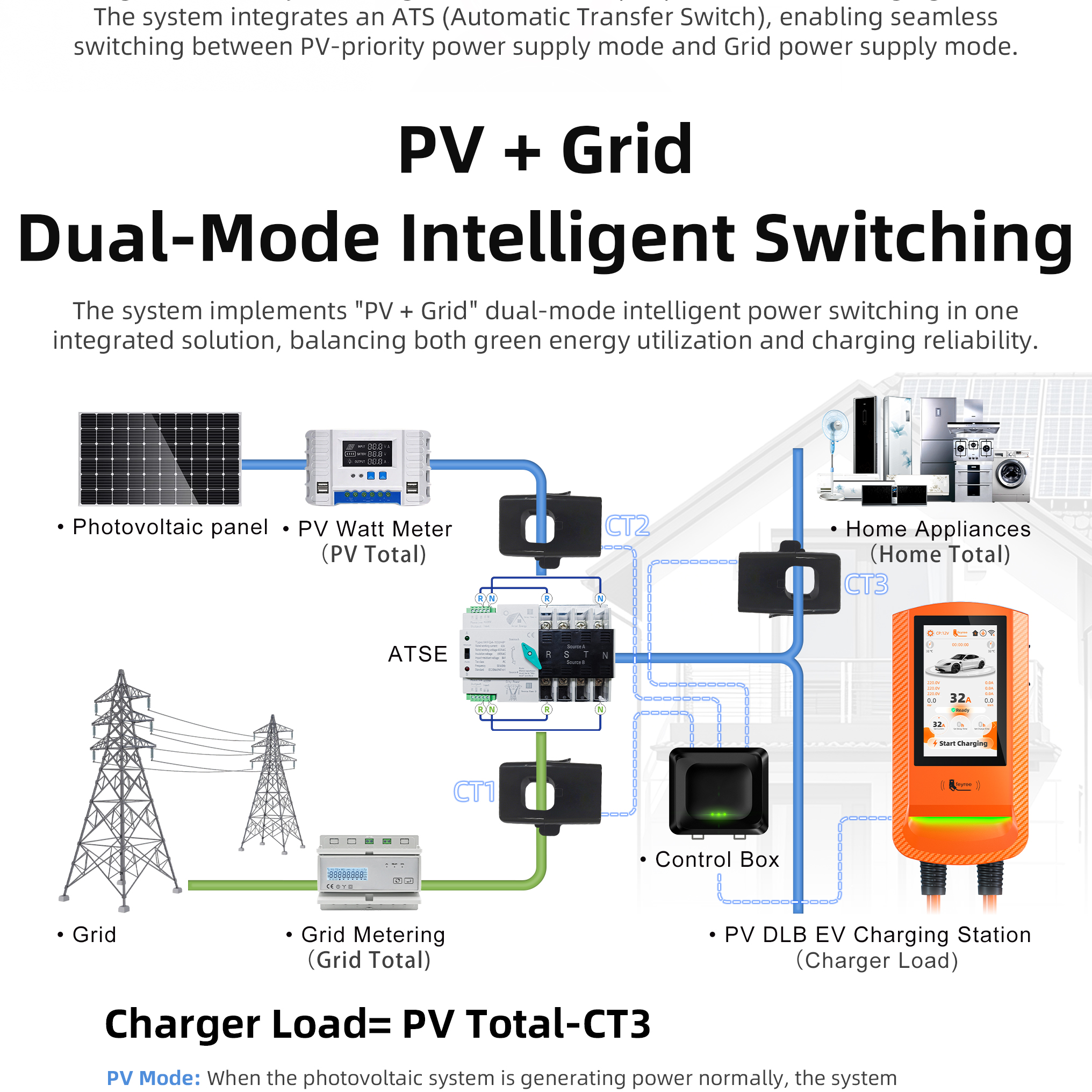
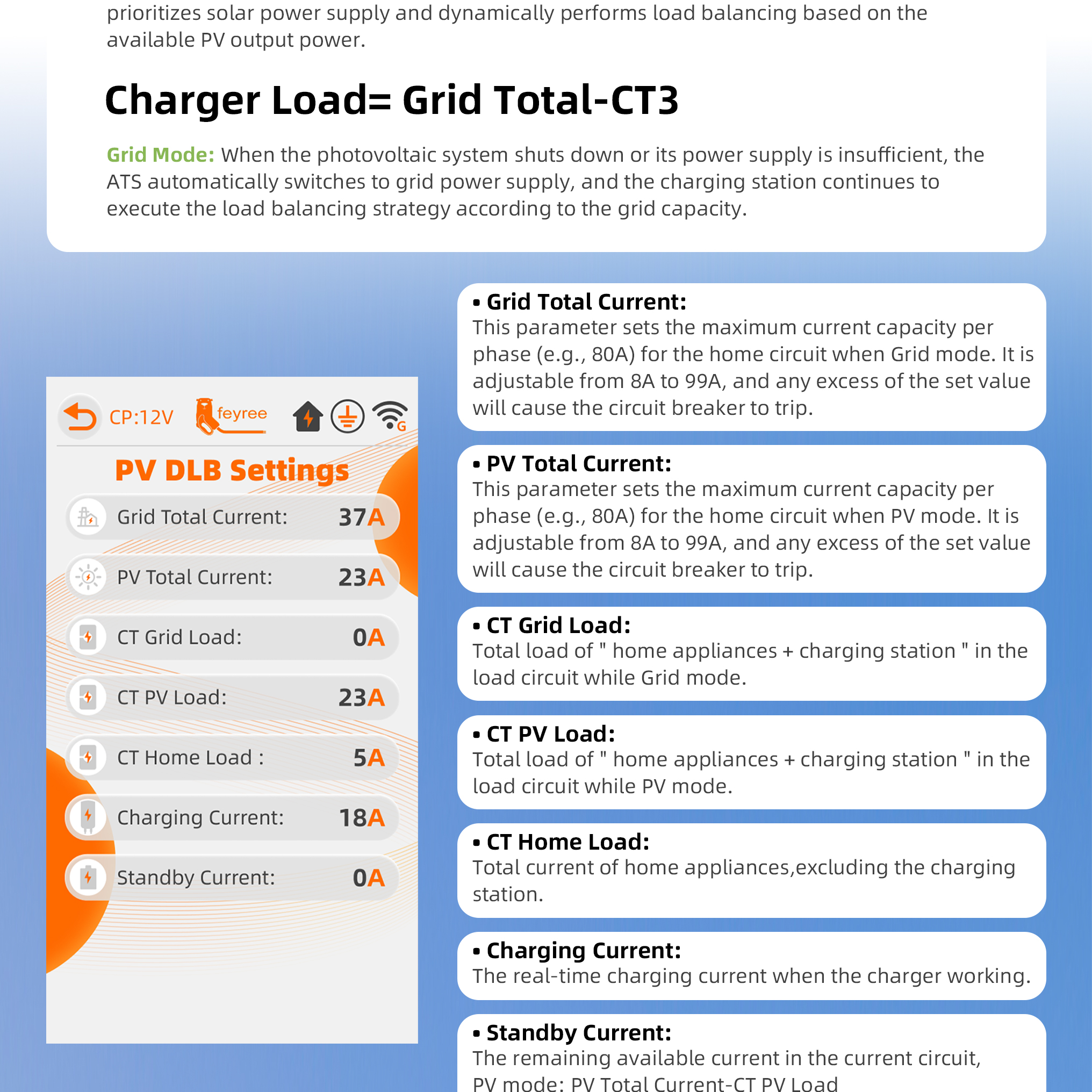
Feyree PV DLB: Solar-Priority Charging With Automatic Grid Backup
One example of a charger that combines both functions is the new Feyree PV DLB EV charger. It gives priority to solar power, so the vehicle charges from the PV system whenever it is producing electricity. If the automatic switch detects that the solar system is no longer generating current, the charger switches to grid power so charging can continue without manual changes.
8. How to Choose the Best Solar EV Charger
The right solar EV charger depends on the home's electrical supply, solar system design, vehicle compatibility, and charging priorities.
1. Check the Electrical Supply
Determine whether the property uses single-phase or three-phase power. The charger must be compatible with the supply, and its maximum charging power must not exceed the limits of the installation or vehicle.
2. Confirm Solar Charging Functionality
If the goal is to prioritize solar electricity, check whether the charger supports solar charging management rather than assuming that Wi-Fi or app control automatically provides this feature.
3. Check Dynamic Load Balancing Requirements
If the household has limited electrical capacity or several high-power appliances, DLB may help manage the combined load. Confirm whether the charger requires CT clamps, a compatible energy meter, or an RS485 communication connection.
4. Consider Battery Storage and Inverter Limits
For homes with hybrid inverters and batteries, confirm the inverter's continuous output power, battery discharge capability, and energy management settings. These specifications determine whether battery power can supplement solar generation during EV charging.
5. Review Grid-Import and Zero-Export Settings
Customers who want to avoid grid imports or prevent electricity export should verify that the inverter and energy management system support the required operating mode. These are separate objectives: zero export limits power sent to the grid, while avoiding grid imports requires sufficient local generation or stored energy.
6. Check Compatibility Before Installation
The inverter, meter, charger, vehicle, and electrical protection devices must all be suitable for the intended configuration. Consult the relevant manuals and a qualified installer before changing electrical settings or wiring.
9. Frequently Asked Questions About Solar EV Charging
Is grid-tied solar EV charging better than off-grid charging?
Neither option is universally better. Grid-tied systems can use the public grid when solar power is insufficient, making them practical for many homes. Off-grid systems are useful where grid access is unavailable or energy independence is a priority, but they require careful sizing of solar generation, inverter power, and battery storage.
Do I need a battery to charge my EV with solar panels?
Not necessarily. A grid-connected solar system can charge an EV during periods of solar generation without battery storage. However, a battery can store surplus energy for later use. Off-grid systems generally benefit from battery storage because solar generation is not available continuously.
Can I charge my EV at night using solar energy?
Yes, if the system has stored energy available in a battery. Without storage, a grid-connected system will generally need grid electricity to charge at night, unless another local power source is available.
Can a 3.5 kW solar system power a 7 kW EV charger?
Not from solar generation alone when the solar array is producing only 3.5 kW. The difference may be supplied by the grid or, in a compatible system, by battery storage. Actual charging power also depends on household demand, inverter capacity, vehicle limits, and energy management settings.
Does dynamic load balancing mean my EV will use only solar energy?
No. Dynamic load balancing primarily manages total electrical demand. Solar-only or solar-priority charging requires the appropriate energy management functionality and compatible equipment.
Can I use a zero-export solar system to charge my EV?
Yes, if the system is designed and configured to support EV charging while limiting electricity export. However, zero-export operation does not automatically prevent grid imports. If solar generation is insufficient, the system may draw electricity from the grid unless it is configured and equipped to operate differently.