From Concept to Production: How FEYREE Develops Smart Solar EV Charging Solutions
As electric vehicles become more common, more homeowners are looking for ways to use solar energy for EV charging. However, developing a reliable solar EV charger requires more than adding a solar function to a conventional charger. It involves coordinated hardware, software, energy management, safety protection, and manufacturing processes.
At FEYREE, we believe that real technological strength lies in turning technical concepts into reliable products that can be consistently manufactured at scale. From product planning and electrical design to firmware development, testing, certification, and mass production, we have established an integrated product development process.
Our solar EV charging technology is one example of how this capability translates into practical charging solutions.
1. Solar-Priority EV Charging: Making Better Use of Solar Energy
Solar generation changes with weather conditions, sunlight intensity, and time of day. Household electricity consumption also fluctuates, making effective solar EV charging more complex than simply detecting whether sunlight is available.
FEYREE's PV charging solution is built around Solar Priority. When sufficient solar energy is available under the system's operating conditions, solar power is prioritized for EV charging. This helps homeowners make better use of the electricity generated by their solar installations and reduce reliance on grid electricity when conditions allow.
When solar power is insufficient, the system can automatically switch to grid power according to its control logic, without requiring users to change the energy source manually.
Achieving this requires coordinated electrical inputs, switching mechanisms, protection functions, and charging controls. FEYREE addresses these requirements through integrated hardware architecture and software logic, supported by testing under different energy-supply conditions.
2. Combining PV Charging with Dynamic Load Balancing
A solar EV charging system becomes more effective when it considers both solar generation and household electricity consumption. This is where Dynamic Load Balancing (DLB) plays an important role.
DLB uses current transformers (CTs) or an electricity meter to monitor household electrical demand. Based on configured limits and available capacity, the system dynamically adjusts EV charging power.
For example, when household demand is low and solar output is sufficient, the charger may be able to provide more charging power within the system's limits. When other household appliances increase electricity consumption or solar output declines, the charger can reduce its power accordingly.
PV charging and DLB serve different but complementary purposes:
- PV priority prioritizes solar energy for EV charging and manages the response when solar power is insufficient.
- DLB monitors electrical demand and adjusts charging power to help keep total consumption within configured limits.
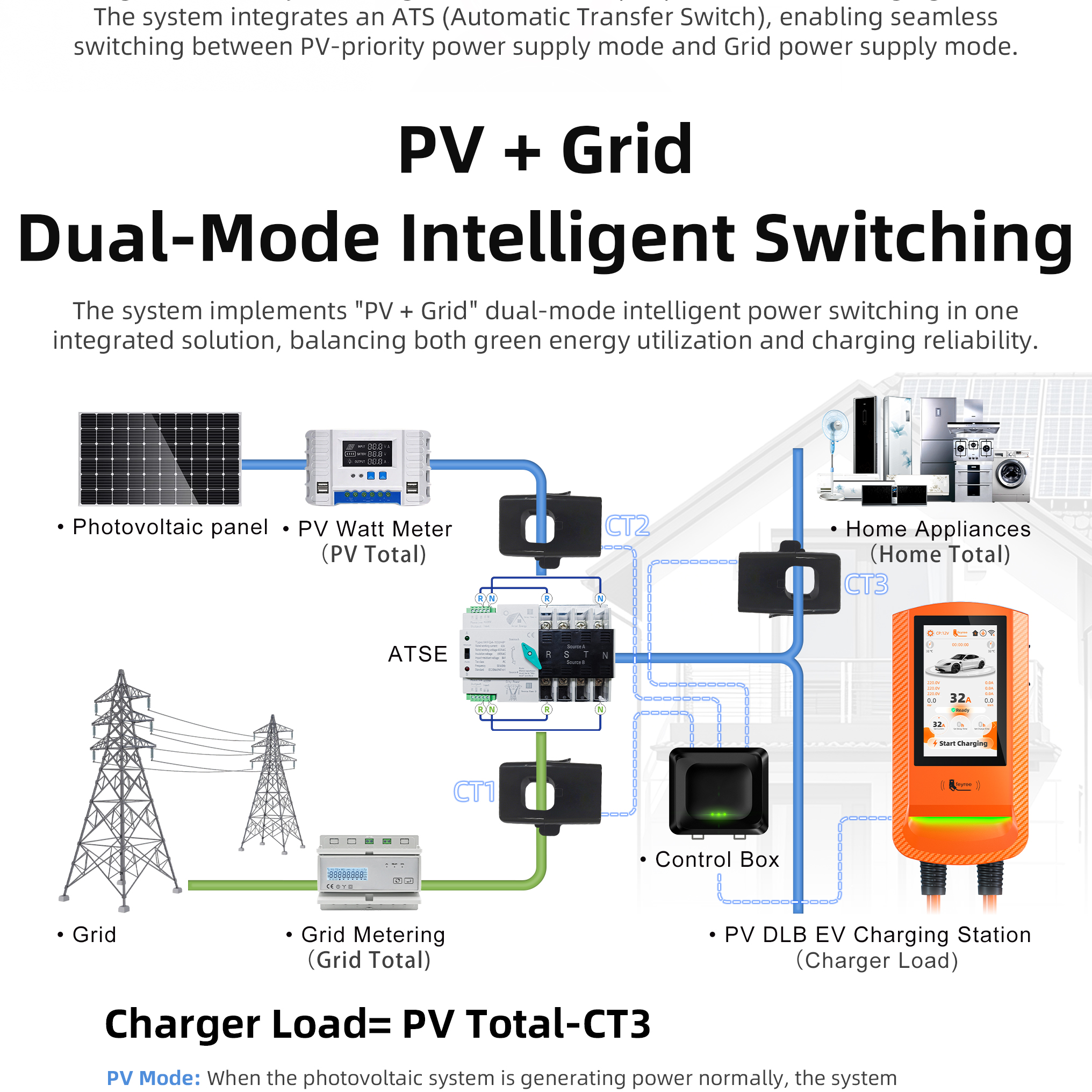
Together, these functions help integrate EV charging into a home's wider energy management system.
The overall PV charging process involves monitoring energy conditions, prioritizing solar power, adjusting charging operation, and switching to grid power when required. When DLB is also supported, household electrical demand can be monitored to help regulate charging power.
3. Smart Charging with a Touchscreen, App, and OTA Updates
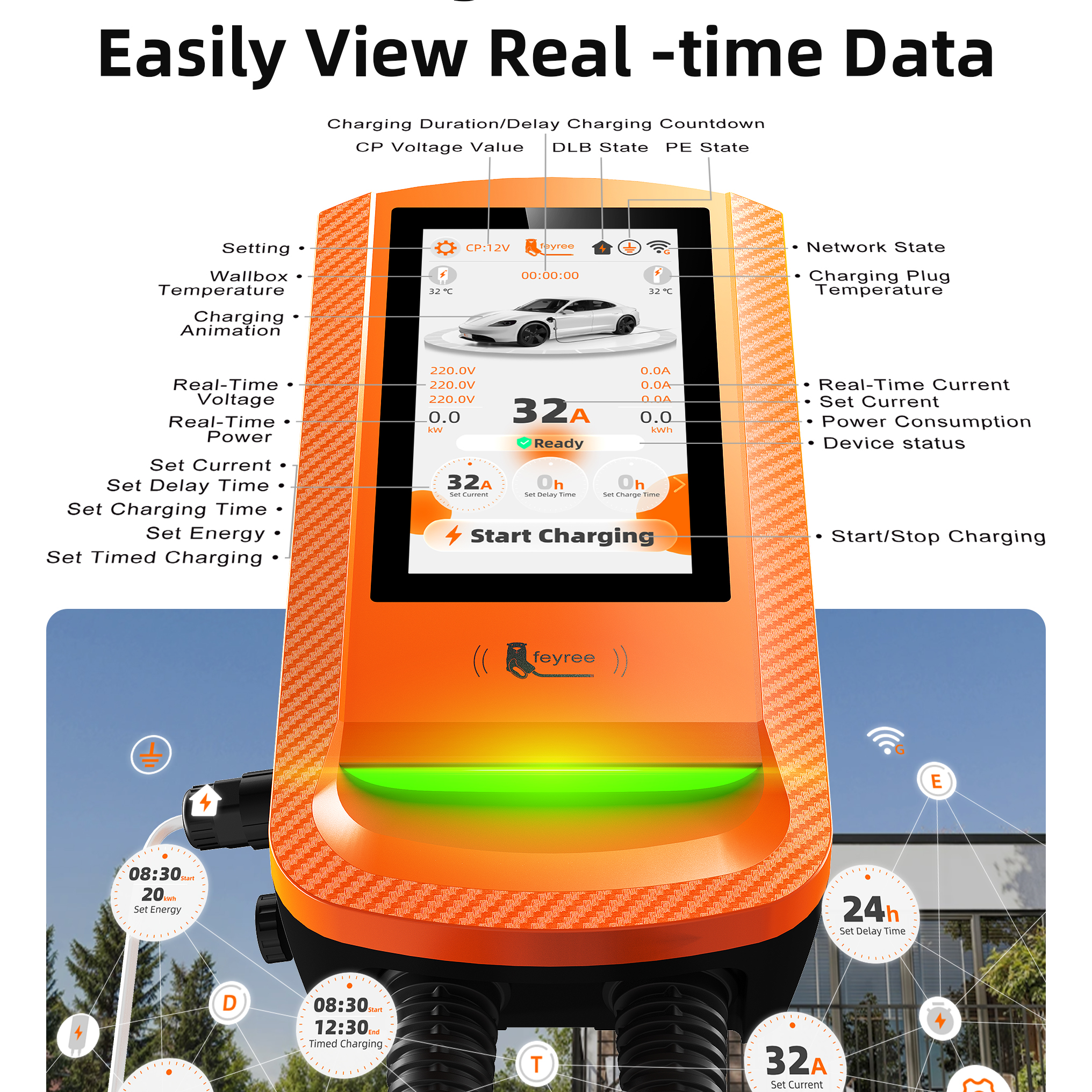
As EV chargers incorporate more advanced energy management functions, users need clear information about charging performance and operating status.
FEYREE integrates a 7-inch touchscreen into selected smart charging products, allowing users to view information such as charging power, voltage, current, charging status, and energy usage, depending on the model.
Mobile app connectivity provides additional options for remote monitoring and management. Meanwhile, Over-the-Air (OTA) firmware updates allow compatible products to receive software updates remotely, creating opportunities for continued optimization after delivery.
These features can improve the user experience and help simplify certain maintenance tasks. For distributors and installers, they are also important considerations when evaluating product functionality and after-sales requirements.
Specific touchscreen, app, and OTA functions vary by model and should be confirmed against the relevant product specifications.
4. From R&D to Mass Production: Engineering for Reliability
A technical concept becomes a commercial product only when it has been properly designed, tested, and validated for manufacturing.
FEYREE's development process covers the product lifecycle, including:
- Requirements analysis: Identifying market needs and defining product functions.
- Electrical and hardware development: Designing the electrical architecture, selecting components, and developing PCBs.
- Firmware engineering: Developing control logic for charging, energy management, and model-specific functions.
- Prototype testing: Evaluating performance, protection functions, and operational stability.
- Certification and pilot production: Completing relevant compliance work and checking manufacturing consistency.
- Mass production and quality control: Applying processes such as SMT, assembly, aging tests, and final quality inspection.
For PV charging products, testing must also consider different solar generation levels, household loads, and power supply conditions. These tests help verify energy switching, charging control, protection mechanisms, and overall system stability.
Pilot production further helps confirm the consistency of electronic components, PCBs, structural parts, and assembly processes before larger-scale manufacturing.
This integrated approach connects product development with engineering validation and manufacturing execution, helping FEYREE turn technical concepts into products that can be produced consistently.

5. Product Certifications and Market Requirements
EV chargers must meet the applicable safety, electromagnetic compatibility, and environmental requirements of their target markets.
Depending on the product and destination market, FEYREE undertakes relevant certification and compliance activities, which may include CE, FCC, UKCA, RoHS, and REACH.
As requirements vary by model and market, the relevant certificates and test reports should be checked against the specific product and local regulations. This is an important step for distributors and installers preparing products for their respective markets.
Conclusion: Turning Solar Charging Technology into Practical Products
Developing a solar EV charger requires more than adding a single feature. It involves coordinated energy management, electrical engineering, firmware development, user interaction, testing, and manufacturing.
FEYREE connects these capabilities throughout the product lifecycle:
Product concept → Requirements analysis → Hardware and software development → Prototype testing → Certification → Pilot production → Quality control → Mass production → OTA optimization
This integrated process supports the development of Smart Charging, Dynamic Load Balancing, and PV charging solutions for different applications and market requirements.
As residential solar installations and EV adoption continue to grow, coordinating solar generation, household consumption, and vehicle charging is becoming increasingly important.
At FEYREE, we focus on turning these challenges into practical charging solutions through product engineering, system integration, and manufacturing experience. For us, solar EV charging is not simply a feature added to a conventional charger, but the result of a complete development process from concept to production.