How to Choose a Solar EV Charger for Your Home: A Complete Guide

Imagine a sunny afternoon at home.
Your rooftop solar panels are generating clean energy, your electric vehicle is parked in the driveway, and you want to use the electricity produced by your own home to charge your car instead of relying on the grid.
However, things are not always that simple.
When household appliances such as air conditioners, heat pumps, or water heaters are running at the same time, the available power can change constantly. Solar production can also fluctuate depending on weather conditions and time of day.
This raises several important questions:
- How can you maximize the use of solar energy for EV charging?
- How can you charge your vehicle without overloading your home electrical system?
- How do you choose a solar EV charger that matches your vehicle and energy needs?
A smart solar EV charging solution is designed to solve these challenges by intelligently managing solar energy, household consumption, and EV charging demand.
In this guide, we will explain the three key factors you should consider when choosing a solar EV charger for your home.
1. Solar Energy Management: Maximize the Value of Your Solar System
The main difference between a traditional EV charger and a solar EV charging solution is how energy is managed.
A standard EV charger simply receives electricity from the grid and delivers it to the vehicle.
A smart solar EV charger, however, can intelligently manage energy from multiple sources:
- Solar generation
- Household electricity consumption
- Grid power
This allows homeowners to use more renewable energy while maintaining stable charging performance.
Solar Priority Charging
One of the most important features is solar priority charging.
When solar production is sufficient, the charger can prioritize available solar energy for EV charging.

For example:
During sunny hours:
- More solar energy is used for charging
- Less electricity is taken from the grid
When solar generation decreases:
- Charging power can be adjusted
- Grid power can supplement the remaining energy demand
This makes EV charging more flexible and helps homeowners improve solar utilization.
Why Solar Management Matters
Without intelligent energy management, solar energy may not be efficiently used because household consumption changes throughout the day.
A smart solar EV charger helps coordinate energy flow between:
Solar panels → Home appliances → EV charging
creating a more efficient home energy system.
2. Dynamic Load Balancing: The Key to Safe Home Charging
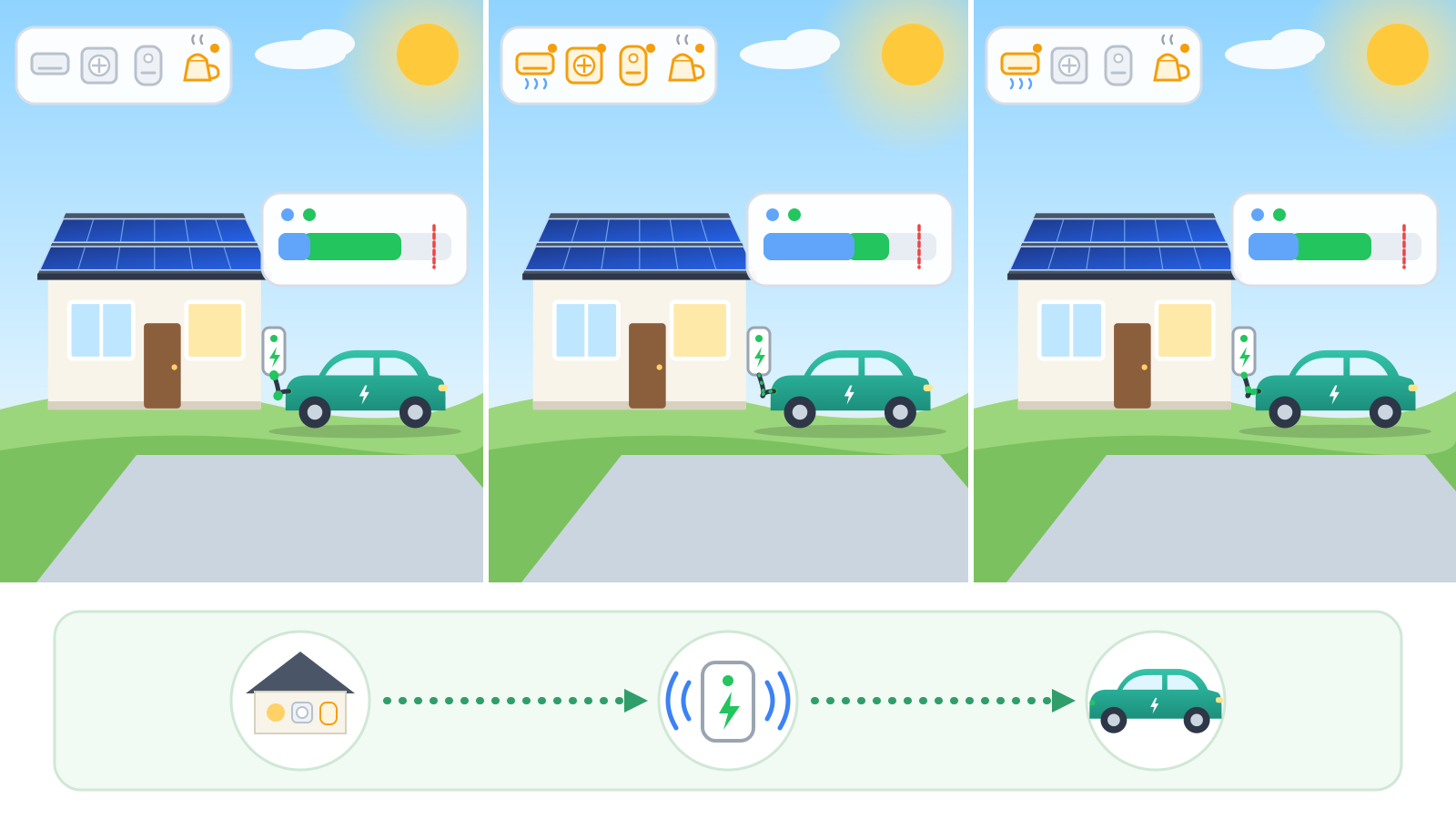
As household demand rises, the charger automatically lowers its charging current to keep the total load within safe limits, then ramps the speed back up as soon as power becomes available again.
For many homeowners, the biggest concern is not only charging speed but whether their electrical system can safely support EV charging.
Household electricity demand changes constantly.
Devices such as:
- Air conditioners
- Heat pumps
- Water heaters
- Kitchen appliances
may increase electricity consumption suddenly.
If the EV charger continues charging at maximum power, it may cause:
- Circuit overload
- Breaker trips
- Reduced charging stability
This is where Dynamic Load Balancing (DLB) becomes important.
How DLB Works
A DLB system monitors household electricity consumption in real time.
When household demand is low:
→ More power is available for EV charging
When household demand increases:
→ Charging current is automatically reduced
When power becomes available again:
→ Charging speed increases automatically
This ensures that EV charging works together with other household appliances instead of competing for limited electrical capacity.
For homes with solar systems, DLB also helps optimize energy usage by balancing solar generation, household loads, and EV charging demand.
3. Choosing the Right Charging Power and System Compatibility
After considering energy management and electrical safety, the next step is selecting a charger that matches your vehicle and home electrical system.
Charging Power Selection
Common residential charging options include:
7kW Single-Phase Charging
Suitable for most homes.
Advantages:
- Easier installation
- Good balance between charging speed and electrical requirements
- Suitable for daily commuting
11kW / 22kW Three-Phase Charging
Suitable for homes with three-phase electricity.
Advantages:
- Faster charging speed
- Better for users with higher daily mileage
- Suitable for larger EV batteries
However, higher power is not always the best choice.
The ideal charging power depends on:
- Vehicle charging capability
- Home electrical capacity
- Solar system size
Vehicle and Connector Compatibility
Before purchasing, users should confirm:
- Vehicle charging standard
- Type of connector
- Maximum charging power supported by the vehicle
For example, most European EVs use Type 2 connectors, but charging speed may still be limited by the vehicle's onboard charger.
Choosing a compatible system avoids unnecessary investment and ensures better charging performance.
Additional Features Worth Considering
Besides the three key factors above, several additional features can improve the overall experience:
Smart Control
A mobile APP allows users to:
- Monitor charging status
- Adjust charging current
- Manage charging schedules
Outdoor Protection
For outdoor installation, users should consider:
- Weather resistance
- IP protection rating
- Temperature monitoring
Future Expansion
A smart solar EV charger should also support future energy upgrades, such as:
- Larger solar systems
- Battery storage
- Home energy management systems
Conclusion: Choose a Solar EV Charger Based on Your Energy Needs
The best solar EV charger is not simply the one with the highest charging power.
A reliable solution should provide:
- Efficient solar energy utilization
- Safe household energy management
- Compatibility with your vehicle and electrical system
By combining solar priority charging, dynamic load balancing, and intelligent charging management, modern solar EV chargers help homeowners create a smarter, more sustainable energy future.