Complete Guide to Certified Type 2 EV Chargers for the EU Market
Standards and compliance, decoded for buyers sourcing charging equipment across the European Union.
As EV market penetration accelerates and charging infrastructure deployment intensifies, countries and regional bodies are establishing increasingly comprehensive access standards for electric vehicle charging equipment. The European Union has built one of the most structured regulatory frameworks, combining safety directives, electromagnetic compatibility requirements, and environmental restrictions — understanding how four key certifications interact is the prerequisite for smooth market entry.
 Certification and compliance documentation, including CE, TÜV, and UKCA certificates.
CE Marking — The Foundation of EU Market Access
CE marking is the primary regulatory requirement for placing electrical products on the European Economic Area market. For certified Type 2 EV chargers destined for the EU market, CE marking confirms compliance with the Low Voltage Directive (2014/35/EU), which covers electrical safety, and the Electromagnetic Compatibility Directive (2014/30/EU), which covers electromagnetic emissions and immunity.
The CE marking process involves the manufacturer issuing a declaration of conformity based on internal testing or third-party verification. The practical value for buyers is that it enables EU-wide distribution without per-country re-certification — a charger carrying CE marking can be sold in any EU and EEA member state without additional country-specific approval. Feyree's wallbox and portable charger lines carry CE marking, with the declaration of conformity available for buyer review.
TÜV Certification — Independent Safety Verification
While CE marking can be based on self-declaration for many product categories, TÜV certification of the cable components adds a layer of independent verification that many European distributors and utility programs require before listing a product. Issued by German-accredited laboratories, TÜV testing subjects the charging cable to comprehensive safety evaluation, including electrical stress tests, thermal behavior analysis, and mechanical durability assessment under controlled conditions.
As part of the CE compliance framework, Feyree's chargers integrate Type B residual current protection (AC 30 mA and DC 6 mA), the level required for EV charging equipment under European installation standards. Detailed product and certification information is available at the Feyree product page.
RoHS and Environmental Compliance
The Restriction of Hazardous Substances (RoHS) directive limits the use of lead, mercury, cadmium, hexavalent chromium, and specific brominated flame retardants in electrical and electronic equipment. For certified Type 2 EV chargers for the EU market, RoHS compliance is verified through material declarations and component sourcing records.
Feyree integrates RoHS compliance at the design stage by specifying 100 percent lead-free PCB manufacturing and selecting component suppliers that provide RoHS-compliant certification documentation. The charging cable jacket uses TPU (thermoplastic polyurethane) insulation — a material that satisfies RoHS requirements while providing the flexibility, UV resistance, and abrasion performance needed for daily charging use.

IEC 61851-1 and Installation Standards
IEC 61851-1 is the international standard for conductive charging systems for electric vehicles, specifying the safety and performance requirements that charging equipment must meet during normal operation and under fault conditions. For the EU market, compliance with IEC 61851-1 is often referenced alongside CE marking as part of the technical documentation package.
Feyree designs its products in accordance with this standard, combining it with wide voltage compatibility (single-phase 85 V to 264 V and three-phase 160 V to 450 V, supporting 50 Hz and 60 Hz frequencies) that covers the electrical configurations found across EU member states. The enclosures carry IP65 or IP66 ratings, suitable for outdoor wall mounting in carports, driveways, and covered parking areas. With an operating temperature range of -30°C to +55°C and UL94 V-0 flame-retardant enclosure materials, these chargers are specified for continuous outdoor use from Nordic winters to Mediterranean summers.
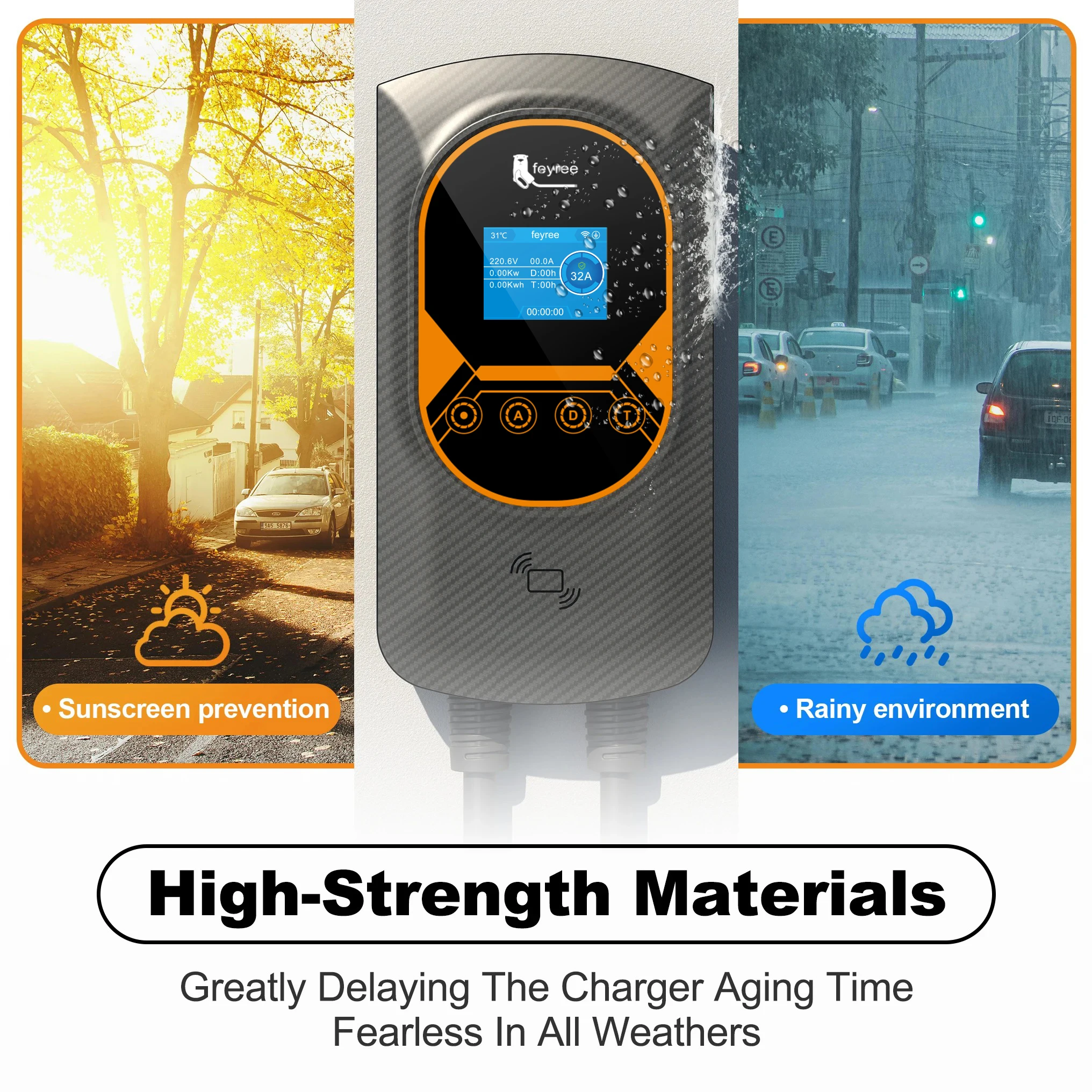 Outdoor wall-mounted installation, rated IP65/IP66 for exposure to rain and dust.
Frequently Asked Questions
CE marking covers the Low Voltage Directive and EMC requirements, but buyers should also check for TÜV certification on the cable assembly, RoHS compliance for materials, and IEC 61851-1 conformity for installation safety.
CE marking can be based on self-declaration for many product categories, while TÜV certification adds independent, third-party verification of the cable assembly through German-accredited laboratories.
RoHS limits the use of lead, mercury, cadmium, hexavalent chromium, and specific brominated flame retardants, verified through material declarations and component sourcing records.
Look for single-phase compatibility from 85 V to 264 V and three-phase from 160 V to 450 V, supporting both 50 Hz and 60 Hz, with an IP65/IP66 enclosure rated for -30°C to +55°C operation.
Verify Certifications Before You Order
Check CE, TÜV, RoHS, and IEC 61851-1 documentation before committing to a Type 2 EV charger supplier for the EU market.
Review Feyree's EU Certification Documentation