Charging an electric vehicle (EV) at home is already far more cost-effective than fueling a gas car. However, electricity prices vary by time of day, and most utilities offer time-of-use (TOU) plans that make power much cheaper during late-night off-peak hours. By scheduling EV charging in these low-rate periods, homeowners can significantly cut their electric bills. In fact, managed charging (shifting EV load to off-peak times) has been shown to reduce average household energy costs by around 10%, which can amount to roughly $200 per year. One real-world pilot in California saw EV owners achieve 98% off-peak charging and about $200 in annual savings per vehicle. Feyree’s smart chargers leverage these same principles – using app-based scheduling and power management to automatically charge your vehicle when electricity is cheapest.
Time-of-Use Rates and Off-Peak Charging
Electricity prices often change by hour. Utilities typically charge higher rates during “peak” demand hours (afternoons/evenings) and much lower rates late at night. For example, one analysis shows off-peak rates (10 p.m.–6 a.m.) around $0.10/kWh, versus peak rates of $0.25/kWh or more. These TOU plans are designed to encourage users to shift consumption to when demand is low. In practice, this means charging an EV after 10 p.m. can cost less than half as much per kWh as charging at 5 p.m. Smart chargers make this easy by automating the shift. Instead of plugging in and charging immediately, the charger can wait until the off-peak period begins. Over a year, charging 1,000 miles per month on a $0.10/kWh night rate instead of a $0.25/kWh peak rate could save well over $500..png?w=1024&h=947)
Feyree’s Smart Charging System
Feyree’s home EV chargers come in portable and wallbox versions, all with Wi-Fi and smartphone connectivity. Using the Feyree mobile app (on iOS/Android), owners can remotely start/stop charging, adjust amperage, and set timers. In practice, these features let you line up charging with the cheapest electricity windows and avoid overloading your home’s circuits. Key features of Feyree’s smart chargers include:
- Smart Scheduling via App: Set charging start/end times or weekly schedules so charging happens during low-rate hours. For example, one model lets you delay the charge by 1–15 hours, ensuring charging occurs during the night when rates are lowest.
-
Adjustable Charge Current: Limit the charger’s output (e.g. 8–32 A) to match your home’s capacity or prioritize grid-friendly operation. You can pick a lower current to use less power if other heavy appliances are running.
-
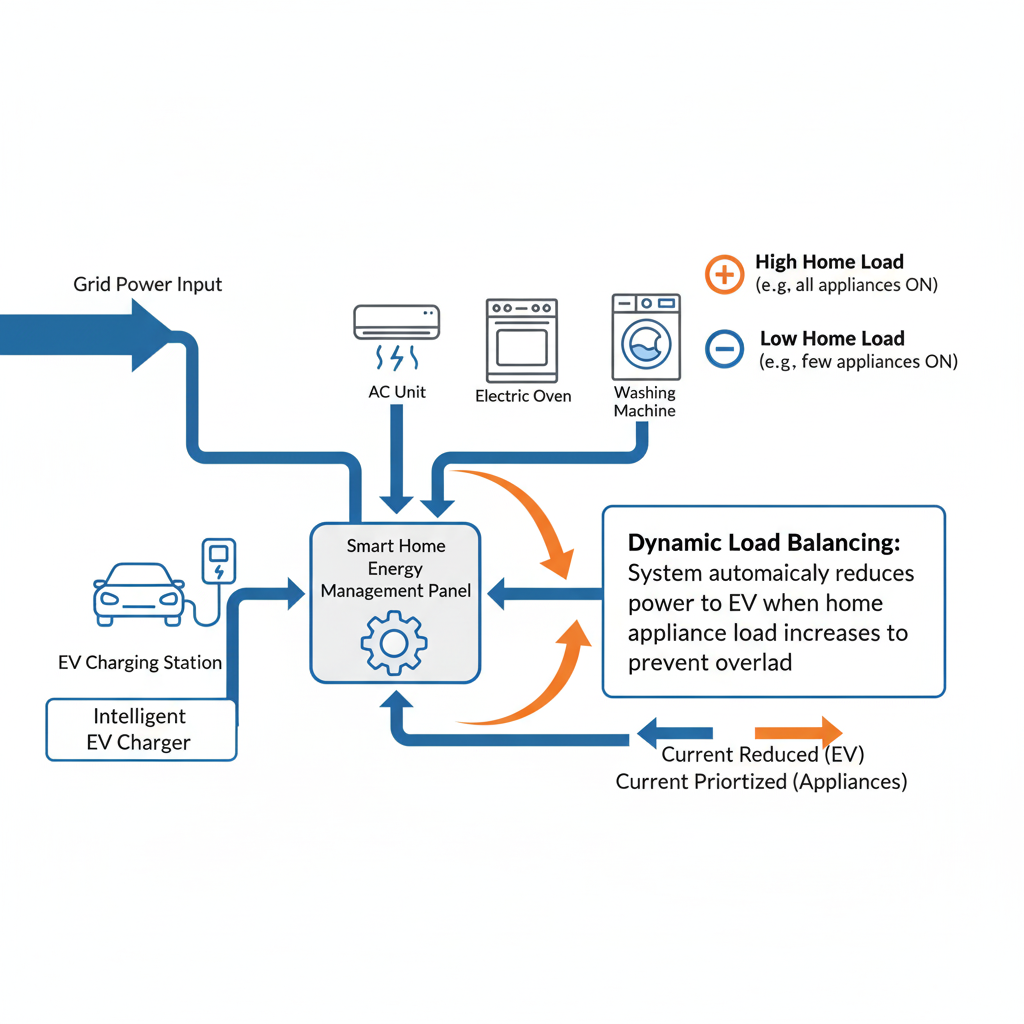
Dynamic Load Balancing (DLB): Some wallbox models include DLB, which monitors total household load and automatically reduces charging power to prevent circuit overload. This means you can safely run other appliances (AC, oven, etc.) without tripping breakers while charging your EV.
-
Robust Safety Protections: All chargers have multi-layer safety (leakage, over-/under-voltage, over-current, short-circuit, lightning protection, etc.), with flame-retardant materials and certified components.
-
Wide Compatibility: Supports common EV standards (Type 2 and others via adapters) and works with almost any plug-in EV. Feyree even offers adapters (e.g. for Tesla’s NACS or China’s GB/T) so one charger can serve multiple vehicle types.
Feyree’s chargers provide a clear on-unit interface for scheduling. In the photo above, the charger’s display highlights a delayed start time (5 h) and current setting (16 A). This illustrates how easily you can program the charger – for example, telling it to wait several hours before beginning a charge. The Tuya-based app works similarly, allowing you to set weekly schedules from your phone so that charging automatically starts during off-peak hours. With this level of control, most of the energy drawn by your EV comes at night when rates are lowest, maximizing your cost savings.
Dynamic Load Management: Feyree’s home wallbox chargers with DLB help balance your home’s power. A current sensor on the main line monitors total electricity use; if your household demand rises (say, the AC or oven is on), the charger automatically throttles back to avoid overload. This intelligent load management ensures the EV can charge quickly when extra power is available, but slows charging when you need the circuit capacity for other appliances. It effectively prevents breaker trips and makes the most of your existing electrical system.
Safety and Reliability: Safety is a top priority for Feyree. Their chargers incorporate multiple protection systems: AC/DC leakage protection, over- and under-voltage shutdown, over-current limit, short-circuit protection, and lightning surge protection. The housing and cable are made of flame-retardant materials (meeting UL94 V-0 standards) and 99.95% pure copper wire for stable conductivity. With an IP66 waterproof rating, the units can be safely installed outdoors in rain or snow. Each charger is certified (CE, FCC, TÜV, etc.), and it will automatically cut power once the battery is full. These features let you charge overnight or unattended with confidence.
Supporting the Grid and Reducing Peak Demand
Smart charging doesn’t just save individual owners money; it also helps the overall power grid. By shifting EV charging to night time, Feyree chargers help flatten the daily demand curve. Studies show that coordinated smart charging can reduce peak grid loads by about 6–9% (compared to unmanaged charging). This “peak shaving” can avoid costly utility investments in new power lines or transformers. Many utilities now encourage such behavior through demand-response programs: they may send price signals or incentives to shift EV load off the grid’s busy times. For example, participating households may earn rebates or special rates by allowing their EV charger to delay charging during a peak event. In effect, your smart charger can act as a virtual power plant resource – responding to the grid’s needs while lowering your own energy bills.
Energy Savings in Practice
All of Feyree’s smart charging features translate directly into lower energy costs. By scheduling most of your charging at night or on weekends, you simply pay the lowest rate per kilowatt-hour. The impact can be dramatic: coordinated EV charging has been estimated to cut household energy bills by roughly 10% (about $200/year). One pilot program (ChargeWise California) achieved 98% off-peak charging and roughly $200 annual savings per EV. With Feyree’s system, taking advantage of those savings is straightforward – you just plug in and let the charger (or app) handle the timing. Over a year, a few cents difference per kWh adds up: switching your 1,000-mile/month charging from $0.25 to $0.10 rates can save hundreds of dollars, simply by clever scheduling.
Frequently Asked Questions
Q1: How much can I realistically save on my bill?
A: It depends on your rates and usage, but savings can be significant. Studies show managed charging can reduce household energy costs by ~10%. In practical terms, pilots report around $200 saved per EV per year by shifting charging to off-peak. Many EV drivers report saving hundreds annually by leveraging off-peak rates and smart scheduling. With Feyree’s scheduling features, you should capture most of those benefits automatically.
Q2: What are Time-of-Use rates and how do I use them?
A: TOU plans are electricity tariffs where prices vary by time. Peak hours (usually late afternoon/evening) have the highest rates, while mid- and off-peak hours (often late night) are cheaper. For example, some utilities charge around $0.25/kWh at 5 pm but only $0.10/kWh after midnight. If your utility offers TOU pricing (or a special EV rate), you simply tell your Feyree charger (via the app or buttons) to charge during the cheap window. This way, most of your EV charging is billed at the lower rate. Check your local utility for exact TOU hours; the Feyree app can then schedule charging within those hours.
Q3: How does this help the electric grid?
A: By delaying charging to off-peak times, smart chargers like Feyree’s reduce strain on the grid. This lowers the overall peak demand and defers infrastructure upgrades. Many utilities also run demand-response programs: if you participate, the charger can automatically pause or delay charging during grid emergencies. In return, utilities offer incentives (bill credits or rebates) for being flexible. So, your charger not only saves you money, but can also earn you utility incentives and help prevent blackouts by smoothing out demand.
Q4: What about installation and compatibility?
A: Feyree offers both portable (plug-in) and wall-mounted chargers. Portable units simply plug into a 240 V outlet (often with an included industrial socket adapter), so no hardwiring is needed. Wallboxes require installation by an electrician on a dedicated 240 V circuit. Choose a model that matches your home’s wiring (e.g. 7.4 kW single-phase or 22 kW three-phase depending on panel capacity). Feyree chargers support multiple EV plug standards: a Type 2 charger works with most European EVs, and adapters or specific models cover SAE J1772 (Type 1), GB/T (Chinese EVs), and Tesla NACS. Ensure your home electrical panel has a free breaker for the charger’s amperage. If you have multiple EVs or high home load, consider the DLB-capable models to safely balance loads.
Q5: How does the mobile app work?
A: Feyree’s chargers connect to your home Wi-Fi. You then use the Feyree app (via the Tuya Smart platform) on your smartphone to control the charger. The app lets you monitor real-time charging status (current, voltage, energy consumed), adjust the charging current, and—importantly—set charging schedules. You can create weekly plans (for example, charge from 11 p.m. to 6 a.m. on weekdays) or one-time timers. The app also sends notifications (e.g. when charging is complete). This makes it easy to automate your charging without manual intervention.
Q6: Are Feyree chargers safe and reliable?
A: Yes. Every Feyree charger includes multi-layer safety protections. As the product literature shows, they have AC/DC leakage protection, over-voltage/under-voltage cutoffs, over-current protection, short-circuit and lightning surge protection. The enclosures are made of UL94-V0 flame-retardant material, and the cables use pure copper conductors for durability. All units are IP66 rated, meaning they can withstand rain and dust if installed outdoors. They carry internationally recognized safety certifications (CE, FCC, TÜV, etc.). In practice, this means you can safely leave them charging your EV overnight — the charger will automatically stop when full, and any fault (like a leakage) will immediately trip the circuit to keep you safe.