
The rapid expansion of electric vehicle (EV) infrastructure has brought with it a growing conversation about the long-term costs of operating and maintaining charging equipment. Whether you are a business owner managing a commercial charging station, a fleet operator overseeing dozens of vehicles, or a property manager offering amenities to tenants, understanding the true cost of EV charger maintenance is essential to making informed decisions. The good news is that with proper planning, proactive strategies, and an understanding of where costs actually concentrate, EV charger maintenance does not need to break the bank.
This article provides a comprehensive analysis of EV charger maintenance costs, breaking them down by category and charger type — from Level 1 and Level 2 AC chargers to high-powered DC fast chargers (DCFC). By understanding where money goes and which areas carry the heaviest financial burden, operators can make smarter investments and avoid costly surprises.
1. Overview of EV Charger Types and Their Cost Profiles
Before diving into specific cost categories, it is important to understand how different charger types differ in complexity and, therefore, maintenance requirements.
Level 1 Chargers (AC, 120V): These are the most basic chargers, typically used in residential settings. They deliver 1.4 to 1.9 kW of power and have minimal moving parts, making them the least expensive to maintain. Annual maintenance costs are generally under $100 per unit.
Level 2 Chargers (AC, 240V): Widely deployed in commercial settings, workplaces, and multifamily properties, Level 2 chargers deliver 3.3 to 19.2 kW. They are moderately complex and typically cost between $150 and $400 per year in maintenance, depending on usage frequency and environmental conditions.
DC Fast Chargers (DCFC): These chargers, which include CHAdeMO, CCS, and Tesla Supercharger-compatible units, deliver 50 kW to 350 kW or more. They are significantly more complex, incorporating power electronics, cooling systems, and advanced software. Annual maintenance costs for DCFC units can range from $1,500 to over $5,000 per unit, making them the most expensive category by far.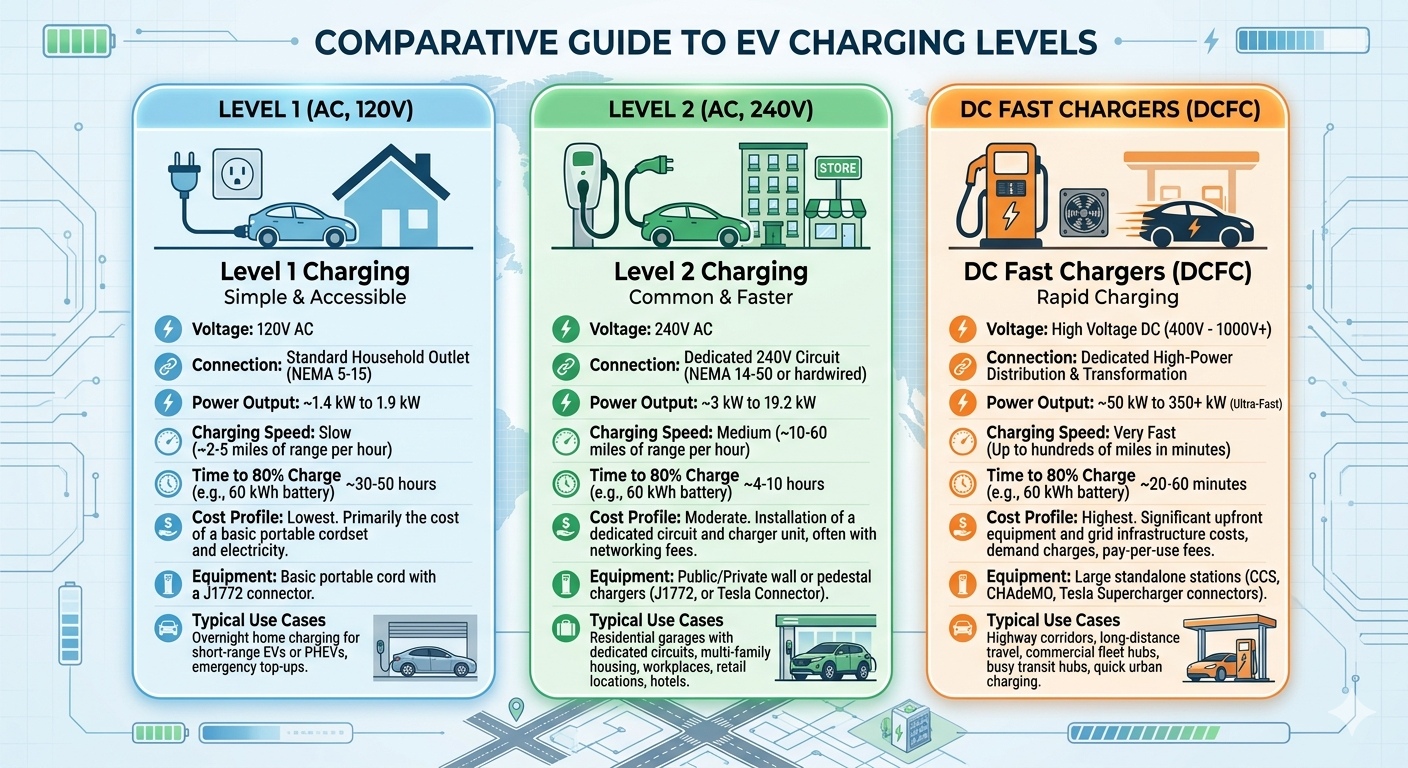
2. Major Categories of EV Charger Maintenance Costs
2.1 Hardware Maintenance and Component Replacement
Hardware wear and component failure represent one of the most significant cost drivers in EV charger maintenance. Over time, physical components degrade from regular use, weather exposure, and electrical stress.
For Level 2 chargers, the most common hardware issues include:
- Charging cable and connector wear — Cables are subject to repeated bending, pulling, and exposure to UV, rain, and temperature extremes. Replacement costs range from $50 to $200 per cable.
- EVSE (Electric Vehicle Supply Equipment) circuit board failures — These can cost $200 to $600 to replace, depending on the unit.
- Display screen and interface degradation — Touchscreens and displays in outdoor environments are prone to failure, with replacements typically costing $100 to $300.
For DC fast chargers, hardware costs are dramatically higher: - Power modules — The core power conversion units in DCFC are expensive, often costing $1,000 to $3,000 each, and may need replacement every 3 to 5 years under heavy use.
- Cooling systems — DCFC units generate substantial heat and rely on active liquid cooling systems or large fans. Fan motor replacement costs $150 to $400, while liquid cooling component repairs can exceed $1,000.
- DC cable assemblies — These high-amperage cables are heavier and more expensive than AC equivalents, often costing $300 to $800 to replace.
2.2 Software and Firmware Updates
Modern EV chargers are network-connected devices that rely on software for payment processing, load management, user authentication, and remote diagnostics. Software and firmware maintenance is a recurring but often overlooked cost.
For Level 2 chargers, software costs are typically bundled into network service subscriptions, which range from $100 to $300 per unit annually. These fees cover firmware updates, remote monitoring dashboards, payment processing integration, and customer support access.
For DCFC units, software complexity is significantly higher. Operators may face costs for OCPP (Open Charge Point Protocol) compliance updates, cybersecurity patches, and integration with utility demand response programs. Some vendors charge separate licensing fees for advanced software features, potentially adding $500 to $1,500 per year per unit.
A particularly high-cost scenario occurs when charger manufacturers discontinue software support for older models, forcing operators to either pay for extended support contracts or invest in hardware upgrades prematurely.
2.3 Electrical Infrastructure and Grid Connection
The electrical infrastructure supporting EV chargers is a major cost center that many operators underestimate. While these costs are largely upfront, ongoing maintenance of the electrical system is necessary and can be costly.
- Panel and breaker maintenance — Dedicated circuit breakers and panels serving EV chargers require periodic inspection and may need replacement after surges or overloads. Costs range from $100 to $500 per inspection cycle.
- Transformer maintenance — DCFC installations often require dedicated transformers. Maintenance and potential replacement of transformers is a high-cost item, sometimes exceeding $10,000.
- Ground fault and surge protection — These protective devices require periodic testing and eventual replacement, adding $50 to $200 per unit annually.
Utility demand charges are also a hidden but significant operational cost for DCFC operators. High-power chargers can trigger peak demand charges from utilities, sometimes adding hundreds of dollars per month to electricity bills.
2.4 Physical Site and Enclosure Maintenance
The physical environment of a charging station requires regular upkeep. This category includes costs that are often invisible until they become serious problems.
- Enclosure and cabinet integrity — Outdoor DCFC units have steel or aluminum enclosures that can rust, crack, or be damaged by vandalism. Repainting or replacing panels can cost $200 to $1,000.
- Holster and mounting hardware — Cable management holsters, mounting posts, and brackets degrade over time. Replacements are generally inexpensive ($50 to $150) but require regular inspection.
- Signage and lighting — Clear signage and adequate lighting around chargers are important for accessibility and safety. Maintaining these elements adds modest but ongoing costs.
- Cleaning — Regular cleaning of charger surfaces, screens, and connectors prevents premature degradation. While low-cost individually, this should be factored into routine maintenance budgets.
2.5 Vandalism, Accidental Damage, and Insurance
EV chargers, particularly those installed in publicly accessible locations, are vulnerable to vandalism and accidental damage. Cut cables, broken screens, and graffiti are common issues. Cable theft is a particularly disruptive and costly problem, especially for DCFC units with expensive DC cable assemblies.
Operators should budget for occasional repair events driven by vandalism. More importantly, comprehensive commercial property insurance covering EV charging equipment is essential. Depending on the portfolio size and risk profile, insurance premiums for charging station coverage can add $200 to $800 per unit annually.
2.6 Service Contracts, Labor, and On-Site Visits
Labor is often the highest variable cost in EV charger maintenance. Service technician visits for troubleshooting, parts replacement, or preventive maintenance are billed at rates typically ranging from $75 to $200 per hour, with travel charges often added for remote sites.
Many operators choose to enter service contracts with their charger manufacturer or a third-party maintenance provider. These contracts provide predictable budgeting and often include:
- Scheduled preventive maintenance visits (typically once or twice per year)
- Priority response times for emergency repairs
- Parts coverage at reduced or no cost
- Remote monitoring and diagnostics support
For Level 2 chargers, service contracts typically cost $150 to $400 per unit per year. For DCFC units, comprehensive service contracts can range from $1,000 to $3,000 per unit annually, reflecting the higher complexity and parts costs.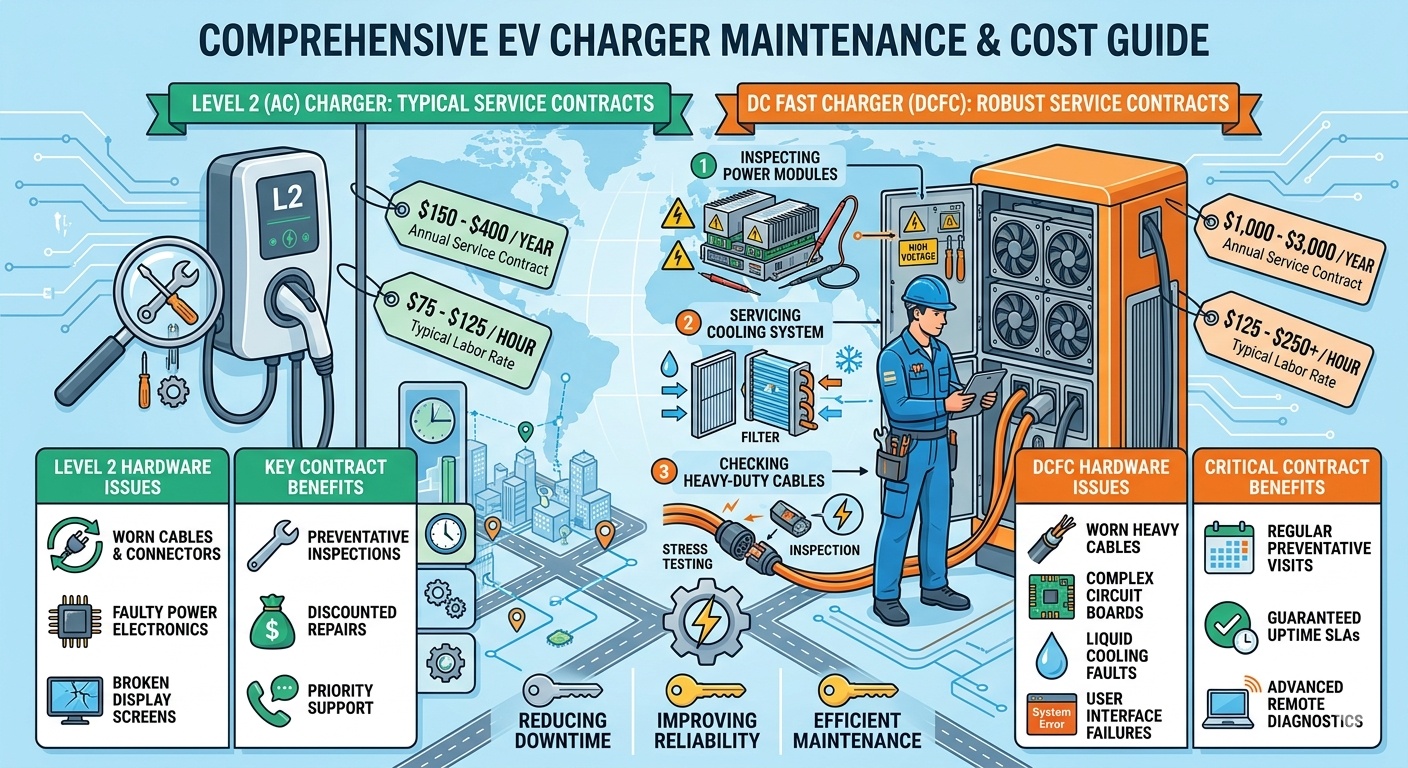
3. Comparative Cost Analysis by Charger Type
To provide a clearer picture, here is a summary of estimated annual maintenance costs by charger type:
Level 1 Chargers: Total estimated annual maintenance cost per unit is $50 to $150. Cost drivers are minimal — primarily cable inspection and occasional outlet or GFCI device replacement. Software costs are negligible as most Level 1 chargers are non-networked.
Level 2 AC Chargers: Total estimated annual maintenance cost per unit is $150 to $600. Key cost drivers include cable and connector replacement, network subscription fees, software updates, and occasional hardware failures. Outdoor units in harsh climates incur higher costs due to accelerated physical degradation.
DC Fast Chargers (50 kW): Total estimated annual maintenance cost per unit is $1,500 to $3,500. The primary cost drivers are power module maintenance, cooling system servicing, software licensing, and higher labor costs for specialized technicians. These units also carry higher downtime risk, which has indirect revenue implications for commercial operators.
High-Power DC Fast Chargers (150 kW+): Total estimated annual maintenance cost per unit is $3,000 to $6,000 or more. At this power level, every component is larger, more complex, and more expensive to service. Cooling systems are more elaborate, power modules require more frequent inspection, and cable assemblies are considerably more costly. Utility demand management costs also become a significant factor..jpg?w=1408&h=768)
4. Highest-Cost Areas: Where the Money Actually Goes
Across all charger types, several areas consistently represent the highest proportion of maintenance spending:
Power Electronics (DCFC only): Power modules are the most expensive single maintenance item for fast chargers. A multi-gun DCFC unit with multiple power modules may require $5,000 to $10,000 in module replacement costs over a 5-year period under heavy usage.
Cable and Connector Systems: Across all charger types, cables and connectors are the most frequently replaced components. High-traffic commercial sites may replace Level 2 cables every 2 to 3 years and DCFC cables every 3 to 4 years.
Unplanned Downtime and Emergency Repairs: While not a direct maintenance cost, unplanned downtime leads to emergency service calls billed at premium rates. For DCFC operators generating revenue from session fees, each day of downtime can represent $500 to $2,000 in lost revenue, making the indirect cost of poor maintenance very high.
Network and Software Services: Annual software and connectivity fees are a recurring cost that grows with portfolio size. Operators managing 50 or more Level 2 chargers may spend $10,000 to $20,000 annually on network fees alone.
5. Strategies to Keep Maintenance Costs Under Control
The key message of this article is that EV charger maintenance does not need to be prohibitively expensive. With the right approach, operators can keep costs manageable:
• Choose quality equipment upfront — Lower-cost chargers often come with higher long-term maintenance burdens. Investing in reputable brands with strong warranty and support ecosystems pays dividends over time.
• Implement proactive preventive maintenance — Scheduled inspections catch small issues before they become expensive failures. For DCFC units, bi-annual professional servicing is recommended.
• Leverage remote monitoring — Networked chargers provide real-time data on performance and faults. Early fault detection through remote monitoring can prevent costly emergency service calls.
• Negotiate multi-unit service contracts — Operators with multiple chargers should negotiate bulk service agreements to reduce per-unit costs.
• Protect physical installations — Anti-vandalism features such as cable retractors, locking holsters, and surveillance cameras reduce damage-related costs significantly.
• Plan for software lifecycle — When selecting chargers, consider the manufacturer's software support commitment. Open-standard devices (OCPP-compliant) offer more flexibility and avoid vendor lock-in.
Conclusion
EV charger maintenance encompasses a wide range of cost categories — from hardware component replacement and software subscriptions to electrical infrastructure upkeep and labor charges. The costs vary dramatically depending on charger type: Level 1 units are nearly maintenance-free, Level 2 chargers are manageable with proper planning, and DC fast chargers carry the highest maintenance burden due to their complexity and the high cost of power electronics and cooling systems.
The highest-cost areas across the board are power modules (for DCFC), cable and connector systems, unplanned emergency repairs, and ongoing software/network fees. However, armed with a clear understanding of these costs and a proactive maintenance strategy, operators can prevent most major expenses and keep their charging infrastructure running efficiently.
As the EV market continues to grow and charger technology matures, manufacturers are investing in more reliable designs and better remote diagnostic tools. The long-term trajectory of maintenance costs is expected to decrease. For operators willing to invest in quality equipment, preventive care, and smart monitoring systems, EV charger maintenance truly does not need to break the bank.