
Introduction
The rapid adoption of electric vehicles (EVs) around the world has transformed the way people think about home energy infrastructure. One of the most frequently asked questions by new EV owners and prospective buyers is: why does my EV charger need its own dedicated circuit? Unlike plugging in a smartphone or a laptop, EV charging is a sustained, high-power operation that places exceptional demands on electrical systems. Understanding why dedicated circuits are not just recommended but often legally required requires a closer look at electrical engineering fundamentals, safety standards, and how different regions have adapted their requirements to local grid realities.
This article provides a comprehensive explanation of the technical reasons behind the dedicated circuit requirement, followed by a detailed examination of region-specific rules and considerations — with particular focus on Europe, North America, Asia, and other markets.
1. The Basics: What Is a Dedicated Circuit?
A dedicated circuit is an electrical circuit that serves only one appliance or device. It runs from the main breaker panel directly to a single outlet or hardwired connection, with no other devices sharing the same wiring or circuit breaker. In contrast, general-purpose circuits in a home power multiple outlets simultaneously, meaning the total load is shared among all plugged-in devices.
For EV charging, a dedicated circuit is essential because the charger draws a consistent, high-amperage load over an extended period — typically several hours. Most Level 2 home EV chargers operate at 32 to 48 amps on a 240V (or 230V in Europe) circuit. This sustained load is categorically different from most household appliances, which either draw lower power or cycle on and off.
2. Core Technical Reasons for Dedicated Circuits
2.1 High and Sustained Current Draw
EV chargers pull large amounts of current for extended periods. A 7.2 kW Level 2 charger operating on a 240V circuit draws approximately 30 amps continuously. Electrical codes universally recognize that circuits should not be loaded beyond 80% of their rated capacity on a continuous basis (defined as loads lasting more than 3 hours). This means a 30-amp continuous load legally requires a circuit rated for at least 40 amps. If other devices shared this circuit, the cumulative load could easily exceed safe thresholds, causing wire overheating, nuisance tripping, or in worst cases, electrical fires.
2.2 Wire Gauge and Thermal Limits
Each gauge of electrical wire is rated for a maximum current based on its thermal limits. When too much current flows through undersized wire, resistance generates heat. If wiring is shared between an EV charger and other loads, the total current may exceed the wire's rated capacity even if the breaker doesn't trip — because breakers protect against short circuits and gross overloads, not sustained moderate overloads on shared circuits. A dedicated circuit ensures the wire gauge is selected specifically for the EV charger's full load with proper safety margins.
2.3 Voltage Drop and Charging Efficiency
Sharing a circuit with other loads causes voltage drop along the wiring. Even modest drops in voltage reduce charging efficiency and can cause the EVSE (Electric Vehicle Supply Equipment) to throttle back its output, extending charge times. In more severe cases, low voltage causes the EVSE's internal electronics to operate outside design parameters, potentially shortening its lifespan. A dedicated circuit minimizes voltage drop by ensuring the full panel voltage is available exclusively for charging.
2.4 Circuit Breaker Coordination and Nuisance Tripping
Circuit breakers are rated for specific continuous loads. If an EV charger shares a breaker with kitchen appliances, workshop tools, or HVAC equipment, the combined momentary inrush currents — for example, when a refrigerator compressor starts — can trip the breaker unexpectedly. This nuisance tripping interrupts charging sessions and can, over time, degrade the breaker's mechanical reliability. Dedicated circuits eliminate this issue entirely.
2.5 GFCI and Safety Device Requirements
Modern EV chargers are required in most jurisdictions to include Ground Fault Circuit Interrupter (GFCI) protection. GFCIs monitor for imbalances between hot and neutral conductors that indicate current leaking to ground — a shock hazard. On shared circuits, nuisance GFCI trips from other appliances (especially those with motors) can interrupt charging. Moreover, adding GFCI protection to a shared multi-outlet circuit is far more complex and expensive than protecting a single dedicated outlet or hardwired connection.
2.6 Code Compliance and Insurance Requirements
Beyond engineering considerations, most national and local electrical codes mandate dedicated circuits for EV chargers. Non-compliance can void homeowner's insurance, complicate property sales, and expose installers to liability. Certified electricians and reputable EVSE manufacturers universally specify dedicated circuits not only for safety but to maintain warranty coverage and regulatory compliance.
3. North American Standards and Requirements
In the United States and Canada, electrical installations are governed primarily by the National Electrical Code (NEC) published by the National Fire Protection Association (NFPA). Canada follows the Canadian Electrical Code (CEC). Both codes require that EV charging equipment be installed on dedicated circuits with appropriate amperage ratings.
The NEC (Article 625) specifically addresses Electric Vehicle Power Transfer Systems. It mandates that EVSE be supplied from a dedicated branch circuit and that the circuit be sized at 125% of the EVSE's continuous load rating. For a typical 32A charger, the minimum circuit size is therefore 40A, with 50A commonly recommended for future-proofing. Wiring must use appropriate conductors — typically 8 AWG copper for 40A circuits and 6 AWG for 50A.
In North America, Level 1 charging (120V, 12–16A) can sometimes be done from an existing 20A circuit, but this is rarely practical as a primary charging method due to slow speeds. Level 2 charging (240V) always requires a dedicated circuit. Increasingly, new construction in the US includes pre-installed EV-ready circuits in garages as part of building codes, especially in California and other progressive states.
4. European Standards and Special Requirements
Europe presents a unique and more complex regulatory landscape for EV charging, largely due to the diversity of national grid standards, the adoption of the EU's shared regulatory framework, and the widespread use of three-phase power in residential settings — something extremely rare in North America.
4.1 The Role of IEC Standards and EU Directives
The International Electrotechnical Commission (IEC) publishes IEC 61851, which defines the modes and requirements for EV charging. Most European national standards are aligned with or derived from IEC 61851. The EU's Energy Performance of Buildings Directive (EPBD) and the Alternative Fuels Infrastructure Regulation (AFIR) further require that new residential and commercial buildings include EV charging infrastructure or at least pre-cabling for future charger installation.
In the EU, all new residential buildings with more than ten parking spaces and all non-residential buildings with more than five parking spaces are required to have EV charging points or EV-ready conduit infrastructure. This makes the dedicated circuit question not just a matter of individual homeowner choice but of regulatory compliance at the building level.
4.2 Three-Phase Power: A European Advantage
One of the most significant differences between European and North American EV charging infrastructure is the availability of three-phase power in residential settings. In much of continental Europe — particularly Germany, France, the Netherlands, Belgium, Scandinavia, and others — residential properties are commonly connected to three-phase 400V supplies.
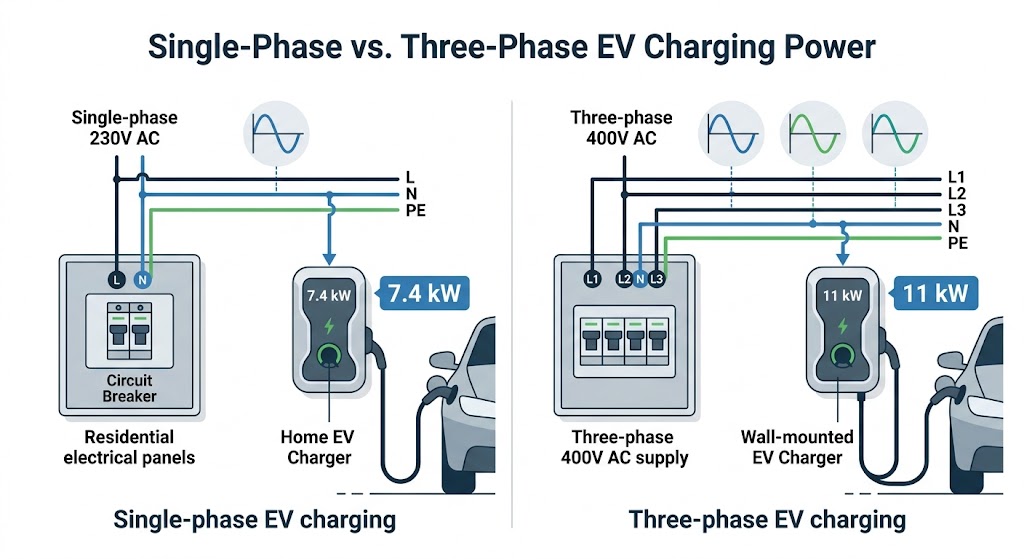
Three-phase charging allows dramatically higher power levels on a single-phase-equivalent conductor size. A three-phase 16A per-phase charger delivers approximately 11 kW, while a single-phase 32A charger delivers only 7.4 kW. Many European EVSEs support three-phase charging, and vehicles like the Renault Zoe, Volkswagen ID series, and others include three-phase onboard chargers as standard. When a dedicated three-phase circuit is installed, the dedicated circuit requirement still applies — but the circuit must be rated for three-phase balanced loads and protected with a three-pole circuit breaker.
4.3 UK-Specific Requirements
The United Kingdom follows its own set of standards post-Brexit, primarily governed by BS 7671 (the IET Wiring Regulations) and supported by the Office for Zero Emission Vehicles (OZEV). The UK has a specific EV charging grant program historically supporting installation costs for home chargers. UK regulations require that home EV chargers be smart chargers capable of load management, time-of-use tariff scheduling, and demand response — features that require a stable, dedicated circuit to function reliably. UK chargers operate at 230V single phase with a maximum of 32A (7.4 kW), identical to much of continental Europe for single-phase systems.
4.4 Germany, France, and Scandinavia
Germany's VDE electrical standards and France's NF C 15-100 wiring regulations both mandate dedicated circuits for EV chargers. French regulations also require that buildings constructed after 2012 include dedicated conduit for future EV charger installation. In Germany, the KfW grant program for home EV infrastructure similarly requires certified installations on dedicated circuits.
Scandinavia presents additional nuance: Norway, the world leader in per-capita EV adoption, has developed sophisticated load balancing solutions because many Norwegian homes are located in older apartment buildings with limited main supply capacity. Dedicated circuits paired with smart load management systems allow multiple EVs to charge simultaneously within the building's total supply limit.
5. Asia-Pacific and Other Regional Considerations
5.1 China
China is the world's largest EV market and has developed its own standards under the GB/T framework. GB/T 18487 governs EV charging system requirements in China. Home charging in China is predominantly done via dedicated AC circuits at 220V single-phase. Chinese regulations require dedicated metering and dedicated circuit protection for EV chargers, partly to enable time-of-use billing. Many residential EV charger installations in China are managed through cooperation between the property owner, the local grid operator, and EV manufacturers, with dedicated submetering circuits required.
5.2 Japan
Japan uses a 100V/200V single-phase grid. Home EV charging (CHAdeMO standard for AC, though CHAdeMO is more commonly associated with DC fast charging) uses dedicated 200V circuits. The Electrical Appliance and Material Safety Law (DENAN) and Japanese Industrial Standards (JIS) regulate EV charging equipment. Dedicated circuits rated for the EVSE's full rated load are required, with 6mm² wiring commonly used for 30A circuits.
5.3 Australia and New Zealand
Australia and New Zealand use 230V single-phase (and three-phase in commercial settings) at 50Hz. The Australian/New Zealand Standard AS/NZS 3000 (the Wiring Rules) and AS/NZS 3112 (plug and socket standard) apply to EV charging installations. Dedicated circuits are required under AS/NZS 3000, with specific requirements for EVSE installation including RCD (residual current device, equivalent to GFCI) protection and appropriate earthing. Australia's state-level building codes increasingly incorporate EV-ready provisions in new construction.
6. Smart Charging and Load Management: An Evolving Dimension
While dedicated circuits remain foundational, modern smart EV chargers add a layer of sophistication that is changing the conversation around home electrical infrastructure. Smart EVSE units can communicate with the home's energy management system (EMS), the grid operator, and the vehicle to dynamically adjust charging rates based on available capacity.
Load management systems — such as those using Powerline Communication (PLC) or Wi-Fi — can enable multiple EVSEs to share a single high-capacity circuit by intelligently distributing available current. However, this still requires a substantial dedicated supply to the load management device itself. In apartment buildings and multi-unit dwellings, these systems are becoming essential, particularly in Europe where older buildings may have limited per-unit electrical supply.
Vehicle-to-Grid (V2G) technology, increasingly deployed in the UK, Netherlands, and Japan, adds bidirectional power flow to the equation. V2G-capable chargers must be on dedicated circuits not only for safety reasons but to ensure metering accuracy and grid compliance when the vehicle exports power back to the grid.
7. Practical Installation Considerations
For homeowners and property managers, the dedicated circuit requirement has direct practical implications. Installing a dedicated circuit for an EV charger typically requires a licensed electrician to run new wiring from the main panel to the garage or parking area, install an appropriate circuit breaker, and mount the EVSE or outlet. Costs vary widely by region: in the US, a typical installation ranges from $500 to $1,500 depending on panel capacity and run length. In the UK and EU, similar installations range from £500–£1,500 or €600–€1,800.
Where panel capacity is insufficient — a common issue in older homes — a panel upgrade may be required, adding cost. Some installers offer 'EV-ready' panels with pre-installed high-amperage breaker spaces. In cases of severe supply limitations, bidirectional load management or dedicated energy storage (home batteries) can be used to supplement available capacity without full panel upgrades.
Conclusion
The requirement for dedicated circuits for EV chargers is not arbitrary bureaucratic caution — it is rooted in fundamental electrical engineering principles governing safe and efficient power delivery. Sustained high-current loads demand wire gauges, breaker ratings, and isolation from other appliances that shared circuits cannot reliably provide. Across the globe, whether under the NEC in North America, IEC 61851 and national derivatives in Europe, GB/T standards in China, or AS/NZS 3000 in Australia, regulatory bodies have reached the same conclusion: EV chargers must have their own circuits.
European markets add additional complexity through widespread three-phase residential supply, mandatory EV-ready building requirements under EU directives, and advanced smart charging mandates. Emerging markets in Asia apply their own national frameworks that equally emphasize dedicated supply for safety, metering, and grid management purposes.
As EV adoption accelerates globally, the dedicated circuit — once seen as an inconvenient extra cost — is increasingly treated as standard residential infrastructure, as fundamental as a kitchen circuit for a dishwasher or an outdoor supply for air conditioning. Planning for this infrastructure early, whether in new construction or existing property upgrades, is one of the most practical and cost-effective investments an EV owner or property developer can make.