
1. Introduction: Why We Need to Convert AC to DC
Electricity travels in two fundamentally different forms: Alternating Current (AC) and Direct Current (DC). Understanding the difference between these two forms — and why converting one to the other is so essential — is the foundation of modern electronics and electrical engineering.
Alternating Current is the type of electricity delivered to homes and businesses through the power grid. In AC, the direction of electron flow reverses periodically. In the United States, this reversal happens 60 times per second (60 Hz), while in most of Europe and Asia, the standard is 50 Hz. AC is ideal for long-distance power transmission because its voltage can be easily stepped up or down using transformers, reducing energy loss over transmission lines.
Direct Current, on the other hand, flows in only one direction at a constant voltage. Batteries, solar panels, fuel cells, and virtually all modern electronic circuits operate on DC. Smartphones, laptops, LED televisions, electric vehicles, and countless other devices require a stable, unidirectional current to function reliably.
This fundamental incompatibility between the AC supplied by the power grid and the DC required by electronic devices makes AC-to-DC conversion not just useful — it is absolutely necessary. Without this conversion, the modern electronic ecosystem simply could not exist.
2. The Core Stages of AC-to-DC Conversion
Converting AC to DC is not a single-step process. It involves a carefully engineered sequence of stages, each designed to bring the raw alternating current closer to a clean, stable direct current. The four primary stages are: Transformation, Rectification, Filtering, and Voltage Regulation.
Stage 1: Transformation
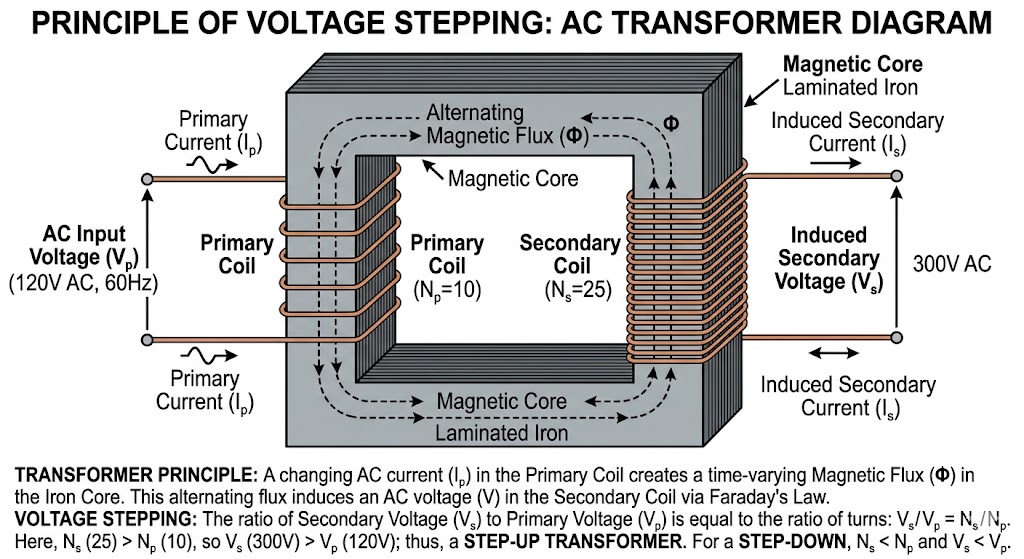
The first step is to adjust the voltage of the incoming AC to an appropriate level. This is accomplished using a transformer — a device that uses electromagnetic induction to transfer electrical energy between two or more circuits.
A transformer consists of two coils of wire (the primary and secondary windings) wound around a shared iron core. When AC flows through the primary coil, it generates a changing magnetic field, which induces a voltage in the secondary coil. The ratio of the number of turns in each coil determines whether the voltage is stepped up or stepped down.
For most consumer electronics, the transformer steps DOWN the voltage. For example, a wall outlet provides 120V (in the US) or 230V (in Europe). A laptop charger might step this down to around 19V before further processing. Transformers are highly efficient and perform this voltage conversion while maintaining electrical isolation between the input and output — an important safety feature.
Stage 2: Rectification
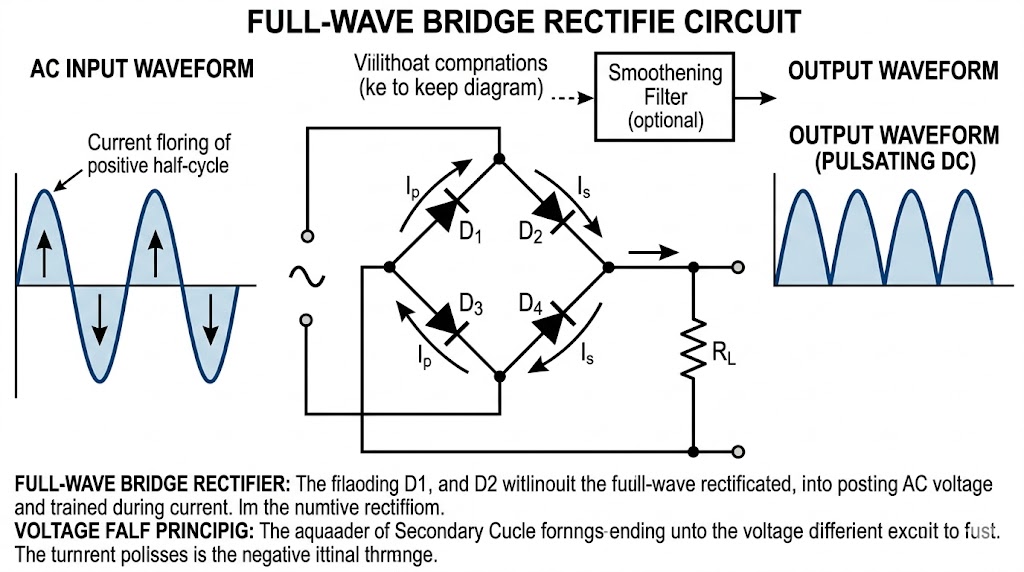
Once the voltage is at the correct level, the next step is rectification — converting the alternating waveform into a unidirectional (one-way) current. This is done using diodes, which are semiconductor components that allow current to flow in only one direction.
There are two primary types of rectification:
• Half-Wave Rectification: Uses a single diode. Only one half of the AC wave (either the positive or negative half-cycle) is allowed to pass through. The other half is blocked. This is simple and cheap, but inefficient, as it discards half the available power.
• Full-Wave Rectification: Uses a bridge rectifier — typically four diodes arranged in a diamond pattern. Both the positive and negative halves of the AC wave are used. When the AC swings negative, the diodes reroute the current so it still flows in the same direction through the load. This is far more efficient and is the standard method used in virtually all modern power supplies.
The output of a full-wave rectifier is a pulsating DC — current that always flows in one direction, but varies in magnitude, peaking at the crest of each half-wave. This is sometimes called "bumpy DC."
Stage 3: Filtering
Pulsating DC is not suitable for sensitive electronics. Fluctuating voltage can cause instability, noise, and damage to components. The filtering stage smooths out these variations, producing a much more stable DC signal.
The most common filtering component is the capacitor. A large electrolytic capacitor is placed in parallel with the output of the rectifier. During the peaks of the pulsating DC, the capacitor charges up. During the troughs, when the rectified voltage dips, the capacitor discharges and releases stored energy to maintain the output voltage. The result is a nearly constant DC voltage with only small residual ripples.
In more sophisticated designs, inductors (coils) are also used in combination with capacitors to form LC (inductor-capacitor) filters, which provide even smoother DC output. The quality of filtering directly impacts the performance of the powered device — inadequate filtering can produce audible hum in audio equipment or visible flicker in lighting systems.
Stage 4: Voltage Regulation
The final stage ensures the output voltage remains precisely constant regardless of variations in the input AC voltage or changes in the load (the device being powered). This is called voltage regulation.
Two main approaches are used:
• Linear Regulators: Components like the classic 7805 regulator dissipate excess voltage as heat to maintain a stable output. They are simple and produce very clean DC, but are inefficient when the input-output voltage difference is large.
• Switching Regulators (Switch-Mode Power Supplies, or SMPS): These use high-frequency switching transistors to convert excess energy into stored magnetic or electric energy, then release it as needed. SMPS designs are far more efficient (often 85–95%) and are used in virtually all modern chargers, computers, and appliances. The trade-off is greater circuit complexity and the potential for electromagnetic interference.
3. Car Chargers: AC-to-DC Conversion in Your Vehicle
One of the most common and relatable examples of AC-to-DC conversion is the car charger — the device you plug into your vehicle's 12V outlet (formerly called the "cigarette lighter" socket) to charge your smartphone or power a GPS unit.
Interestingly, car chargers actually involve two different electrical scenarios depending on the context:
3.1 The 12V DC Environment of a Car
A car's electrical system runs on Direct Current, not AC. The 12V battery stores DC, and the alternator generates AC that is immediately rectified to DC to charge the battery and power the car's systems. So when you plug a device into your car's 12V outlet, the charger is actually receiving DC, not AC.
A basic car charger is therefore a DC-to-DC converter — it takes the car's 12V DC and steps it down to 5V DC (for USB charging) using a switching regulator. Modern fast-charging car adapters can deliver 18W, 30W, or even 65W of power by using sophisticated power delivery protocols (such as Qualcomm Quick Charge or USB Power Delivery).
3.2 AC-to-DC Conversion in Electric Vehicle Charging
The more complex and directly relevant example is electric vehicle (EV) charging. When you charge an EV from a household outlet or a Level 2 charging station, the grid delivers AC power. However, an EV's battery stores DC. The conversion must happen somewhere — and there are two possible locations:
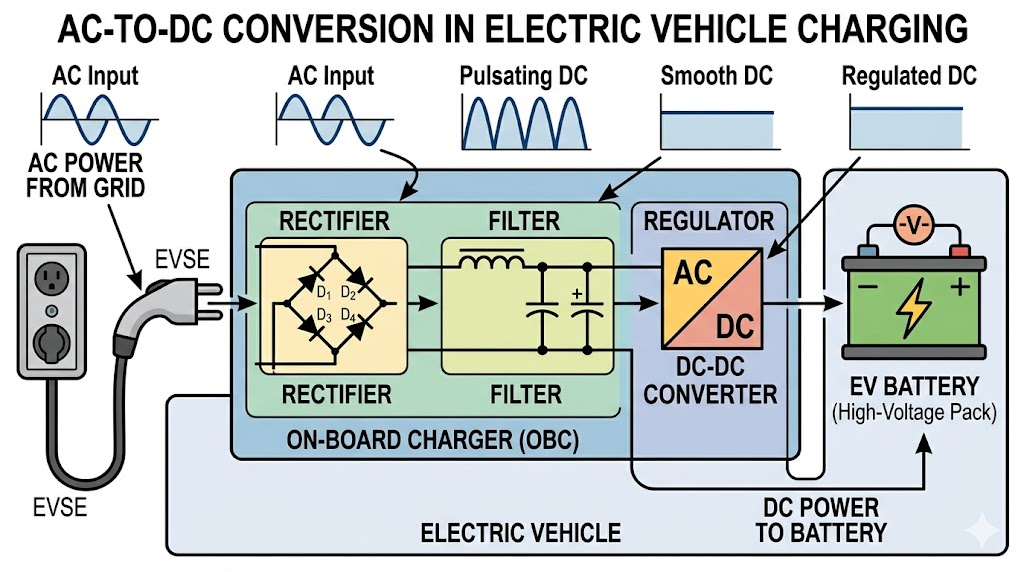
• On-Board Charger (OBC): The EV carries an AC-to-DC converter inside the vehicle. The on-board charger accepts AC from the charging cable, performs the full conversion sequence (rectification, filtering, and regulation), and delivers stable DC to the battery pack. Typical on-board chargers for consumer EVs range from 3.3 kW to 22 kW.
• DC Fast Charging: In this case, the AC-to-DC conversion happens inside the external charging station (not the vehicle). The station delivers DC directly to the battery pack at much higher power levels — 50 kW, 150 kW, or even 350 kW in the latest ultra-fast chargers. The vehicle's Battery Management System (BMS) communicates with the charger to control voltage and current for safe, efficient charging.
The on-board charger in an EV is, in essence, a highly sophisticated version of the four-stage AC-to-DC conversion process described above — it transforms 240V AC grid power, rectifies it with a high-power bridge rectifier using MOSFETs or IGBTs (industrial-grade transistors), filters the output with large capacitors and inductors, and regulates the final voltage to match the battery's state of charge.
4. Everyday Examples of AC-to-DC Conversion
AC-to-DC conversion is embedded in virtually every aspect of modern life. Below are some of the most common and important examples:
| Device / Application | Role of AC-to-DC Conversion |
|---|---|
|
Smartphone Charger |
Converts 120/230V AC from the wall outlet to 5V–20V DC for charging the lithium-ion battery. The charger is a compact SMPS housed in the plug adapter. |
|
Laptop Power Adapter |
Steps down and rectifies AC to provide 19V–20V DC to the laptop's internal circuitry and battery charging system. |
|
LED Lighting |
LED drivers convert AC mains voltage to low-voltage DC (typically 12V or 24V) required by LED arrays. Poor AC-to-DC conversion in cheap LED bulbs causes flickering. |
|
Desktop Computer PSU |
The Power Supply Unit (PSU) converts 120V/230V AC into multiple DC rails: +12V (for CPU and GPU), +5V (for drives and controllers), +3.3V (for logic circuits). |
|
Flat-Screen TV |
The internal power board performs AC-to-DC conversion to supply the display panel, backlight, and processing boards with appropriate DC voltages. |
|
Medical Equipment |
Hospital equipment such as infusion pumps, patient monitors, and imaging systems require ultra-stable, isolated DC power — making high-quality AC-to-DC conversion a matter of patient safety. |
|
EV Battery Charging |
As described above, AC grid power is converted to DC to charge high-voltage battery packs (300V–800V) in electric vehicles. |
5. Why AC-to-DC Conversion Is Essential
Given the ubiquity of AC power delivery and DC-powered devices, the importance of efficient, reliable AC-to-DC conversion cannot be overstated. There are several key reasons why this technology is indispensable:
Compatibility
The global power infrastructure was built around AC for economic reasons — AC voltage is easily transformed for efficient long-distance transmission. But virtually all computational, communication, and lighting technology fundamentally requires DC. AC-to-DC converters are the essential bridge between these two worlds.
Safety
High-voltage AC is dangerous in direct contact with electronic components. Proper conversion reduces voltages to safe levels and provides electrical isolation, protecting both devices and users. The transformer stage in particular creates a safety barrier between the mains supply and the user-facing circuitry.
Efficiency and Sustainability
Modern switch-mode power supplies have achieved efficiencies above 90%, dramatically reducing energy waste compared to older linear regulators. As the world transitions to renewable energy and electrification — including EVs, heat pumps, and battery storage — high-efficiency AC-to-DC conversion becomes even more critical to reducing overall energy consumption.
Precision and Stability
Sensitive electronics require a stable, noise-free power supply. Voltage regulation ensures that fluctuations in the input AC supply (which are common in real grids) do not affect the performance or longevity of powered devices. This is why your laptop continues to operate normally even when the grid voltage fluctuates slightly.
6. Conclusion
AC-to-DC conversion is one of the most consequential processes in modern electrical engineering, yet it operates invisibly in the background of everyday life. From the charger on your desk to the on-board converter in an electric vehicle, the four-stage process — transformation, rectification, filtering, and regulation — works continuously to reconcile the AC world of power transmission with the DC world of digital technology.
As electronic devices grow more sophisticated, as electric vehicles become mainstream, and as renewable energy systems proliferate, the demand for efficient, compact, and intelligent AC-to-DC converters will only increase. Understanding how this conversion works is not just academic knowledge — it is the foundation upon which the electrified future is being built.